


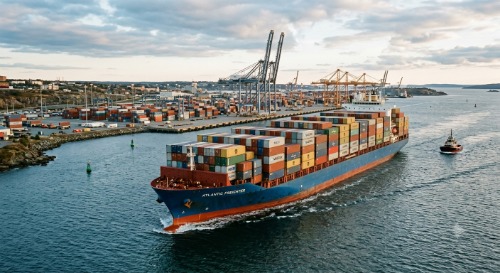
Hillebrand Gori, the beverage logistics specialist within DHL Group, has introduced two GoGreen Plus services offering different levels of allocated greenhouse gas emissions reductions for ocean and air freight shipments.
The new options, GoGreen Plus Base and GoGreen Plus Premium, are designed to give beverage companies greater flexibility in managing transport-related emissions while balancing sustainability objectives, logistics requirements and costs.
Both services are available for full-container load (FCL), less-than-container load (LCL) and air freight shipments. Customers can apply them to individual consignments, specific trade lanes or larger transport volumes.
Two service tiers offer different emissions reductions
GoGreen Plus Base provides a 10% reduction in allocated main-haul well-to-wake greenhouse gas emissions, with pricing based on a regional flat-fee structure.
GoGreen Plus Premium offers emissions reductions of up to approximately 85%, with prices determined by individual trade lanes. For eligible ocean freight routes, the Premium option may also include a waiver of maritime surcharges associated with the European Union Emissions Trading System (EU ETS).
The two-tier structure allows shippers to choose an option according to their transport routes, desired emissions reductions and available budgets. The stated reductions relate to allocated emissions savings rather than a guarantee that the fuel used for a particular shipment will directly deliver the same reduction.
“Beverage companies are looking for practical ways to make progress on transport decarbonization while maintaining efficient and resilient supply chains,” said Dominique von Orelli, chief executive officer of Hillebrand Gori.
Sustainable fuels underpin the book-and-claim approach
The services use a verified book-and-claim methodology to allocate emissions reductions generated through the alternative fuels used within Hillebrand Gori’s logistics network.
For ocean freight, the methodology relies on sustainable marine fuels, while sustainable aviation fuel (SAF) is used for air freight.
Under a book-and-claim system, the physical fuel and the customer receiving the associated emissions-reduction claim do not necessarily need to be connected to the same shipment. A vessel or aircraft carrying a customer’s goods may therefore operate using conventional fuel even when the customer purchases an eligible emissions-reduction service.
Instead, verified emissions reductions generated through alternative fuel use are allocated to eligible transport activity within the same transport mode. This approach can help extend the commercial reach of alternative fuels without requiring every customer shipment to be physically powered by them.
The environmental value of such claims depends on the credibility of the verification and allocation process, including how fuel use and emissions savings are accounted for and how the risk of double counting is managed.
Freight decarbonisation and cost flexibility
Hillebrand Gori’s launch adds two pricing and emissions-reduction options to its transport decarbonisation offering for beverage shippers. The services combine alternative-fuel-based emissions accounting with the flexibility to select individual shipments, trade lanes or larger volumes.
The Premium option’s potential EU ETS maritime surcharge waiver may also be relevant to customers shipping on eligible ocean freight routes. However, the waiver is not described as applying to every route or shipment.
As companies work to address supply-chain emissions, book-and-claim services offer one way to support the use of lower-emission fuels across freight networks. Their effectiveness depends not only on the emissions reductions claimed but also on transparent accounting, credible verification and clear communication about the relationship between fuel use and customer-specific shipments.
Bioenergy Business Analysis
Hillebrand Gori’s two GoGreen Plus options highlight how alternative fuels and book-and-claim accounting are being used to offer emissions-reduction services in freight logistics. The approach can help create demand for sustainable marine fuels and SAF even when physical fuel supply is not available at every port or airport serving a customer’s shipment.
The distinction between allocated emissions reductions and direct fuel use is central to understanding these services. The 10% reduction under Base and the reduction of up to approximately 85% under Premium are service-specific claims, not universal reductions in the emissions of every vessel, aircraft or shipment. For shippers, the practical value will depend on pricing, route eligibility, verification standards and how the allocated reductions are documented.