


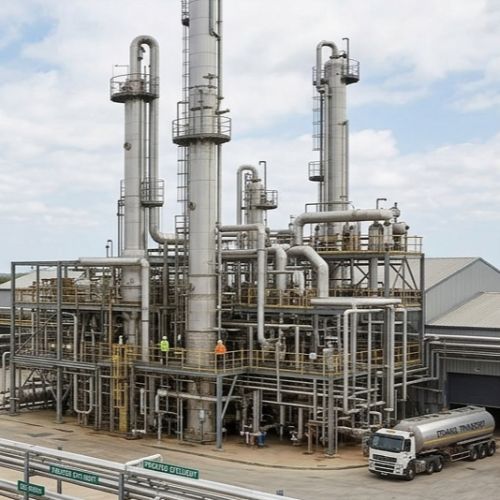
The Punjab Pollution Control Board (PPCB) has issued a show-cause notice to Harp Chemicals Private Limited, which operates an ethanol manufacturing facility in Jahangir village, Sangrur district, over alleged environmental violations, including non-compliance with zero liquid discharge requirements.
The company has been asked to appear for a hearing in Patiala on October 22, following complaints from villagers living near the facility and an ongoing protest over alleged industrial pollution. The notice, dated October 8, asks the company’s management to explain why appropriate legal action should not be initiated.
According to the PPCB notice, the facility was allegedly discharging wastewater or leachate outside its premises through loaded tippers carrying wet boiler ash, in violation of the Water (Prevention and Control of Pollution) Act, 1974. The board also cited alleged breaches of conditions attached to the plant’s environmental clearance, particularly requirements relating to maintaining zero liquid discharge.
PPCB Executive Engineer Rohit Singla said the notice was issued after the factory was found to be violating zero liquid discharge requirements.
The notice states that if the company fails to appear before the competent authority, it will be presumed to have nothing further to submit, and appropriate legal action may follow without another notice.
PPCB action follows villagers’ pollution complaints
The regulatory action comes amid protests by residents of villages surrounding the factory. Protesters, including members of various unions, have been demonstrating outside the facility’s main gate and blocked the Dhuri–Sherpur road, prompting police to divert traffic.
Jaspal Jassa, one of the protesters, alleged that ash from the factory was settling on houses and agricultural land, causing health problems among residents. He also claimed that a farmer’s crop across approximately three acres had been damaged by the ash.
Another protester, Gurkirtan Singh, alleged that an unpleasant odour from the facility could be detected as far as six to seven kilometres from the village.
These allegations have not been independently established in the supplied source material.
Harp chemicals denies environmental non-compliance
Pushpinder Singh, managing director of Harp Chemicals Private Limited, said the company would respond to the PPCB notice and maintained that the facility was complying with applicable environmental requirements.
He argued that the factory’s surroundings included substantial greenery and said no complaints had previously been raised. He also stated that the company had not observed pollution affecting the factory’s water or the water used by nearby residents.
Singh alleged that political or personal motives were behind the protests. He added that the company had obtained a no-objection certificate from the gram panchayat of Jahangir village before establishing the facility. According to him, the certificate was signed by panchayat representatives and sarpanches from approximately 25 to 30 villages, including representatives associated with farmers’ unions, following discussions.
The company’s response and the allegations made by protesters present differing accounts of the environmental concerns surrounding the facility. The PPCB hearing is expected to provide an opportunity for the company to respond to the regulatory notice.
Ethanol plant’s production capacity
Harp Chemicals operates a large-scale ethanol manufacturing facility with a reported production capacity of 125,000 litres per day.
The case highlights the importance of environmental compliance in the ethanol industry, particularly the management of industrial wastewater, boiler ash and other process-related residues. Zero liquid discharge requirements are intended to prevent the routine discharge of liquid effluent outside an industrial facility, subject to the applicable consent and environmental clearance conditions.
The PPCB proceedings will determine the regulatory response to the alleged violations. The allegations should not be treated as final findings of liability before the relevant authority completes its process.