


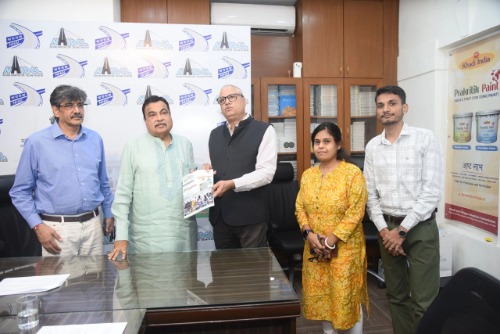
Sanjay Ganjoo, Director General, Indian Federation of Green Energy (IFGE), held a detailed discussion with Union Minister for Road Transport and Highways Nitin Gadkari on the possibility of blending biochar with asphalt used in road construction.
Ganjoo said Gadkari believes biochar has greater potential in agriculture, particularly for improving soil health. However, the Minister assured the IFGE team that the proposal to explore its use in road construction would be examined.
The discussion highlights a potential avenue for expanding the applications of biochar, a carbon-rich material produced through the thermal conversion of biomass, while assessing its suitability for infrastructure development.
The use of biochar in asphalt could offer another avenue for utilising biomass-derived materials. However, its technical feasibility, performance, durability and suitability for road construction would need to be evaluated before any wider application.
IFGE Seeks State-Level Push for FFV and Biomobility Policies
During the meeting, the IFGE delegation also requested Gadkari to recommend the introduction of flex-fuel vehicle (FFV) and biomobility policies to state governments.
According to Ganjoo, the Minister assured the delegation that he would take up the matter with the states.
The request comes amid efforts to promote alternative fuels and strengthen the adoption of cleaner mobility solutions. State-level policy support could help advance the development of an enabling ecosystem for flex-fuel vehicles and bio-based mobility solutions.
Ganjoo was accompanied by other IFGE team members, including Vaibhav Dange, Rahul Saxena, Anamika Ghosh and Vinay Bansal, during the meeting.
The discussions covered both the potential application of biochar in road construction and policy support for alternative-fuel mobility, reflecting IFGE’s engagement in advancing bioenergy and sustainable transport initiatives.
While the biochar-asphalt proposal remains subject to examination, the Minister’s assurance marks a step towards further consideration of the proposed application.
Bioenergy Business Analysis
The discussion highlights two potential pathways for expanding the contribution of biomass to India’s energy and infrastructure systems: developing additional applications for biomass-derived materials and creating policy conditions that support bio-based mobility.
For biochar, road construction could represent an additional application beyond agriculture. However, the potential environmental and commercial benefits should not be assumed without technical evidence. Material performance, feedstock sourcing, production emissions, lifecycle impacts and cost would all influence whether biochar can become a viable asphalt additive.
On the transport side, state-level FFV and biomobility policies could complement existing efforts to develop alternative-fuel markets. Their impact would depend on policy design, vehicle compatibility, fuel availability and coordination between state governments and industry.
For now, both proposals remain under consideration. The next significant developments to watch are any formal government announcement on the biochar-asphalt proposal, technical trials or pilot projects, and concrete state-level measures supporting FFVs and biomobility.


