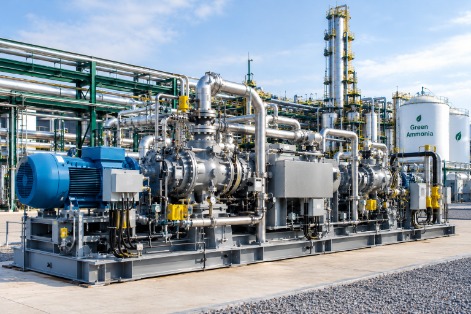
Everllence has secured its first commercial order for its PARSYN® synthesis gas compressor train for AM Green’s green ammonia project in Kakinada, Andhra Pradesh, India.
The equipment will serve one production unit at the site, where AM Green is converting an existing natural gas-based ammonia and urea complex into a facility designed to produce green ammonia using renewable hydrogen.
The unit supported by Everllence’s compressor train is designed for a production capacity of 1,500 tonnes per day, equivalent to approximately 525,000 tonnes annually. Phase 1 of the wider Kakinada project is planned to have a total annual green ammonia production capacity of 1 million tonnes.
Everllence said the order represents the first commercial application of PARSYN®, a compressor train concept developed for green ammonia production. Delivery is scheduled for late 2027, with commissioning planned for 2028.
Electric-driven compression for green ammonia production
Ammonia is produced by combining hydrogen and nitrogen under high pressure. A synthesis gas compressor raises the pressure of the gas mixture before it enters the ammonia synthesis loop.
In conventional ammonia plants, these compressors are typically driven by steam turbines, with much of the steam generated during hydrogen production from natural gas. Green ammonia facilities generate substantially less process steam, making an electrically driven compressor a better fit for the process configuration, according to Everllence.
The PARSYN® system uses an electric motor to drive the compressor train. Its design places two compressors in parallel and connects them through a gearbox, allowing each compressor to operate at a suitable speed.
Everllence said the arrangement is intended to create a more compact system, improve maintenance access and support efficiency. The company also expects the design to help reduce plant investment and operating energy requirements.
The equipment package for Kakinada will include two barrel-type RB compressors, an electric motor, gearbox, dry gas sealing system, coolers, lubrication system, controls and instrumentation. The order also covers performance testing, dynamic simulation and process piping engineering.
Equipment manufacturing and delivery timeline
Everllence’s process gas compressor specialists in Oberhausen, Germany, developed the PARSYN® concept and the overall compressor train design.
The RB compressors will be manufactured and performance-tested in Zurich, Switzerland, before packaging and integration in Oberhausen. Delivery is scheduled for late 2027, followed by planned commissioning in 2028.
The order marks the first commercial deployment of the PARSYN® concept in an ammonia plant. Its performance in the Kakinada project will provide an industrial application for the design in a green ammonia production setting.
Kakinada project targets international ammonia markets
AM Green is developing the Kakinada facility by repurposing an existing ammonia and urea production site. The project is intended to supply renewable ammonia to international markets, including Europe.
AM Green has signed a long-term offtake agreement with Germany’s Uniper for the purchase of up to 500,000 tonnes of renewable ammonia annually from its projects. First shipments from Kakinada have been targeted for as early as 2028.
The company has also been selected as the winner of the Asian lot in the H2Global auction conducted by HINT.CO GmbH. The award provides for a long-term purchase agreement covering renewable ammonia from Phase 2 of the Kakinada project, with first deliveries expected in 2029, according to Everllence.
The ammonia covered by the H2Global arrangement is described as RFNBO — Renewable Fuels of Non-Biological Origin. This classification refers to renewable fuels produced through qualifying non-biological pathways, rather than fuels derived from biomass.
AM Green’s project therefore links renewable hydrogen production, ammonia synthesis and export-oriented offtake agreements. The compressor order is one equipment component within that broader industrial conversion.
Emissions reduction potential
Everllence’s announcement states that the production unit served by the compressor train is expected to avoid approximately one million tonnes of carbon dioxide emissions annually compared with conventional ammonia production.
That figure is a project estimate rather than a verified emissions outcome. Actual emissions performance will depend on the plant’s operating configuration, the renewable electricity and hydrogen supply, and the emissions boundary used for comparison.
Green ammonia can help reduce emissions in sectors that rely on ammonia as a chemical feedstock or are exploring it as a potential fuel or hydrogen carrier. Its climate benefits depend on how the hydrogen is produced and the energy used across the production chain.
Bioenergy Business Analysis
The Everllence order highlights an important part of the emerging green ammonia supply chain: adapting industrial equipment to work with renewable hydrogen rather than conventional fossil-based production processes.
The shift changes more than the hydrogen feedstock. Lower process-steam availability can also affect the machinery and drive systems used in ammonia synthesis, creating a need for equipment configurations designed around the operating conditions of green ammonia plants.
For India, the Kakinada project brings together existing industrial infrastructure, renewable hydrogen, specialised process equipment and international offtake arrangements. These elements will be important in determining whether renewable ammonia can move from planned capacity to reliable commercial supply.
The immediate milestone is the compressor order, with delivery expected in late 2027 and commissioning planned for 2028. The broader test will be whether the project can bring its planned capacity online, secure qualifying renewable inputs and deliver ammonia that meets buyers’ technical and certification requirements.
The project is not a bioenergy development in the conventional biomass-derived sense. It is part of the wider renewable fuels and green hydrogen economy, with relevance to Bioenergy Business through the expanding market for low-carbon fuels and industrial decarbonisation technologies.