


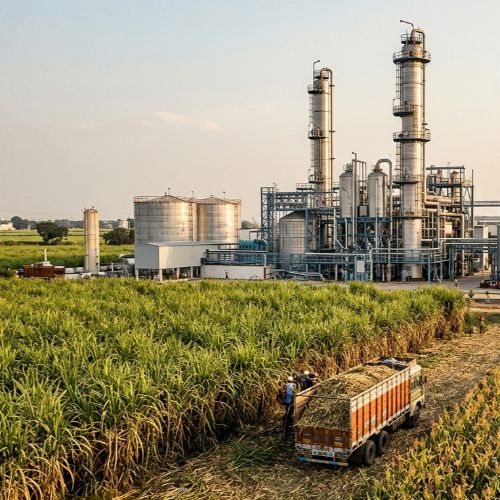
The Indian Federation of Green Energy (IFGE) has called for a long-term, predictable and balanced ethanol procurement policy in India, urging policymakers to review ethanol procurement prices and incentives while addressing the financial pressures facing sugar mills and farmers.
The industry body said a sustainable policy framework should support both grain-based and sugar-based ethanol producers, with appropriate pricing mechanisms to ensure fair returns across the value chain.
The recommendations come amid changes in India’s ethanol procurement landscape, where feedstock availability, sugar supply and producer economics remain important considerations for the country’s ethanol-blending programme.
IFGE has identified ethanol procurement prices and incentives as key areas requiring review. The organisation is also calling for a revision of the minimum selling price (MSP) of sugar to improve the financial position of sugar mills and support payments to sugarcane farmers.
Ethanol produced from different feedstocks operates under different pricing arrangements. Sugar-based ethanol prices have historically been set through government-approved mechanisms, while procurement prices for several grain-based feedstocks are determined by oil marketing companies.
A predictable pricing framework could help producers make investment and operating decisions with greater clarity, particularly when feedstock costs and market conditions change.
The government’s existing ethanol procurement framework includes multiple feedstocks, such as sugarcane juice, sugar syrup, molasses, maize, damaged food grains and surplus rice. Their relative economics and availability influence procurement decisions and the supply mix available to oil marketing companies.
Industry leaders call for a sustainable policy framework
Sanjay Ganjoo, Director General of IFGE, and Ravi Gupta, Chairman of the organisation’s Sugar Bioenergy Forum, have emphasised the need for a policy framework that supports the long-term sustainability of India’s ethanol ecosystem.
Their position highlights the importance of balancing the interests of grain-based distilleries, sugar mills and farmers as the country continues to develop its domestic biofuel industry.
For producers, procurement terms and feedstock-specific prices influence the viability of investments in distillation capacity. For sugar mills, ethanol sales can provide an alternative revenue stream alongside sugar production, while payments for sugarcane remain a central consideration for farmers.
Feedstock choices shape India’s ethanol market
India’s ethanol-blended petrol programme draws on both agricultural grain and sugar-industry feedstocks. Diversification can help expand ethanol availability, but changes in procurement priorities can affect individual producer groups differently.
In October 2026, Reuters reported that India’s ethanol supply tender for the 2026–27 supply year excluded ethanol made from sugarcane juice, sugar syrup and B-heavy molasses, reflecting concerns about domestic sugar availability. The tender instead sought ethanol from alternative sources, including maize and rice.
That shift underscores the policy challenge facing the sector: maintaining ethanol supply for fuel blending while managing competing demands for agricultural raw materials and supporting the financial viability of different producer groups.
IFGE’s call for a balanced approach places procurement prices, incentives and sugar pricing within this broader discussion. The organisation has not, in the supplied announcement, specified revised price levels or a detailed alternative procurement mechanism.
Bioenergy Business Analysis
IFGE’s recommendations raise a central question for India’s ethanol industry: how can procurement policy provide stable investment signals without compromising sugar availability, farmer returns or the economics of grain-based production?
A long-term framework could improve visibility for distilleries planning capacity expansions and help producers assess the risks associated with feedstock-price changes. However, a balanced policy would need to account for differences in production costs, feedstock availability, seasonal conditions and the wider market for agricultural commodities.
Reviewing sugar’s minimum selling price alongside ethanol procurement prices may also affect the financial relationship between sugar sales, ethanol production and payments to sugarcane farmers. Any revisions would need to consider the implications for consumers, mills and agricultural producers.
The next developments to watch are whether policymakers review feedstock-specific procurement prices, revise sugar pricing arrangements or introduce measures to provide greater certainty to producers. Until formal decisions are announced, IFGE’s proposals should be understood as industry recommendations rather than adopted government policy.


