China has reported early progress on some of its 2030 climate commitments, citing rapid renewable energy expansion, growth in low-carbon industries and stronger climate regulations as it prepares for the UN climate summit COP31 in Türkiye next month.
Li Gao, China’s vice-minister of ecology and environment, outlined the progress at a State Council Information Office news conference on Wednesday, according to a report published by China’s government. His remarks highlighted the country’s expanding clean energy infrastructure and its push to shift international climate discussions from negotiating commitments towards implementing them.
Renewable energy reaches 60.7% of installed power capacity
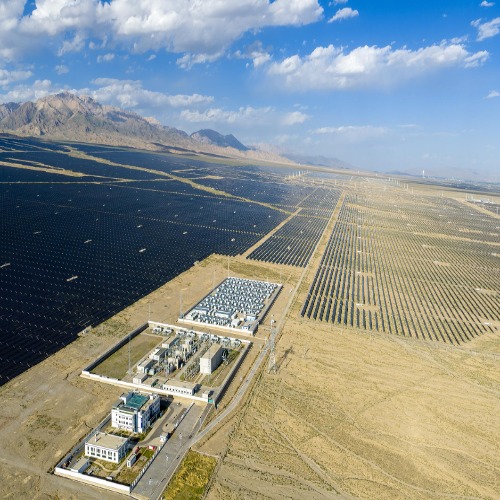
China’s installed renewable energy capacity reached approximately 2.46 billion kilowatts (2,460 GW) in the first half of 2026, accounting for 60.7% of its total installed power generation capacity, Li said.
By the end of July, installed solar photovoltaic capacity had surpassed coal-fired power capacity for the first time, making solar the country’s largest source of installed power generation capacity.
The figures reflect the scale of China’s renewable energy build-out. However, installed capacity measures the maximum rated output of power facilities, rather than the electricity they actually generate. The share of electricity supplied by renewables depends on factors including weather conditions, grid infrastructure, storage and the availability of other generation sources.
China’s progress also extends beyond electricity infrastructure. Li said the country’s production and sales of new energy vehicles had ranked first globally for 11 consecutive years. He also highlighted the scale of China’s clean energy manufacturing industry and its contribution to economic growth.
Climate targets and regulatory measures
China’s reported progress comes under its nationally determined contributions (NDCs), the climate action commitments it submits under the Paris Agreement.
Li said some targets under China’s 2030 commitments had been achieved ahead of schedule, although the remarks in the supplied report did not specify every target or provide a complete assessment of progress against the country’s NDCs.
The government has also strengthened its climate policy framework. According to Li, China’s Ecological and Environmental Code, adopted in 2026, includes a dedicated chapter on climate change, marking the first time Chinese law has included specific provisions on the issue.
China has issued 113 national standards for carbon emissions management and plans to introduce more than 50 additional standards during 2026. The planned standards will cover areas including carbon accounting, emissions trading and carbon footprints.
These measures are intended to strengthen the systems used to measure and manage emissions. Their impact will depend on implementation, enforcement and the extent to which businesses and industries apply the standards.
Adaptation gains prominence alongside emissions reduction
China is also placing greater emphasis on adapting to climate impacts, including extreme heat and other weather-related risks.
Li said all 31 provincial-level regions had issued climate change adaptation action plans. The government is guiding 39 cities in piloting climate-adaptive urban development, while Shenzhen, Haikou and Chengdu are exploring climate-adaptive communities.
The initiatives address risks to food production, infrastructure, urban operations and ecological security. They reflect the growing need for governments to prepare for climate impacts alongside efforts to reduce greenhouse gas emissions.
Li described mitigation and adaptation as the two main responses to climate change and said China attaches equal importance to both.
China calls for implementation-focused COP31
Li will lead China’s delegation to the 31st UN Climate Change Conference, or COP31, scheduled to take place in Antalya, Türkiye, from 9 to 20 November 2026.
China wants the conference to prioritise the implementation of existing climate commitments. Li said international climate cooperation must address shortfalls in emissions reduction efforts and financial support from developed countries, while countering unilateralism and protectionism that could undermine collective action.
He also stressed the importance of enabling developing countries to implement their NDCs and advance the Paris Agreement’s objectives.
Climate finance remains a central issue for many developing economies, which face substantial costs in expanding clean energy, strengthening infrastructure and adapting to climate impacts. The availability of funding, technology and implementation capacity will influence how quickly countries can turn their commitments into measurable outcomes.
International climate cooperation and clean energy access
China has expanded climate cooperation with developing countries through its South-South cooperation initiatives. Li said the country had signed 60 memorandums of understanding on climate change cooperation with 46 developing countries and trained more than 10,000 officials and technicians from over 120 countries.
He cited a climate and meteorological monitoring microsatellite provided to Ethiopia in 2020, alongside technical training that enabled Ethiopian personnel to use satellite imagery to monitor urban areas, water bodies and fires.
Another project, launched in 2023, has helped five African countries provide lighting to nearly 20,000 households. The initiative is expected to benefit 50,000 households by 2027, Li said.
The examples illustrate how climate cooperation can extend beyond emissions targets to include technical training, monitoring capabilities and access to energy services.
Bioenergy Business Analysis
China’s reported climate progress highlights the scale at which renewable energy deployment, clean technology manufacturing and climate regulation can develop together. Its installed renewable capacity and expanding solar sector are significant indicators of the energy transition, but they do not by themselves establish that all national climate objectives are on track or that emissions are falling across every sector.
For the wider clean energy industry, the next test is how effectively capacity additions translate into lower emissions, reliable energy supplies and measurable progress towards national climate targets. Grid development, energy storage, industrial decarbonisation and transparent emissions accounting will be important in determining the overall impact.
As COP31 approaches, China is calling for greater emphasis on implementation and support for developing countries. The conference will provide an important forum for governments to assess how climate commitments can be translated into practical action, with financing, adaptation and accountability likely to remain central to negotiations.