


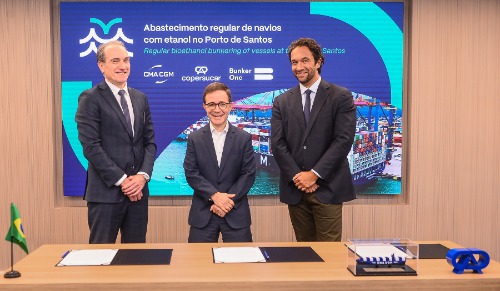
Brazil’s Port of Santos has begun regular bioethanol bunkering for commercial vessels following a pioneering operation in July. According to the Santos Port Authority’s announcement, the latest phase began on 19 October 2026, when the CMA CGM IRON, a 13,000-TEU container ship, received bioethanol fuel through a partnership involving CMA CGM, Copersucar, Bunker One, AGEO Terminais, Santos Brasil and the Santos Port Authority.
The vessel is equipped with a tri-fuel engine certified to operate on bioethanol, the Everllence-B&W G95ME-C10.5-LGIM. The operation marks a move towards recurring bioethanol supply for maritime transport rather than a one-off demonstration.
The partners plan additional bioethanol bunkering operations for CMA CGM vessels by the end of 2026, with Copersucar supplying the fuel. The initiative could create an additional market for Brazil’s established bioethanol industry while supporting efforts to reduce emissions from international shipping.
Bioethanol Supply Chain Connects Mills to Ship Bunkering
The operation brings together fuel production, transportation, storage and delivery infrastructure.
Bioethanol produced by mills associated with Copersucar is supplied and transported to Santos by Evolua Etanol, part of the Copersucar ecosystem. The fuel is stored at AGEO Terminais before being made available for ship bunkering at the Santos Brasil terminal.
Bunker One, part of Denmark-based Bunker Holding, developed a bunkering protocol for the operation following studies and specialised team training. The procedures account for bioethanol’s low flash point, a property that requires specific precautions during fuel handling and transfer.
This coordination is central to moving bioethanol from conventional fuel markets into marine applications. Regular bunkering requires more than suitable engine technology: it also depends on safe handling procedures, reliable supply, storage capacity and coordination among fuel suppliers, terminals, vessel operators and port authorities.
The participating companies are positioning the operation as a step towards establishing a regular supply model at Santos. Additional operations will help demonstrate how consistently the system can serve commercial shipping requirements.
CMA CGM and Partners Expand Alternative Marine Fuel Options
CMA CGM, the global shipping and logistics group, is participating as the vessel operator and a partner in the initiative. Copersucar provides the bioethanol supply, while Bunker One contributes bunkering expertise and Santos Brasil and AGEO Terminais support terminal and storage operations. The Santos Port Authority is also involved in the wider initiative.
Giovani Grassi, CEO of CMA CGM Brazil, said the progression from the July operation to regular bunkering demonstrates the potential to incorporate bioethanol into maritime operations on a commercial basis.
Copersucar president Tomás Manzano described the initiative as an opportunity to connect Brazil’s bioethanol production and logistics infrastructure with international demand for lower-carbon marine fuels.
The project’s longer-term potential will depend on the availability of vessels with compatible engines, the commercial competitiveness of bioethanol, fuel supply reliability and the development of bunkering infrastructure in additional ports.
Brazil’s Sugarcane Ethanol Offers a Potential Marine Fuel Pathway
Copersucar says the bioethanol used in the initiative comes from a consolidated and certified production chain. The company states that sugarcane cultivation expands predominantly into degraded pastureland and that Brazil’s RenovaBio programme applies sustainability requirements, including criteria intended to prevent deforestation.
The environmental performance of bioethanol used in shipping depends on its production pathway and lifecycle emissions, including cultivation, processing, transport and combustion. Sustainability certification and responsible land-use practices can support emissions accounting, but the actual carbon reduction should be assessed against an appropriate marine-fuel baseline.
For Brazil, marine bunkering offers a potential route to diversify ethanol demand beyond established road-fuel markets. It could also connect domestic agricultural production to the international shipping industry, provided the fuel meets vessel requirements and can be delivered at competitive prices.
Bioethanol’s Potential Market in Maritime Transport
The companies involved point to the scale of the marine fuel market as a reason to explore bioethanol bunkering. Their announcement cites global marine fuel demand of more than 270 billion litres annually and estimates that replacing 10% of this consumption on an energy-equivalent basis could represent a potential bioethanol market of approximately 50 billion litres per year.
This is a theoretical market-sizing scenario, not a forecast of demand or a commitment by shipowners to switch fuels. Actual uptake would depend on engine compatibility, fuel availability, pricing, lifecycle emissions, safety requirements and the economics of converting or ordering suitable vessels.
The potential addressable fleet is also developing. The partners cite Det Norske Veritas (DNV) figures indicating that 159 vessels are already operating with methanol-ready engines that can also use bioethanol, while more than 450 additional vessels with this technology are expected to be delivered by 2030. The number of vessels capable of using the fuel does not necessarily indicate that they currently do so or that all will adopt bioethanol.
Port of Santos Positions Itself for Low-Carbon Marine Fuels
Santos Brasil CEO Antônio Carlos Sepúlveda said hosting the operation at Tecon Santos supports the company’s wider work to reduce the carbon footprint of its own operations and those of its customers.
Bunker One LatAm CEO Flavio Ribeiro said the initiative combines Brazil’s bioethanol production capabilities with the company’s bunkering expertise and international reach. Santos Port Authority president Anderson Pomini also described the operation as a milestone for maritime trade.
The move towards recurring bunkering could provide a reference point for other ports considering bioethanol as part of their alternative-fuel offerings. Replicating the model elsewhere would require compatible vessels, dependable fuel sourcing, suitable terminal infrastructure and safety procedures tailored to the fuel.
Bioenergy Business Analysis
The development at Santos matters because it moves bioethanol marine-fuel use beyond a pioneering demonstration and towards repeat commercial operations. It also illustrates how an established agricultural biofuel supply chain can be connected to a new end-use market through cooperation among fuel producers, logistics providers, terminal operators and shipowners.
The next test is repeatability. Additional bunkering operations will help establish whether the fuel can be supplied consistently, handled safely and priced competitively for commercial shipping. Vessel compatibility is another important constraint: the existence of engines capable of using bioethanol does not guarantee widespread adoption, and shipowners will weigh fuel economics, availability and regulatory requirements when choosing their energy pathways.
For the bioenergy sector, the key indicators to monitor are the frequency of subsequent bunkering operations, the number of vessels actually fuelled with bioethanol, supply volumes, fuel specifications and expansion to other ports. Those results will show whether the Santos initiative can develop into a durable international market for renewable marine fuels.
Related coverage: Wasaline’s liquefied biogas supply agreement for a Baltic Sea ferry illustrates a separate renewable marine-fuel pathway, using a different fuel and vessel application.


