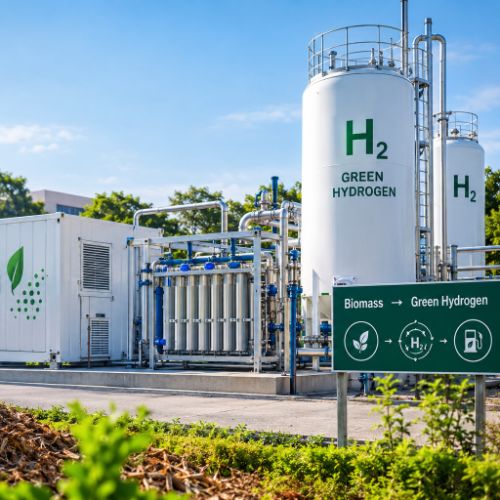
French energy company HDF Energy has completed its acquisition of Rubis’s shares in Renewstable (Barbados) Inc., making it the sole shareholder of the proposed Renewstable Barbados project. The development combines solar power, hydrogen production, battery storage and fuel cells to supply renewable electricity to Barbados, subject to regulatory approvals and financing.
The ownership change consolidates project control under HDF Energy as the development progresses towards key milestones, including tariff approval and financial close. The transaction does not, by itself, confirm that construction will begin or that the project has secured the funding required for implementation.
Renewstable Barbados to Combine Solar Power and Hydrogen Storage
The proposed facility is designed around a 50 MWp solar photovoltaic plant integrated with hydrogen production and storage systems, lithium-ion batteries and hydrogen fuel cells. The configuration is intended to address the variability of solar generation while supporting a more consistent supply of electricity to the Barbadian grid.
The system is designed to use solar electricity in three ways: supplying power directly to the grid, charging batteries for short-term balancing, and producing hydrogen for longer-duration energy storage.
The combination is intended to provide flexibility across periods of changing solar availability. However, actual system performance will depend on the project’s final design, storage capacity, operating strategy and overall economics.
HDF Energy Consolidates Ownership as Project Awaits Key Approvals
Rubis acquired a 51% stake in Renewstable Barbados in February 2022, becoming the majority shareholder alongside HDF Energy. The latest transaction transfers Rubis’s shares to HDF Energy, consolidating ownership of the project under its original developer. In its 23 October announcement, HDF Energy said the acquisition was completed on 15 October 2026 and announced on 23 October 2026.
The ownership change gives HDF Energy sole control of the project company, but the development still needs to progress through regulatory and financing requirements before construction can proceed.
A decision on the electricity tariff from the Barbadian government remains a key outstanding requirement, according to the acquisition announcement. The tariff will be important in determining the project’s revenue framework and its ability to secure financing.
Financial close is the milestone at which the required financing arrangements are finalised. Until that stage is reached, the proposed facility’s construction schedule and eventual commissioning remain uncertain.
The distinction is important for investors and the wider hydrogen industry: a completed share acquisition represents a change in project ownership, not completion of the power plant or confirmation that all development risks have been resolved.
Project Aligns with Barbados’ Renewable Energy Ambitions
Barbados has set a national policy objective of achieving 100% renewable energy by 2030. Its energy policy identifies reduced dependence on imported fossil fuels, energy security and the development of domestic renewable energy resources as important goals.
Renewstable Barbados is designed to address a key challenge in this transition: maintaining a reliable electricity supply when solar generation fluctuates.
According to the project’s official website, the facility is planned for Harrow Plantation in the parish of Saint Philip. Its proposed output profile includes 13 MW of baseload power during periods of higher electricity demand and costs, and 3 MW during other periods. These are planned operating parameters, not evidence of electricity currently being supplied.
The project’s financing history also demonstrates the scale of capital support being assembled. In November 2023, HDF Energy announced that the Green Climate Fund had committed to providing up to US$41 million to support a proposed International Finance Corporation investment in the project. That announcement concerned financing support and should not be interpreted as confirmation that the entire project had achieved financial close.
If implemented, the facility could provide a practical demonstration of how hydrogen storage can complement solar generation on an island electricity grid. Its wider relevance will depend on construction, operating performance, delivered electricity costs and the ability to reproduce the model in other markets.
Bioenergy Business Analysis
HDF Energy’s acquisition of full ownership of Renewstable Barbados is a change in project governance at a time when the development’s commercial and regulatory requirements remain central to its progress. The project also highlights a broader question for the energy transition: whether green hydrogen can provide cost-effective, dispatchable electricity alongside variable renewable generation.
The principal opportunity is long-duration energy storage. Solar photovoltaic systems can supply low-carbon electricity during daylight hours, but output varies with weather and time of day. Hydrogen produced through electrolysis can store some of that electricity for later conversion through fuel cells. This offers a potential complement to batteries, which are generally better suited to shorter-duration balancing.
The project’s proposed configuration includes a 50 MWp solar plant, a 15 MW battery energy storage system, electrolysers with a combined capacity equivalent to 15 MW, and hydrogen fuel cells with a total capacity of 3 MW. These specifications are detailed in the environmental and social review published by IDB Invest.
However, installed capacity alone does not establish how economically or efficiently the facility will operate. Hydrogen production, compression, storage and reconversion all involve energy losses, while the economics depend on capital costs, operating expenditure, electricity tariffs and utilisation rates.
For Barbados, the project could contribute to reduced dependence on imported fossil fuels if it becomes operational and delivers its intended output. For the international hydrogen sector, it offers a case study in integrating solar generation with chemical energy storage to provide more consistent power.
The acquisition is therefore a meaningful ownership milestone, but the project’s wider significance will ultimately depend on whether HDF Energy can secure the remaining approvals, close financing and demonstrate reliable electricity generation at a commercially viable cost.