


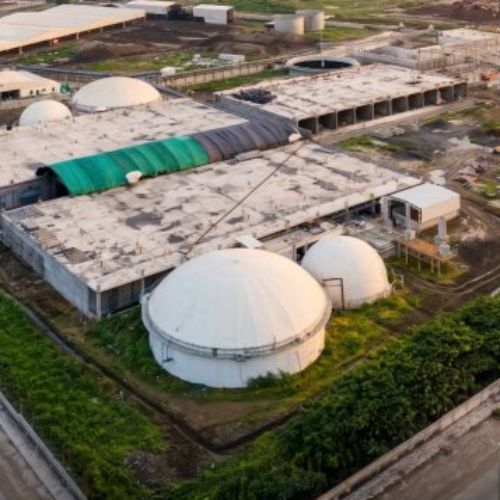
SusBDe’s integrated municipal solid waste-to-compressed biogas (CBG) facility in Bhandewadi, Nagpur, Maharashtra, is designed to process up to 1,200 tonnes of municipal solid waste per day and produce up to 55 tonnes of CBG daily at full design capacity. Developed through Indian-Dutch cooperation, the project combines waste sorting, dry anaerobic fermentation, biogas upgrading and recovery of other materials within one industrial site.
The project began as a development concept in 2021, with the concession agreement signed in 2023. SusBDe presents the facility as a reference model for future municipal waste-to-CBG developments in India through its partnership with Keva SusBDe Biotech Private Limited.
An important distinction is that 55 tonnes per day is the full design capacity, not the facility’s reported current output. SusBDe reported in October 2026 that production was approximately 28 tonnes per day, with commissioning progressing towards the full design capacity.
How the Nagpur facility converts municipal waste into CBG
The Bhandewadi facility covers approximately 12 hectares and uses an integrated process to recover energy and materials from mixed municipal solid waste.
The integrated design aims to reduce the quantity of waste requiring landfill disposal while generating renewable gas and other usable products. Actual environmental benefits depend on operating performance, waste composition and how recovered products are ultimately used.
The facility’s design capacity, regulatory approval and reported output represent different measures of its development.
The Maharashtra Pollution Control Board issued an amended Consent to Operate on 24 May 2026. According to SusBDe’s project information, two fermentation sections were operational while the third remained under construction as of October 2026. The full 55-tonne daily CBG figure should therefore be presented as the facility’s design target, not its current production or regulatory-authorised output.
Indian-Dutch partnership supports project delivery
The project combines Indian project development and execution with Dutch engineering and waste-treatment technology. SusBDe identifies Nagpur Municipal Corporation as the project owner and municipality, SusBDe LOC Nagpur Private Limited as the operator, and Keva Fragrances Private Limited as the project promoter. Keva SusBDe Biotech Private Limited serves as the India development platform.
SusBDe says the experience gained in Nagpur will inform the development of additional municipal waste-to-CBG projects in India through Keva SusBDe Biotech Private Limited. The company is also pursuing projects involving other waste streams through separate development platforms.
Bioenergy Business Analysis
Nagpur illustrates how municipal solid waste can serve as feedstock for renewable gas production while supporting material recovery. By combining mechanical segregation, dry anaerobic digestion and gas upgrading, the facility is designed to recover value from mixed waste rather than relying exclusively on landfill disposal.
For India’s CBG sector, the most important measure will be the facility’s ability to move from partial operation towards sustained production at scale. Its design capacity of 55 tonnes per day is significantly higher than the approximately 28 tonnes per day reported in October 2026, while the amended regulatory consent specifies an authorised output equivalent to around 35.6 tonnes per day. These figures describe different stages and constraints; they should not be treated as interchangeable.
The project also highlights the importance of managing all outputs from municipal waste processing. CBG production is only one part of the system: recyclables, RDF and organic manure also need appropriate processing, quality control and end markets. Reliable waste segregation, plant uptime, gas quality and environmental compliance will be central to the facility’s long-term performance.
For future projects, Nagpur offers a reference for integrating waste treatment, renewable gas production and resource recovery within a single development framework. Whether the model can be replicated economically elsewhere will depend on local waste composition, collection systems, project financing, regulatory requirements and access to markets for CBG and recovered materials.


