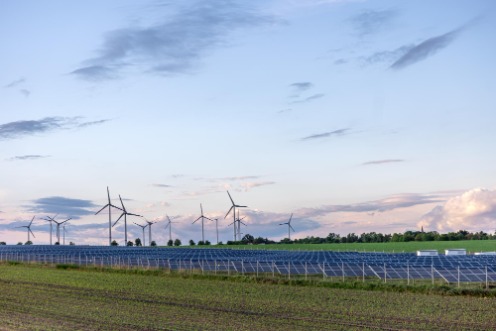
Enerjisa Enerji Üretim, a joint venture involving Türkiye’s Sabanci Holding and Germany’s E.ON, plans to invest approximately TRY 438 million in a 30 MW solar power facility integrated with 40 MWh of battery storage in southern Türkiye. The project will support mining operations associated with the Tufanbeyli thermal power plant in Adana province, with installation planned within one year.
According to Renewables Now, the solar and battery energy storage system will be developed in the Tufanbeyli district and operate entirely off-grid. The project is designed to supply electricity directly to the associated industrial operations rather than relying on the national grid for its power supply.
The development combines renewable electricity generation with battery storage to help meet industrial energy requirements. Its off-grid configuration also distinguishes it from utility-scale solar projects that export electricity to the wider grid.
Solar and Battery Storage Project to Support Mining Operations
The planned installation will comprise a 30 MW solar photovoltaic plant paired with a battery energy storage system rated at 40 MWh. The two technologies will occupy approximately 63 hectares of land in the Tufanbeyli district of Adana province.
Solar panels will generate electricity during daylight hours, while the battery system is intended to store energy for use when solar generation falls or demand needs to be balanced. The combination could help align variable solar output with the electricity requirements of the associated industrial operations.
The project is linked to mining activities at the Tufanbeyli thermal power plant. Its off-grid design means the solar and storage installation is intended to serve these operations directly, rather than functioning as a conventional grid-connected solar park.
TRY 438 Million Investment Planned
Enerjisa Enerji Üretim announced an estimated investment of TRY 438 million for the project, according to Renewables Now. The planned installation is expected to be completed within one year.
The project adds to the development of renewable energy assets by Turkish power producers seeking to diversify electricity generation and integrate storage into industrial energy supply.
Battery storage is particularly relevant in off-grid applications, where electricity supply must be balanced locally. Unlike grid-connected projects that can draw on the wider electricity network, an isolated solar-storage system must account for fluctuations in generation and demand through its own resources and any other connected generation assets.
Sabanci and E.ON Joint Venture Expands Renewable Energy Development
Enerjisa Enerji Üretim is associated with Sabanci Holding and E.ON, which have a broader presence in Türkiye’s energy sector. The separate listed company Enerjisa Enerji operates electricity distribution and retail supply businesses and is jointly owned by Sabanci Holding and E.ON, with each holding a 40% stake and the remaining 20% publicly traded.
The Tufanbeyli project concerns the generation business, Enerjisa Enerji Üretim, and should not be confused with the separate distribution and retail utility, Enerjisa Enerji.
The planned solar-storage installation illustrates a potential route for integrating renewable power into industrial operations that have substantial and location-specific electricity requirements. Its performance will depend on the solar resource, storage operation, demand patterns and the economics of the completed system.
Bioenergy Business Analysis
The planned Tufanbeyli installation highlights an expanding role for battery storage in industrial decarbonisation. Although the project is not a bioenergy development, its underlying approach—matching renewable generation with the specific needs of an industrial consumer—is relevant to the wider clean energy market.
The most significant feature is the project’s off-grid configuration. By pairing 30 MW of solar generation with 40 MWh of battery storage, the developer is planning a system that can supply electricity directly to an industrial site. This could reduce reliance on grid-supplied electricity during periods when solar output and stored energy are sufficient, although the source does not quantify expected fossil fuel displacement or emissions savings.
The next milestones to watch are installation, commissioning and disclosure of operational performance. Annual generation, storage utilisation, the proportion of industrial demand supplied and verified emissions reductions would provide a clearer basis for assessing the project’s contribution to industrial decarbonisation.