


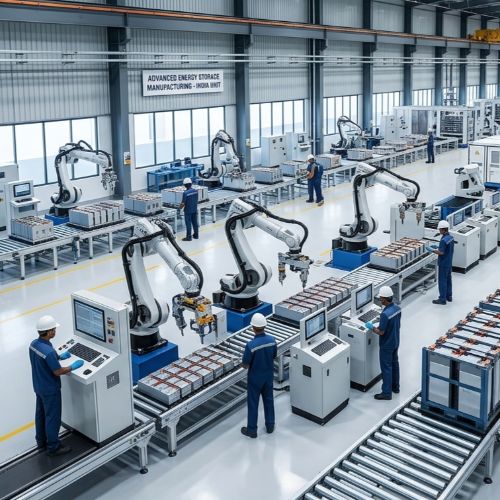
China-based clean energy technology company Sigenergy is advancing plans for a 40 GW manufacturing facility in India, targeting the start of first-phase production by the second quarter of 2027.
The initial phase will focus on commercial and industrial (C&I) and utility-scale solutions. A second phase is planned to expand manufacturing to battery energy storage systems (BESS) and residential hybrid inverters, adding a further 30 GW of capacity.
The proposed investment forms part of Sigenergy’s broader effort to establish local manufacturing capabilities, strengthen its distribution network and expand customer support in India as demand for energy storage and intelligent energy management develops alongside renewable power generation.
The company entered the Indian market in January 2026 and is positioning the country as a key market in its long-term growth strategy.
Two-phase plan targets storage and utility-scale markets
Sigenergy’s proposed manufacturing strategy covers several segments of the clean energy market.
The first phase is intended to manufacture solutions for commercial and industrial customers as well as utility-scale applications. The second phase would extend production to BESS and residential hybrid inverters, with the company planning to add a further 30 GW of capacity.
Battery storage systems can help manage fluctuations in renewable electricity generation by storing surplus power and making it available when required. Hybrid inverters coordinate power from solar panels, batteries and other connected sources, supporting energy management across residential and commercial installations.
The company’s planned expansion therefore spans equipment used in large-scale energy infrastructure as well as systems serving distributed solar and storage applications. However, the proposed capacity and production schedule remain forward-looking plans.
Sigenergy expands its Indian market presence
Since entering India in January 2026, Sigenergy says it has established channel partnerships, opened an experience centre in Mumbai and begun conducting EPC Connect programmes.
These initiatives are intended to strengthen engagement with engineering, procurement and construction (EPC) companies, business owners, installers and other industry stakeholders.
The company also plans to establish six service centres across India to support customers and strengthen its after-sales service network.
Alongside manufacturing, these activities indicate that Sigenergy is seeking to build a broader local operating presence encompassing distribution, technical engagement and customer support.
Energy storage technologies showcased at REI Expo 2026
At the Renewable Energy India Expo 2026, Sigenergy showcased its Sigen Neo, Sigen Cube and Sigen Terra product lines, which address energy management requirements across residential, commercial and utility-scale applications.
The company is also known for SigenStor, an integrated system that combines a solar inverter, battery pack, battery power conversion system, electric vehicle DC charger and energy management system in a five-in-one configuration. The platform incorporates artificial intelligence-enabled energy management features.
These product offerings reflect the company’s focus on integrating solar generation, energy storage, electric vehicle charging and energy management within connected systems.
Abhilash Borana, CEO of Sigenergy in India, said the country’s renewable energy market was moving beyond generation towards energy storage and intelligent energy management.
He said the company was investing in its local team, partner network, service infrastructure and manufacturing capabilities to establish a stronger presence in India.
Bioenergy Business Analysis
Sigenergy’s proposed manufacturing expansion reflects a broader shift in India’s clean energy equipment market, where energy storage and power management are becoming increasingly important alongside renewable electricity generation.
If implemented as planned, Sigenergy’s facility could expand domestic manufacturing capacity across utility-scale, commercial and residential energy technologies. Its potential contribution will depend on project execution, the development of local supply chains, market demand and the company’s ability to bring production online according to its proposed schedule.
The distinction between announced manufacturing capacity and actual output will be important when assessing the project’s impact. The next milestones to watch include confirmation of the facility’s location and investment details, progress towards the targeted Q2 2027 production start, and the rollout of the second phase.


