


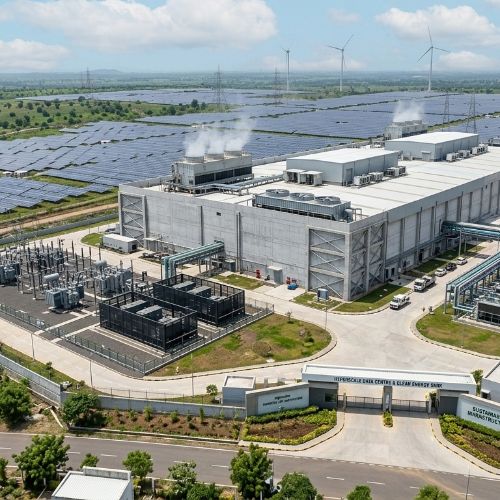
Sembcorp Utilities and Nxera Singapore have signed a memorandum of understanding (MoU) to explore renewable and low-carbon energy supply options for data centres in Singapore, as growing digital infrastructure and artificial intelligence workloads increase demand for reliable electricity.
The agreement brings together Sembcorp’s energy capabilities and Nxera’s data-centre development and operational expertise. The companies will assess scalable solutions intended to strengthen energy resilience and reduce carbon emissions as Singapore’s digital economy expands, according to Sembcorp’s announcement.
Options under consideration include low-carbon hydrogen-based power generation, biomethane-based electricity generation, vertical building-integrated photovoltaics (PV) and renewable electricity imports associated with a 2.2 GWp floating solar project at Linggiu Reservoir in Johor, Malaysia.
The MoU was exchanged during Singapore International Energy Week 2026 in the presence of Singapore’s Minister for Energy, Trade and Industry (Energy and Industry), Tan See Leng, and Malaysia’s Deputy Prime Minister and Minister of Energy Transition and Water Transformation, Fadillah Yusof.
Hydrogen and biomethane among potential power solutions
The companies will evaluate several technologies and supply pathways rather than commit to a single source of lower-carbon electricity.
Hydrogen-based generation is one option being considered. Depending on the production method and supply chain, hydrogen can support lower-carbon energy systems, although its overall emissions profile depends on how it is produced and delivered.
Biomethane-based power generation is another potential route. Biomethane, a purified gas produced from organic materials, can be used in suitable gas-based energy applications and may offer a way to connect waste-derived resources with electricity demand.
The MoU also includes vertical building-integrated photovoltaics. This approach incorporates solar panels into building surfaces, allowing structures to generate electricity without relying exclusively on conventional rooftop installations.
The announcement does not specify the capacity, deployment schedule or emissions-reduction targets for these potential solutions.
Malaysia-linked solar imports under consideration
The companies will also explore renewable electricity imports associated with the 2.2 GWp floating solar project at Linggiu Reservoir in Johor, Malaysia.
Cross-border electricity supply could provide another route for Singapore to access renewable power as it seeks to meet rising demand within a land- and resource-constrained market.
However, the MoU only establishes an assessment of possible supply options. It does not confirm that electricity from the floating solar project will be supplied to Nxera’s data centres, nor does it specify a contracted volume or delivery date.
AI growth increases focus on data-centre energy resilience
The agreement comes as wider adoption of AI increases the importance of reliable power for data-centre operations. These facilities require continuous electricity to run computing equipment, cooling systems and supporting infrastructure.
Koh Chiap Khiong, President and CEO of Gas and Related Services and CEO of Singapore at Sembcorp, said demand for reliable, scalable and lower-carbon energy was increasing as AI adoption accelerated. He said Sembcorp’s energy portfolio could support the evolving requirements of the data-centre sector.
Bill Chang, CEO of Nxera and Singtel’s Digital InfraCo unit, said the source of electricity was particularly important in Singapore because of constraints on land and resources. He said working with Sembcorp would provide additional options for sustainable growth and help strengthen energy resilience.
The companies intend to assess solutions that can support Nxera’s long-term development in Singapore while contributing to the country’s digital ambitions.
Bioenergy Business Analysis
The Sembcorp–Nxera agreement highlights an emerging intersection between digital infrastructure and the energy transition. As data centres support AI and other computing-intensive services, operators face the challenge of securing dependable electricity while managing the environmental impact of their power consumption.
For the bioenergy sector, the inclusion of biomethane-based generation is notable. Biomethane can create a potential link between organic-waste processing and the energy requirements of large electricity users. Its practical contribution will depend on available feedstock, production economics, gas infrastructure, emissions performance and the ability to deliver power reliably.
Hydrogen, building-integrated solar and cross-border renewable electricity offer complementary pathways, but each has distinct infrastructure, cost and deployment requirements. Evaluating them together may allow the companies to compare options against their operational needs rather than relying on a single technology.
The immediate significance of the MoU is that it establishes a framework to explore potential supply solutions; it is not confirmation that the technologies have been selected or that supply contracts are in place. Key developments to watch include any binding agreements, confirmed project capacities, delivery timelines and details of how the proposed options will contribute to Nxera’s electricity needs and emissions goals.


