


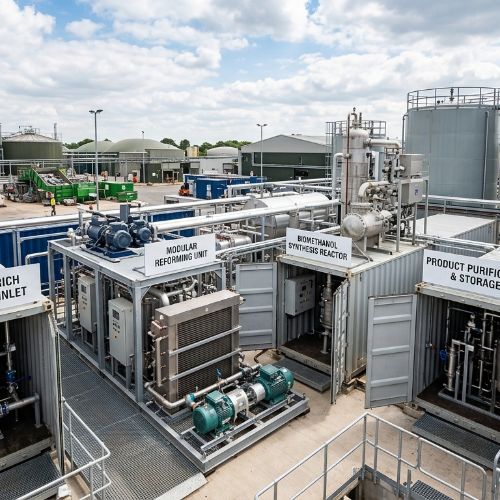
Emvolon plans to deploy its first commercial-scale biomethanol production system after raising $22 million through a Series A funding round and securing non-dilutive government grants. The Massachusetts-based technology company aims to convert methane-rich waste gases into liquid fuels at sites such as landfills, wastewater treatment facilities and industrial operations, with the funding supporting its commercial rollout and organisational expansion.
The funding announcement, dated October 27, comes as Emvolon seeks to expand its work with renewable energy developer Montauk Renewables and establish additional production projects across North America and international markets. The company has also appointed energy trading veteran Eric Bensaude to its board of directors to support the expansion of its biomethanol business.
Funding targets first commercial-scale biomethanol system
Emvolon said the Series A round included participation from MassVentures, VX Ventures, Wagner Carbon and other investors.
The capital will support the delivery of Emvolon’s first commercial-scale modular chemical system, designed to convert methane-rich waste streams into biomethanol. The company also plans to expand its operations as it moves from pilot-stage demonstrations towards commercial deployment.
The project builds on Emvolon’s pilot work with Montauk Renewables. According to the announcement, the companies intend to scale production to a combined capacity of up to 50,000 tonnes per year across multiple sites through their joint venture.
Following the Montauk deployment, Emvolon plans to introduce its modular systems at additional waste-gas locations in North America and selected international markets.
Emmanuel Kasseris, co-founder and CEO of Emvolon, said the funding would help the company move into commercial deployment and develop supply chains for industries seeking alternative fuel sources.
“The world is wasting an enormous energy resource every day.”
Kasseris said Emvolon’s approach focuses on producing fuels at the source, establishing local supply chains and strengthening regional energy resilience. He added that the funding would enable the company to deploy its first commercial system and demonstrate the viability of its model.
Priya Yadav of MassVentures said Emvolon’s standardised modular platform could change the economics of distributed clean-fuel production. She noted that MassVentures had supported the company since 2023 and highlighted its progress from field-pilot operations towards commercial deployment.
Yadav described the first commercial system as an important step towards developing a repeatable, cost-competitive model that could be deployed across multiple projects.
Freepoint agreement provides a route to commercial markets
A key element of Emvolon’s commercial strategy is its agreement with Freepoint Commodities. Announced in August 2026, the arrangement gives Freepoint a first purchase option for Emvolon’s biomethanol and associated liquid fuels under a seven-year framework, with a potential value exceeding $450 million as production scales. The agreement also includes provisions for Freepoint to participate in financing future projects.
The planned supply would enter Freepoint’s global distribution network, connecting Emvolon’s production sites with prospective customers in maritime shipping, heavy transport, aviation and specialty chemicals.
The purchase option is a significant commercial development, but it should not be interpreted as guaranteed revenue or a confirmed purchase of the full stated value. Actual sales will depend on project deployment, production volumes, product specifications and the terms of the agreement.
Emvolon has said the first commercial deployment and subsequent projects will support its wider expansion plans. Its immediate priority is to demonstrate that the modular production model can operate commercially beyond the pilot stage.
Biomethanol demand spans shipping, chemicals and aviation
Emvolon is targeting several markets for its liquid fuels, including maritime shipping, heavy-duty transport and specialty chemicals.
The company estimates that its addressable market represents approximately $40 billion annually and says qualifying biomethanol can command a premium of around $1,000 per metric tonne. These are company-provided commercial estimates rather than independently established market-wide figures. The realised price premium would depend on fuel specifications, certification, carbon-intensity accounting, supply availability and the applicable regulatory framework.
The European Union’s Renewable Energy Directive framework, including its revised requirements under RED III, is also relevant to the market for qualifying renewable fuels. However, eligibility and the value of any compliance premium depend on the specific production pathway and applicable rules; compliance should not be assumed solely because a fuel is derived from waste methane.
Eric Bensaude joins the board as Emvolon prepares to scale
Emvolon has appointed Eric Bensaude to its board of directors as it prepares to expand production and commercial distribution.
Bensaude brings more than 30 years of experience in energy, oil and natural gas trading and marketing. He previously served as managing director of LNG commercial operations at Cheniere Energy , where he built the company’s global LNG trading platform. He also held the position of head of global LNG at EDF Trading and worked as an associate in Booz Allen Hamilton’s energy practice.
Bioenergy Business Analysis
Emvolon’s $22 million funding round highlights a potential alternative to centralised fuel production: converting methane-rich waste gases into transportable liquid fuels at the point of generation. The model seeks to address two linked challenges — capturing value from underused waste-gas resources and expanding supplies of lower-carbon fuels for industries that are difficult to electrify.
Commercial execution will matter more than the headline funding figure. The first commercial installation must demonstrate reliable operation, predictable maintenance costs and consistent biomethanol quality. Performance across multiple sites will be particularly important because landfill gas, agricultural biogas and industrial gas streams can differ substantially in composition and treatment requirements.
The company’s agreement with Freepoint Commodities provides a potential route to market, while the Montauk Renewables partnership offers a basis for expanding deployment. Nevertheless, the purchase option of more than $450 million is not equivalent to secured revenue of that amount. Investors and prospective project partners will need to assess actual contracted volumes, commissioning schedules, financing requirements and offtake conditions as projects progress.
The next milestones are therefore concrete: commissioning the first commercial system, publishing evidence of operating performance, demonstrating saleable fuel output and progressing from planned capacity to verified production. Those results will provide a stronger basis for assessing whether the company’s modular model can scale into a commercially durable biomethanol supply business.
Related: Wasaline signs two-year agreement with St1 Biokraft for 42 GWh of annual LBG supply


