


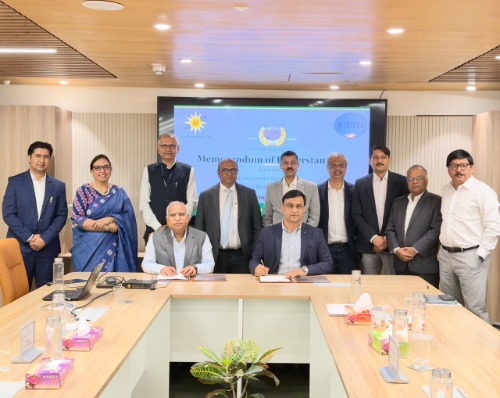
Indraprastha Gas Limited (IGL) and CEID have signed a Memorandum of Understanding (MoU) to establish more than 25 compressed biogas (CBG) plants across India, with a combined production capacity exceeding 125 tonnes per day (TPD), under a proposed joint venture.
The agreement was signed at IGL’s head office in New Delhi by Ajai Tyagi, Executive Director – Business Development and Corporate Strategy at IGL, and Prince Gandhi, Executive Director at CEID.
The proposed collaboration aims to convert organic waste into compressed biogas, supporting the development of India’s renewable gas infrastructure. With more than 25 plants planned and aggregate capacity exceeding 125 TPD, the initiative represents a multi-project expansion effort.
MoU signing attended by IGL and BPCL leadership
The signing ceremony was attended by senior representatives from IGL, Bharat Petroleum Corporation Limited (BPCL) and GAIL.
Those present included:
- Subhankar Sen, Chairman of IGL and Director (Marketing) at BPCL
- Sanjay Kumar, Director at IGL and Director (Marketing) at GAIL
- Kumar Shanker, Managing Director of IGL
- Mohit Bhatia, Director (Commercial) at IGL
Other IGL board members and senior officials from both organisations also attended the event.
Projects aligned with GOBARdhan initiative
IGL and CEID said the proposed projects would align with the Government of India’s GOBARdhan initiative, which promotes the conversion of organic waste, including cattle dung and agricultural residues, into biogas and other useful products.
The partnership is also intended to support decentralised waste processing, rural economic opportunities and greater domestic production of renewable gas.
By developing multiple CBG facilities, the companies aim to contribute to India’s efforts to diversify its energy sources and reduce dependence on conventional fossil fuels.
Bioenergy Business Analysis
The proposed IGL–CEID partnership adds to the development pipeline for India’s CBG sector, where scaling up production capacity depends not only on plant construction but also on reliable feedstock supply, efficient waste collection, gas upgrading and access to buyers.
The planned capacity of more than 125 TPD across over 25 facilities suggests a distributed project model rather than a single large production site. Such an approach could support local waste-management systems while creating opportunities for agricultural and municipal waste utilisation.
However, the MoU is an initial step, not confirmation that the plants are operational or under construction. The partnership’s progress will depend on the finalisation of the joint venture structure, project locations, investment plans, feedstock arrangements and offtake agreements. These details will be important in assessing the initiative’s eventual contribution to India’s CBG production capacity.


