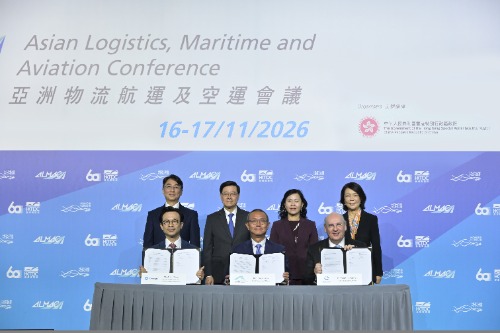
Airport Authority Hong Kong (AAHK), The Hong Kong and China Gas Company Limited (Towngas) and sustainable fuel producer EcoCeres have signed a memorandum of understanding (MoU) to advance the development of a sustainable aviation fuel (SAF) blending facility in Tuen Mun, Hong Kong.
The agreement, signed on 17 November 2026 during the Asian Logistics, Maritime and Aviation Conference (ALMAC), establishes a framework for the three parties to continue discussions on the facility’s design, construction and operation. Its implementation will depend on further agreements between the parties. The proposal comes alongside Hong Kong’s 2030 sustainable aviation fuel strategy.
The MoU was signed by Steven Yiu, Chief Operating Officer of AAHK; Alan Chan, Executive Director and Chief Investment Officer of Towngas; and Matti Lievonen, Chief Executive Officer of EcoCeres. Hong Kong Chief Executive John KC Lee witnessed the signing, alongside Secretary for Transport and Logistics Mable Chan, AAHK Chief Executive Officer Vivian Cheung and Towngas Chairman Peter Lee.
Tuen Mun facility to support Hong Kong’s SAF supply chain
The proposed blending facility is intended to strengthen Hong Kong’s domestic SAF infrastructure and connect fuel production in the Greater Bay Area with aviation fuel supply at Hong Kong International Airport (HKIA).
According to Towngas and EcoCeres, the three parties will undertake further discussions and feasibility studies covering the facility’s design, operating model and commercial arrangements. Specific investment and implementation details will depend on the outcome of these studies and prevailing market conditions.
The proposed development forms part of a wider regional supply chain linking the collection and recycling of waste oils and fats across the Guangdong-Hong Kong-Macao Greater Bay Area, SAF production in Dongguan and fuel blending and aircraft refuelling in Hong Kong.
EcoCeres is also planning to establish an SAF production base in Dongguan, Guangdong province, as part of the regional development strategy. The company has indicated a 2030 completion target for the proposed Hong Kong blending facility in its announcement, although the AAHK MoU statement does not specify a construction schedule.
Hong Kong targets 1%–3% SAF consumption by 2030
The agreement supports the Hong Kong Special Administrative Region Government’s objective of increasing SAF adoption in the aviation sector.
Hong Kong’s first Five-Year Plan for Economic and Social Development (2026–2030) sets a target for SAF to account for 1% to 3% of fuel consumed by flights departing from HKIA by 2030.
In his 2026 Policy Address, Chief Executive John Lee said the Government would take forward the construction of an SAF blending facility to establish an end-to-end supply chain and reduce logistics costs, helping improve the price competitiveness of SAF.
The Government also plans to study the establishment of a mandatory SAF consumption-ratio mechanism by 2028, alongside public awareness and education initiatives to support the 2030 target.
The development of the Dongguan production base is another part of the strategy, with Hong Kong and Guangdong expected to combine their respective industrial and technological capabilities to strengthen the regional SAF value chain.
HKIA already equipped to handle pre-blended SAF
Hong Kong International Airport’s existing fuel infrastructure can already receive, store and supply pre-blended SAF to aircraft.
AAHK confirmed that one of Hong Kong’s local airlines has successfully uplifted SAF at the airport. This provides an existing operational foundation for the proposed blending infrastructure, although the airport authority has not disclosed the airline’s identity, fuel volume or timing of the operation.
The proposed Tuen Mun facility would add a local blending component to the wider supply chain, supporting the Government’s efforts to improve SAF availability and reduce associated logistics costs.
Further progress will depend on the outcome of the feasibility studies, commercial arrangements and agreements between AAHK, Towngas and EcoCeres.