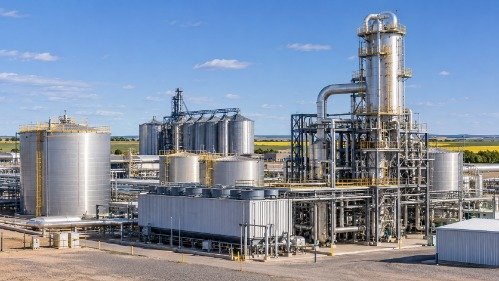
Federated Co-operatives Limited (FCL) has commissioned and brought its carbon capture project at the Co-op Ethanol Complex (CEC) in Saskatchewan, Canada, into full operation. The project is designed to capture up to 90,000 tonnes of greenhouse gas emissions annually for pipeline transport and permanent geological storage at the nearby Belle Plaine Carbon Hub.
The project integrates carbon capture and compression technology with the ethanol complex’s existing infrastructure, allowing FCL to add emissions-management capabilities to its operating fuel-production assets.
FCL said the project is expected to reduce the carbon intensity of ethanol produced at the facility by approximately 51%. The company also expects the captured carbon to generate compliance credits and improve the competitiveness of its ethanol in low-carbon fuel markets.
Carbon capture project enters full operation
The newly commissioned system captures and compresses carbon dioxide generated at the Co-op Ethanol Complex. The captured CO₂ is intended to be transported through a pipeline to the Belle Plaine Carbon Hub, where it will be permanently stored in geological formations.
FCL said the project makes use of the complex’s existing infrastructure, integrating carbon capture technology into the operating ethanol facility rather than developing a separate fuel-production site.
The company expects the system to remove up to 90,000 tonnes of greenhouse gas emissions annually. This is a projected annual capture capacity; FCL has not provided actual operating capture figures in its commissioning announcement.
FCL chief executive officer Heather Ryan said the project supports the co-operative’s Pathways to Energy Compliance programme and aligns with the federal Clean Fuel Regulations.
Ryan added that the infrastructure is expected to support the long-term operation of the ethanol complex and FCL’s production of lower-carbon fuels for the Co-operative Retailing System and communities across Western Canada.
Project expected to lower ethanol carbon intensity by 51%
According to FCL, integrating carbon capture at the complex is projected to reduce the carbon intensity of its ethanol by approximately 51%.
Carbon intensity measures the greenhouse gas emissions associated with producing and using a unit of fuel, generally expressed as grams of carbon dioxide equivalent per megajoule. Capturing and permanently storing process-related CO₂ can reduce the emissions attributed to ethanol production, depending on the accounting methodology and project boundaries.
FCL expects the project to generate compliance credits under applicable fuel regulations, support its wider greenhouse gas reduction strategy and strengthen the market position of ethanol produced at the facility.
The company has linked the investment to Canada’s Clean Fuel Regulations, which establish a framework for reducing the lifecycle carbon intensity of fuels supplied in the Canadian market.
Co-op Ethanol Complex produces up to 130 million litres annually
The Co-op Ethanol Complex is located near Belle Plaine, Saskatchewan. FCL’s facility information states that the plant can produce up to 130 million litres of ethanol annually, primarily using wheat and other starch-rich crops sourced from Western Canadian producers.
The ethanol is blended into Co-op fuels distributed through the co-operative’s retail network. The facility also produces dried distillers’ grain, a co-product used in animal feed.
The carbon capture project adds a CO₂ management component to the facility’s existing ethanol production operations. Its expected annual capture capacity of up to 90,000 tonnes is intended to support the production of lower-carbon ethanol for fuel markets.
FCL advances wider carbon management and renewable fuels plans
FCL said it is continuing work on carbon capture at the Co-op Refinery Complex in Regina, alongside plans involving the co-processing and blending of renewable fuels.
The commissioning of the ethanol complex project marks a new operational stage in FCL’s carbon management programme. Its next steps include advancing the refinery-related carbon capture work and integrating renewable fuel activities into its wider energy strategy.
Saskatchewan Premier Scott Moe said the project supports employment in the Belle Plaine area and represents investment in the province’s energy sector.