


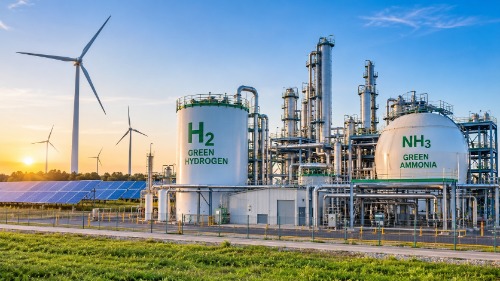
ACME Group has completed the final investment decision (FID) for a 760,000-tonne-per-annum (TPA) green ammonia project in Odisha, India, marking a major step towards developing large-scale renewable hydrogen derivatives production capacity. The approximately US$3.6 billion project is expected to be commissioned by 2029.
The facility will operate entirely on renewable energy and use electrolysers to produce green hydrogen, which will subsequently be converted into ammonia through the Haber-Bosch process. German engineering company Thyssenkrupp Uhde has been appointed as the project’s technology partner and will design its 2,200-tonne-per-day ammonia production loop.
ACME describes the project as the largest green ammonia project in India to have reached the FID stage so far. The company expects the facility to avoid more than 1.5 million tonnes of greenhouse gas emissions annually.
The project follows ACME’s first-phase green ammonia facility in Duqm, Oman, which has a planned annual capacity of 100,000 tonnes and is expected to be commissioned soon.
Green ammonia offtake commitments secured in India and Japan
ACME has outlined supply commitments for customers in domestic and international markets. The Odisha facility will supply 370,000 tonnes of green ammonia annually to Indian fertiliser companies through the Solar Energy Corporation of India (SECI) under the government’s Strategic Interventions for Green Hydrogen Transition (SIGHT) programme.
A further 83,000 tonnes per year will be supplied to Japan’s IHI Corporation under the country’s Long-Term Decarbonisation of Power Auction (LTDPA).
The company has also identified customers in the European Union as part of its wider offtake strategy. However, it has not disclosed the specific volume allocated to European buyers in the announcement.
The two quantified supply allocations total 453,000 tonnes per year, leaving approximately 307,000 tonnes of the facility’s planned annual capacity without a specified allocation in the announcement.
The project is intended to serve multiple applications and end-use markets, including fertiliser production and other industrial and energy-related uses.
Brookfield backs ACME’s green molecules platform
The investment decision follows Brookfield’s entry into ACME’s green ammonia platform in September 2026, when it committed up to US$600 million as a strategic investor.
The commitment is intended to support ACME’s wider green molecules business and its pipeline of projects in India and West Asia. It should be distinguished from the Odisha project’s estimated US$3.6 billion investment, as the announced Brookfield commitment relates to the broader platform rather than being identified solely as funding for this facility.
Commenting on the investment decision, Manoj Kumar Upadhyay, Chairman of ACME Group, said,
“The Final Investment Decision on our Odisha green ammonia project marks a critical milestone as we move from ambition to execution at scale. Building on the learnings from our Green Ammonia Duqm project in Oman, designed exclusively for the European RFNBO market, the Odisha project demonstrates India’s ability to produce competitive green molecules for diverse markets and end uses. The project is underpinned by long-term offtake commitments from customers in India, Japan and the European Union. We thank Brookfield for its confidence in the project as a marquee investor. Together, we are building a platform to help decarbonise hard-to-abate industries and strengthen energy security in India and globally.”
Project designed to meet EU renewable fuel requirements
The Odisha facility is being developed to comply with the European Union’s Renewable Fuels of Non-Biological Origin (RFNBO) requirements, which set criteria for the renewable origin and sourcing of electricity used to produce qualifying renewable hydrogen and its derivatives.
ACME said CertifHy, a certification scheme operating in the RFNBO framework, had verified the project’s proposed renewable electricity architecture. This assessment covers geographical correlation between renewable electricity generation, transmission and consumption at the facility.
The company said the green ammonia produced at the plant would be aligned with the applicable green standards in India, Japan and the European Union.
The project will use the Haber-Bosch process to combine renewable hydrogen with nitrogen to produce ammonia. Green ammonia can serve as a lower-carbon alternative to conventionally produced ammonia, which is generally manufactured using fossil fuels. It is also being developed for applications in fertiliser production, power generation, shipping and industrial processes.
With the Odisha project reaching FID, ACME is advancing its plans to expand green hydrogen-derived fuel and chemical production for domestic consumption and international markets. The next stages will involve project execution, renewable power integration and development of the infrastructure required to bring the facility into operation by 2029.



