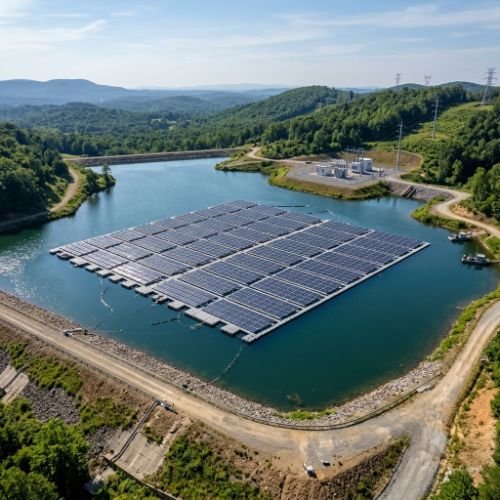
The Asian Development Bank (ADB) has approved a $20 million financing package to support the development of Kyrgyzstan’s first utility-scale floating solar photovoltaic (PV) power plant, a 15 MW project planned at an existing hydropower reservoir near the capital, Bishkek.
The financing will support construction of the facility at Chakan Hydropower Plant 5 (HPP-5), where the floating solar panels will be installed on the existing reservoir and connected to the electricity grid. The plant is expected to generate approximately 20 gigawatt-hours (GWh) of electricity annually.
ADB’s financing package comprises a $19.55 million concessional loan from its ordinary capital resources and a $450,000 grant from the Asian Development Fund. The Government of the Kyrgyz Republic will contribute an additional $2.02 million towards the project.
The project is intended to diversify the country’s domestic electricity supply, reduce reliance on imported power and complement its existing hydropower generation capacity.
Financing to support 15 MW floating solar project
The planned facility will have a capacity of 15 MWac, equivalent to approximately 18 MWp, according to ADB project documentation.
The project will use an existing reservoir and grid infrastructure, while also supporting grid upgrades and institutional capacity development. Open Joint Stock Company Chakan GES will receive support to strengthen its ability to develop and operate floating solar facilities.
ADB expects the project to establish an operational model that could encourage further investment in floating solar technology, including participation from private-sector developers.
The bank’s project documentation identifies approximately 176 MW of additional feasible floating solar capacity across other reservoirs in the country. These sites could provide opportunities for future projects and expansion of the technology beyond the initial installation.
Floating solar to complement hydropower generation
The project comes as Kyrgyzstan seeks to diversify an electricity system heavily dependent on hydropower.
Nearly 90% of the country’s electricity generation comes from hydropower plants. However, rising electricity consumption and climate-related pressures on water resources have increased challenges in meeting demand throughout the year.
According to ADB, electricity consumption in the Kyrgyz Republic has increased by more than 45% since 2012. The country has also become increasingly reliant on imported electricity, particularly during winter months.
The floating solar facility is expected to add another domestic renewable electricity source and complement hydropower generation. By combining solar generation with existing hydropower infrastructure, the project aims to support a more diversified and resilient electricity supply.
ADB Country Director for the Kyrgyz Republic Zheng Wu said: “As the Kyrgyz Republic’s economy grows, so does the need for reliable and sustainable energy.”
He added that the project would help diversify domestic energy supply, make better use of existing resources and establish a model for future renewable energy investment. Kabar
Project includes grid upgrades and emissions reduction targets
In addition to constructing the floating solar plant, the project will support improvements to grid infrastructure and technical capacity development for Chakan GES.
ADB also plans to share the project’s experience and technical lessons with other developing member countries across Central and West Asia. The initiative is intended to reduce barriers to private-sector participation and support the longer-term expansion of floating solar investments in the region.
The project is expected to reduce greenhouse gas emissions by approximately 4,628 tonnes of carbon dioxide equivalent annually.
It will also include technical training and workforce development programmes aimed at expanding opportunities for women in the renewable energy sector.
Kyrgyzstan’s floating solar development moves beyond pilot stage
Although the proposed 15 MW facility is described as Kyrgyzstan’s first utility-scale floating solar project, a smaller pilot installation is already operating at the HPP-5 site.
The Ministry of Energy reported that a 0.1 MW floating solar pilot plant was commissioned there on 1 March 2024. It generated 133,900 kWh of electricity in 2024 and 141,100 kWh in 2025, according to information reported by Kabar in November 2026.
The larger ADB-backed project will build on this experience by introducing floating solar at utility scale, while using existing hydropower reservoir and grid infrastructure.
Its implementation could provide a reference for further floating solar development in Kyrgyzstan and other countries across Central and West Asia.