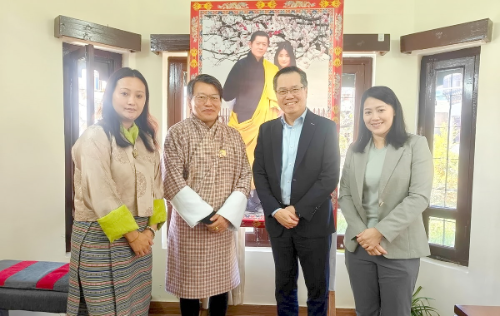
Ecopha DrukBees has held discussions with the Asia Pacific Sustainable Aviation Centre (APSAC) on potential cooperation to advance sustainable aviation fuel (SAF) development, with a particular focus on Pongamia-based feedstock, sustainability certification and regional aviation decarbonisation.
The meeting took place in Thimphu on 25 November 2026, when an APSAC delegation led by founding Chief Executive Officer Philip Goh and Deputy Director Ke Liyin visited Ecopha DrukBees to explore Bhutan’s potential contribution to the Asia-Pacific region’s transition towards lower-carbon aviation fuels.
The discussions covered technical capacity building, the development of a national sustainable aviation roadmap, Pongamia-based SAF research and potential green financing mechanisms. The two organisations identified four areas for further technical dialogue, although the announcement does not indicate that a formal partnership or commercial agreement has been concluded.
Ecopha DrukBees Develops Pongamia-Based SAF and Biorefinery Model
During the meeting, Karma Dorji, Promoter of Ecopha DrukBees, presented the company’s Sustainable Aviation Fuel and Pongamia Bioeconomy Project.
Ecopha DrukBees is an Australia–Bhutan joint venture, with Ecopha officially opened in July 2026. According to the announcement, the Bhutan operation is being developed as a research, demonstration and certification hub rather than a conventional large-scale mass-production facility.
The proposed model centres on Pongamia pinnata, an oil-bearing tree whose seeds produce non-edible oil that can serve as a feedstock for renewable fuel production. The tree can grow on marginal land, potentially reducing competition with agricultural land used for food production.
The project intends to use the Hydroprocessed Esters and Fatty Acids (HEFA) pathway to process Pongamia oil into sustainable aviation fuel. HEFA involves processing oils and fats using hydrogen to produce hydrocarbon fuels that can be used as aviation fuel, subject to applicable fuel specifications and certification requirements.
Ecopha also presented its patent-filed integrated biorefinery concept, which is designed to produce two principal outputs:
- 85–90% Sustainable Aviation Fuel: Aviation fuel produced through the proposed HEFA pathway and intended to be compatible with conventional jet fuel.
- 10–15% PHA bioplastics: Polyhydroxyalkanoate biomaterials intended for applications requiring biodegradable alternatives to conventional plastics.
The company also outlined plans to return agricultural residues to plantations for soil improvement and explore carbon-credit generation as part of its proposed circular bioeconomy model.
These percentages represent the company’s stated production model; the announcement does not provide independent technical validation, operating data or evidence of commercial-scale production.
Global Tree Passport System Targets Feedstock Traceability
Feedstock traceability and sustainability certification were another central part of the presentation.
Ecopha demonstrated its proposed Global Tree Passport System, a digital tracking framework designed to assign individual identities to Pongamia trees and connect plantation-level information with downstream fuel and biomaterial production.
The system is intended to incorporate unique tree identification numbers, GPS coordinates, genetic and provenance records, sensor-assisted growth monitoring, carbon sequestration and biomass measurements, and chain-of-custody tracking.
QR codes would link plantation information with the final SAF or PHA output, providing a digital record of feedstock origin and movement through the production chain.
Such traceability mechanisms could support sustainability assessments and supply-chain verification. However, the announcement does not establish that the system has received independent certification or regulatory recognition.
Pongamia Planting Begins in Nganglam
Ecopha DrukBees also reported initial planting activities in Nganglam, Bhutan, using approximately 1 kg of imported Pongamia seeds, equivalent to around 400 seeds.
The early-stage activities include plans for a solar-powered nursery, deployment of the Tree Passport system and engagement with local farmers.
The announcement identifies Bhutan Agro Industries, Drukair and the Ministry of Agriculture and Livestock among the partners involved in the broader initiative. However, it does not specify the precise contractual roles or financial commitments of these organisations.
The Nganglam activities indicate that the project has moved into initial feedstock establishment, but the available information does not establish plantation acreage, survival rates, future seed production volumes or a timeline for commercial SAF output.
Four Areas Identified for Cooperation Between Ecopha and APSAC
The discussions resulted in four proposed areas for further technical engagement.
Capacity building: The organisations identified opportunities for training on non-food SAF feedstocks, HEFA production pathways, sustainability criteria and International Civil Aviation Organization (ICAO) requirements.
National sustainable aviation roadmap: Technical support for assessing Bhutan’s aviation emissions and developing a national SAF strategy was discussed, including consideration of Gelephu.
SAF development and research: Potential joint studies could examine Pongamia’s lifecycle emissions, regional feedstock supply opportunities and pathways towards commercial deployment.
Green financing: The discussions also covered possible blended-finance structures, carbon-credit frameworks and green investment instruments to support future development.
These areas remain prospective cooperation opportunities rather than confirmed projects or funding commitments.
APSAC’s Role in Asia-Pacific Aviation Decarbonisation
Established by Singapore’s Civil Aviation Authority (CAAS) and launched in July 2025, APSAC is a not-for-profit centre focused on policy research, regional collaboration and capacity building for aviation decarbonisation.
Its work supports the International Civil Aviation Organization’s (ICAO) Long-Term Aspirational Goal (LTAG) of achieving net-zero carbon emissions from international aviation by 2050.
The engagement with Ecopha DrukBees reflects an effort to examine how alternative feedstocks and emerging SAF supply chains could contribute to the region’s aviation transition.
For Bhutan, the proposed Pongamia initiative combines feedstock cultivation, digital traceability and biorefinery research. Its future contribution to the SAF market will depend on feedstock availability, conversion performance, lifecycle emissions, certification and the commercial viability of production.
The discussions in Thimphu provide a starting point for further technical engagement, but the project’s progress towards certified and commercially available SAF remains to be demonstrated.