


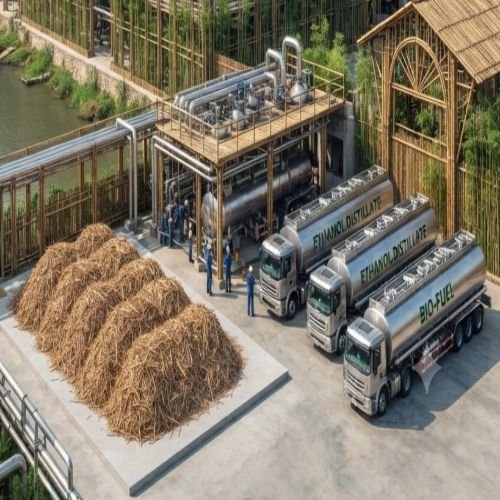
Numaligarh Refinery Limited’s (NRL) bamboo-based second-generation (2G) bioethanol refinery in Assam has commenced production, marking a further development in India’s advanced biofuel manufacturing sector. The facility, developed by Assam Bio Ethanol Private Limited (ABEPL) within NRL’s premises in Golaghat district, uses bamboo biomass as its primary feedstock.
The project, whose construction began in 2018, is being implemented by ABEPL, a joint venture between NRL and Finnish companies Fortum and Chempolis Oy.
The latest report places the project’s estimated investment at approximately ₹5,000 crore, compared with earlier estimates of ₹4,200 crore. The project is also expected to establish a significant market for bamboo growers across Northeast India, with an estimated annual feedstock requirement of around 500,000 tonnes.
Bamboo-Based Refinery Uses Second-Generation Ethanol Technology
The Numaligarh facility uses second-generation bioethanol technology to convert bamboo biomass into fuel-grade ethanol. Unlike conventional first-generation ethanol production, which commonly uses sugar- and starch-based feedstocks, 2G technology processes non-food biomass.
Bamboo is the principal feedstock for the facility, with its availability across Northeast India offering an opportunity to establish a regional agricultural supply chain for advanced biofuel production.
The production of these additional products forms part of the facility’s broader biorefinery model, which aims to derive multiple industrial outputs from bamboo biomass.
The project was inaugurated by Prime Minister Narendra Modi on 14 September 2025. At the inauguration, the government highlighted the facility’s potential to support alternative fuel production, strengthen rural economic activity and create opportunities for farmers and bamboo-based enterprises.
Bamboo Procurement Expected to Support Northeast Farmers
The refinery is expected to require approximately 500,000 tonnes of bamboo annually at its planned operating level.
This requirement could create additional demand for bamboo cultivation and procurement across the Northeast, providing market opportunities for farmers, growers and local entrepreneurs involved in bamboo collection and processing.
NRL has previously outlined its involvement in developing the feedstock supply chain, including distributing bamboo saplings and engaging with local farming communities.
At the September 2025 inauguration, the government highlighted an expected annual economic benefit of approximately ₹200 crore from the bamboo-related activities associated with the facility. This was presented as a projected benefit rather than a verified income figure.
The latest report estimates that the project could generate direct and indirect employment for approximately 1,000–1,500 people. However, the figure represents an expected employment impact, and the report does not provide a breakdown of jobs already created.
NRL Refinery Expansion Reaches Reported 90% Completion
Separately, NRL is progressing with its refinery expansion project, which will increase its crude oil processing capacity from 3 million metric tonnes per annum (MMTPA) to 9 MMTPA.
Assam Chief Minister Himanta Biswa Sarma reportedly stated that approximately 90% of the expansion work had been completed following a review of the project during his visit to the refinery on 25 November 2026.
The expansion involves the installation of an additional 6 MMTPA refining train at Numaligarh. According to NRL’s project information, the expansion is scheduled for completion by March 2027. The company’s published progress figures recorded 88.4% physical completion of the new refinery as of 30 September 2026.
The expansion also includes the 1,635-kilometre Paradip–Numaligarh crude oil pipeline, designed to transport additional imported crude oil to the refinery. NRL reported physical progress of 93.8% on the pipeline as of 30 September 2026.
The Chief Minister also stated that Assam’s total refining capacity would reach 13 MMTPA, although the latest report does not provide a breakdown of the capacity contributing to that figure.
Assam Strengthens Its Position in Advanced Biofuel Production
The commencement of production at the Numaligarh bamboo-based refinery adds to India’s developing second-generation bioethanol infrastructure.
The use of bamboo as a non-food feedstock provides an alternative to conventional ethanol production pathways and creates opportunities to connect agricultural biomass supply chains with industrial fuel manufacturing.
The facility’s progress will be particularly relevant for Northeast India, where bamboo cultivation and processing could support feedstock procurement, rural employment and associated industrial activities.
However, the next important milestone will be the transition from initial production and commissioning activities to stable commercial operations and higher capacity utilisation.
NRL’s progress in this area will help determine the extent to which the bamboo-based refinery can contribute to India’s advanced biofuel production and regional agricultural value chains.
Bioenergy Business Analysis
The Numaligarh project is an important development for India’s 2G ethanol sector because it demonstrates the potential to use bamboo as an industrial-scale biofuel feedstock.
Its significance extends beyond ethanol production. The facility’s planned output of furfural, acetic acid and food-grade liquid carbon dioxide also reflects the broader biorefinery approach, in which biomass is processed into multiple products rather than a single fuel.
The project’s commercial performance will depend on consistent bamboo procurement, conversion efficiency, operational stability and the ability to utilise its full range of planned products.




