


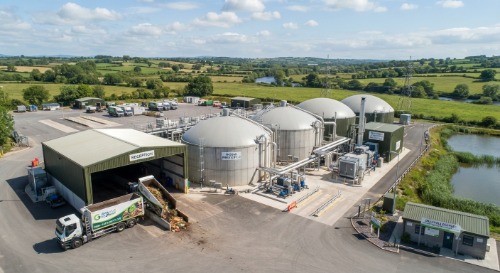
Granville Ecopark in Dungannon, Northern Ireland, is using food waste as a feedstock for enhanced anaerobic digestion, with the facility capable of exporting 4.8 MWe of renewable electricity to the local grid.
The project began its planning process in 2009 and has since developed into a renewable energy facility that converts food waste into biogas for electricity generation. According to Edina, the site can export 4.8 MWe of renewable electricity to Northern Ireland’s grid.
Food waste converted into biogas and renewable electricity
Granville Ecopark uses an enhanced anaerobic digestion process to treat food waste and produce biogas. Anaerobic digestion breaks down organic material in the absence of oxygen, generating a methane-rich gas that can be used for energy production.
At Granville Ecopark, the resulting biogas is used to generate renewable electricity. The facility’s 4.8 MWe export capacity allows electricity produced from the food-waste feedstock to be supplied to Northern Ireland’s local electricity network.
The development illustrates how food waste can be diverted towards energy recovery while producing a renewable energy output.
Excess biogas can support biomethane production
In addition to electricity generation, excess biogas from the facility can be converted into biomethane for renewable heat and power, according to the source material.
Biomethane is produced by upgrading biogas to remove carbon dioxide and other impurities, resulting in a gas with properties suitable for applications that require a higher methane concentration. Depending on the infrastructure and end use, biomethane can provide an alternative renewable gas source for heat and power.
The ability to use biogas for different energy applications provides flexibility in how organic waste resources can be integrated into local energy systems.
Granville Ecopark’s long development timeline
The planning process for Granville Ecopark’s food-waste anaerobic digestion project began in 2009. Its development reflects the longer timeframes that can be associated with establishing waste-to-energy infrastructure, including project planning, development and integration with energy networks.
The Dungannon facility now combines food-waste management with renewable energy production, linking the treatment of an organic waste stream with electricity generation.
Its 4.8 MWe grid-export capacity provides the clearest reported measure of the facility’s electricity contribution. The source material does not specify the plant’s annual electricity output, the volume of food waste processed, the amount of biogas produced or the number of households supplied by its renewable electricity.
Bioenergy Business Analysis
Granville Ecopark demonstrates the role that anaerobic digestion can play at the intersection of waste management and renewable energy. Food waste provides the feedstock while the resulting biogas can be directed towards electricity generation or, where appropriate, upgraded to biomethane.
The project’s long development history also highlights that waste-to-energy infrastructure can require extended planning and development periods before reaching operational scale. Its reported 4.8 MWe grid-export capacity shows how an organic waste treatment facility can become part of local renewable electricity infrastructure, while the potential for biomethane production adds another route for using the biogas resource.