


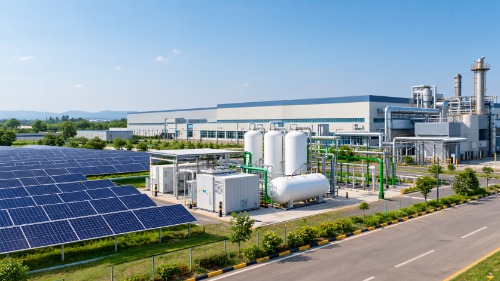
Maruti Suzuki India has commissioned a 300 kW green hydrogen electrolyser plant at its Manesar manufacturing facility in Haryana, marking the company’s first green hydrogen installation and adding hydrogen to its portfolio of renewable energy sources for manufacturing operations.
The pilot plant will use hydrogen produced from surplus solar power generated at the Manesar facility and blend it with natural gas for use as process fuel. The company said solar electricity generated during holidays, when manufacturing demand is lower, can instead be used to produce and store green hydrogen for subsequent use in plant operations.
Maruti Suzuki plans to use the experience gained from the pilot to assess wider deployment of green hydrogen across its manufacturing facilities in Haryana and Gujarat. The company said the initiative forms part of its broader strategy to reduce the carbon intensity of manufacturing.
300 kW electrolyser converts surplus solar power into hydrogen
The Manesar project has been designed to address one of the challenges associated with variable renewable electricity: utilisation of solar generation when on-site industrial demand is lower.
Under the pilot model, surplus solar electricity is used to power an electrolyser, producing green hydrogen. The hydrogen is then stored and subsequently blended with natural gas for manufacturing process applications.
This effectively adds hydrogen as an energy-storage and process-fuel pathway alongside Maruti Suzuki’s existing investments in solar power, biogas, compressed biogas (CBG) and battery energy storage.
The company has not disclosed the pilot plant’s hydrogen production rate, storage capacity or the proportion of natural gas that will ultimately be displaced by hydrogen.
Maruti Suzuki targets wider green hydrogen adoption
The Manesar installation is intended to provide operational experience before the company considers scaling up the technology.
Maruti Suzuki said learnings from the pilot will inform potential adoption of green hydrogen across its manufacturing facilities in Haryana and Gujarat.
Managing Director and CEO Hisashi Takeuchi said the company is pursuing multiple renewable energy solutions for its manufacturing operations rather than relying on a single pathway.
He said the green hydrogen project is aligned with India’s National Green Hydrogen Mission and forms part of a wider programme that includes solar expansion, biogas and battery energy storage.
The company’s stated ambition is to reduce the carbon footprint of its manufacturing operations from 615,000 tonnes of CO₂ to 266,000 tonnes in FY2030-31. This is a company target rather than an independently verified forecast.
Solar capacity provides the foundation for hydrogen pilot
Maruti Suzuki has been expanding its renewable electricity capacity alongside its alternative-fuel initiatives.
In June 2025, the company announced a 30 MWp expansion in solar capacity, comprising a 20 MWp solar project at Kharkhoda and an additional 10 MWp at Manesar. The additions took its total solar capacity across locations to 79 MWp at that time.
Maruti Suzuki has said it aims to increase its overall solar capacity to 319 MWp by FY2030-31, while targeting an 85% share of renewable sources in total electricity consumption by that financial year.
The Manesar hydrogen pilot creates a potential route for using renewable electricity beyond the immediate electricity demand of the manufacturing facility.
Biogas and CBG add to Maruti Suzuki’s clean-fuel portfolio
Green hydrogen is being introduced alongside several bioenergy initiatives already under development across Maruti Suzuki’s manufacturing network.
In June 2026, the company announced a 10 tonnes-per-day biogas plant at Kharkhoda, targeted for commissioning during FY2026-27. It also expanded the existing Manesar biogas plant from 0.2 TPD to 0.7 TPD.
The Manesar biogas facility uses food waste, Napier grass and paddy straw as feedstock, with provision to use cattle dung. The resulting biogas can be used for paint-shop heating and canteen operations, while fermented organic manure from the process can be used for horticulture or returned to the agricultural ecosystem.
Maruti Suzuki has also begun integrating CBG as a process fuel. Its board has approved four CBG projects with a combined earmarked budget of ₹561 crore, according to the company’s latest disclosure supplied for this article.
Separately, Suzuki Motor Corporation is developing dung-based biogas projects in partnership with the National Dairy Development Board and dairy organisations. Suzuki reported in August that three such plants were already operational in Gujarat.
Battery storage adds another flexibility option
The company’s clean-energy strategy also includes battery storage.
Maruti Suzuki has commissioned a 1 MWh battery energy storage system at Kharkhoda, adding another mechanism for managing renewable electricity within its manufacturing operations.
Taken together, solar generation, battery storage, biogas, CBG and green hydrogen provide the company with several different pathways for reducing fossil-fuel use in industrial processes.
The technologies, however, serve different functions. Battery storage can shift electricity consumption over time, while hydrogen can store renewable energy in chemical form and provide a combustible process fuel. Biogas and CBG, meanwhile, rely on biomass feedstocks and can directly replace fossil gas in suitable applications.
Green hydrogen could complement industrial decarbonisation
The Manesar project is a pilot rather than a large-scale hydrogen production facility. Its immediate importance is therefore linked to technology validation and operational learning rather than the volume of hydrogen produced.
For industrial users, green hydrogen can potentially decarbonise applications where direct electrification is difficult or where existing equipment is designed around gaseous fuels. However, the emissions benefits depend on the electricity used for electrolysis, hydrogen utilisation efficiency and the extent to which hydrogen actually replaces fossil fuel.
The Manesar configuration also highlights a different use case: using hydrogen to absorb renewable electricity that might otherwise be curtailed or remain unused during periods of low industrial demand.
Bioenergy Business Analysis
Maruti Suzuki’s Manesar pilot is notable less for its 300 kW electrolyser capacity than for the way the company is testing green hydrogen alongside several other renewable-energy technologies within an operating manufacturing ecosystem.
The use of surplus solar electricity for hydrogen production addresses a practical integration challenge. Rather than treating hydrogen solely as a fuel-production project, the pilot can test whether renewable electricity can be shifted into a storable fuel and subsequently used in industrial processes. The commercial value of that model will depend on the plant’s actual hydrogen output, utilisation rate, storage requirements and the amount of natural gas it can displace.
The broader strategy also illustrates why industrial decarbonisation is increasingly being approached through multiple technologies. Solar and battery storage can address electricity demand, while biogas and CBG can provide renewable gaseous fuels from organic feedstocks. Green hydrogen could add another option for applications requiring a combustible fuel.
The next significant milestone will be the operating data generated by the Manesar pilot. Maruti Suzuki has indicated that these learnings will guide potential deployment in Haryana and Gujarat, but the company has not yet disclosed the scale, investment or timeline of any future green hydrogen expansion.
Read also: Bihar Green Hydrogen Policy can attract ₹16,000 crore investment