


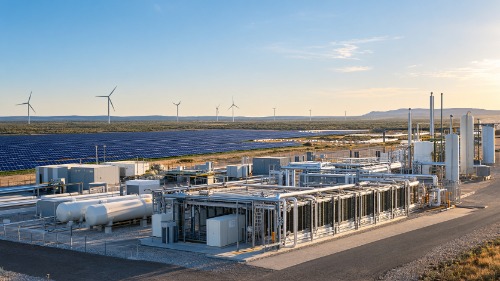
Australian electrolyser manufacturer Hysata and green fuels developer InterContinental Energy (ICE) have entered an engineering collaboration aimed at integrating Hysata’s high-efficiency electrolyser technology into ICE’s P2(H₂)Node architecture for large-scale green hydrogen and green fuels projects.
Under the agreement, Hysata will provide electrolyser engineering design and performance data for ICE’s Digital Twin Optimisation Framework, allowing the companies to model the technology within the modular P2(H₂)Node system before projects move into construction.
The collaboration targets one of the key cost variables in green hydrogen production: electricity consumption. Hysata says its capillary-fed electrolyser achieves 95% system efficiency, equivalent to 41.5 kWh per kilogram of hydrogen, compared with around 75% efficiency for incumbent commercial systems.
ICE, meanwhile, says its P2(H₂)Node architecture can reduce the levelised cost of hydrogen by an estimated 10–20% compared with traditional approaches by integrating electrolysis more closely with renewable generation and using a standardised modular design.
Hysata electrolyser technology targets lower electricity use
Hysata’s capillary-fed electrolysis technology changes how water and electrolyte are supplied to the cell.
Rather than submerging electrodes in liquid electrolyte, the system uses a capillary mechanism to deliver electrolyte to the electrodes. Hysata says this design avoids gas bubbles that contribute to energy losses in conventional electrolysis systems.
The company reports system efficiency of 95% or 41.5 kWh/kg of hydrogen and says the technology can produce around 20% more hydrogen from each megawatt of electrolyser capacity than incumbent systems.
Higher efficiency has a direct impact on project economics because electricity represents a substantial share of the cost of producing green hydrogen. It can also reduce the renewable generation and electrolyser capacity required to produce a specified quantity of hydrogen.
Hysata says its simplified balance of plant, reduced cooling requirements and modular design can provide additional capital-cost benefits alongside the electricity savings.
P2(H₂)Node integrates electrolysis with renewable generation
ICE’s P2(H₂)Node architecture is designed to place electrolysis systems within wind and solar generation areas rather than relying on long-distance transmission of all the electricity to a central hydrogen plant.
The company says this configuration can reduce electrical losses and allow more renewable energy to be transported in molecular form through hydrogen infrastructure. Its standardised architecture is intended to allow projects to be replicated and expanded in stages.
ICE says the P2(H₂)Node is patented in more than 50 countries and is designed as a modular building block for giga-scale green energy hubs. The architecture can also integrate green-compute infrastructure alongside hydrogen production.
Under the companies’ new agreement, Hysata’s electrolyser design will be modelled as part of this integrated architecture.
The objective is to establish technical and performance parameters before construction, allowing developers and financiers to assess the configuration and economics at an earlier stage.
Digital modelling intended to reduce project uncertainty
The collaboration combines Hysata’s electrolyser engineering data with ICE’s Digital Twin Optimisation Framework.
The digital approach is intended to evaluate how electrolyser performance interacts with renewable generation, hydrogen production and other components of a large integrated energy system.
ICE says standardisation and optimisation through the P2(H₂)Node can reduce capital and operating costs by 10–20% and shorten project delivery timelines. Those figures are company estimates rather than independently verified outcomes from a commercial project.
For developers, the potential benefit is the ability to optimise technology selection and plant configuration before committing significant capital to construction.
That becomes increasingly relevant as green hydrogen projects move from pilot-scale developments towards multi-gigawatt systems, where renewable power requirements, transmission infrastructure, electrolyser utilisation and downstream fuel conversion can have major effects on project economics.
Green ammonia forms part of the target market
The companies’ collaboration extends beyond hydrogen itself to green fuels, including green ammonia.
The source companies estimate that a one-gigawatt electrolyser configuration could produce up to approximately 700,000 tonnes of green ammonia annually, depending on operating conditions and system configuration.
Hysata also estimates that using its higher-efficiency electrolysers could generate around 20% more green ammonia from the same gigawatt of renewable generation than incumbent systems. The company puts the potential incremental output at approximately 120,000 tonnes per year, with a value of around US$100 million at the prices cited in its announcement.
These figures are technology and market assumptions supplied by Hysata and should not be interpreted as guaranteed project output or revenue.
Green ammonia is particularly relevant to large-scale hydrogen export projects because ammonia provides an established route for transporting hydrogen-containing energy over long distances.
ICE develops giga-scale green energy hubs
InterContinental Energy has been developing large renewable energy and green fuels projects across Australia and the Middle East.
Its portfolio includes the Australian Renewable Energy Hub (AREH), the Western Green Energy Hub (WGEH) and Green Energy Oman (GEO). ICE’s current corporate materials list resource potential of 26 GW at AREH, 70 GW at WGEH and 25 GW at GEO.
The company describes its P2(H₂)Node as a standardised architecture intended to support phased development of large green-fuel projects.
ICE has also designed the architecture to accommodate data-centre capacity alongside hydrogen production, creating an integrated system combining renewable power, hydrogen and green computing.
Hysata moves towards commercial-scale deployment
The engineering collaboration follows a series of commercialisation steps for Hysata. The company previously announced a commercial-scale demonstration agreement with ACWA Power in Saudi Arabia, involving its capillary-fed electrolyser technology.
Hysata subsequently announced in June 2026 that it had secured its first binding megawatt-scale export order from a global heavy-industry customer, with delivery planned for the first half of 2027.
In September 2026, Hysata also commissioned its first production line at its 8,500-square-metre Port Kembla headquarters in New South Wales. The company says the AI-optimised manufacturing platform can increase output from the same physical production line by up to 15%.
The company is therefore moving from technology development and demonstration towards manufacturing scale-up, while the ICE collaboration provides a route for its electrolyser technology to be evaluated within larger integrated green-fuel architectures.
Lower-cost electrolysis remains critical to green hydrogen scale-up
Green hydrogen production requires renewable electricity to split water into hydrogen and oxygen. The cost and availability of renewable electricity therefore remain fundamental to the economics of hydrogen and hydrogen-derived fuels.
Hysata’s approach seeks to address that equation primarily through higher electrolyser efficiency and a simplified balance of plant. ICE’s approach focuses on integrating renewable generation and hydrogen production within a repeatable architecture.
The combination could potentially address both the technology efficiency and system-level integration components of large green hydrogen projects.
However, commercial performance will ultimately depend on factors beyond electrolyser efficiency, including renewable electricity costs, capacity utilisation, financing conditions, equipment durability, hydrogen storage and transport requirements, downstream conversion costs and offtake arrangements.
Bioenergy Business Analysis
The Hysata–ICE collaboration is significant because it addresses green hydrogen economics at two different levels. Hysata is targeting the electricity intensity and equipment complexity of electrolysis, while ICE is attempting to standardise how renewable generation, electrolysis and downstream infrastructure are configured at very large scale.
The potential advantage of higher electrolyser efficiency is producing the same quantity of hydrogen with less electricity can reduce operating costs and, depending on project design, the amount of renewable generation and electrolyser capacity required. Hysata’s reported 41.5 kWh/kg system consumption is therefore an important technical parameter, although commercial bankability will require sustained performance under real operating conditions rather than laboratory or manufacturer specifications alone.
The ICE architecture adds another dimension. Locating electrolysis close to renewable generation can reduce dependence on long-distance electricity transmission, while standardised engineering and digital optimisation could reduce some of the bespoke design work that has characterised early green hydrogen projects. ICE’s claimed 10–20% cost reduction, however, remains a company estimate and will need to be demonstrated across actual projects.
Read also: Hysata secures up to $49 Million for Port Kembla Electrolyser Plant