


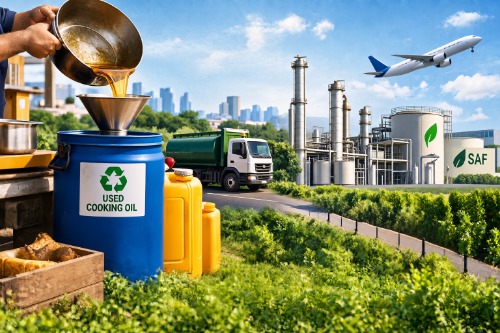
India could face a major feedstock-collection challenge as it prepares to scale sustainable aviation fuel (SAF), with nearly 94% of the country’s used cooking oil (UCO) estimated to remain outside formal collection systems.
India generates an estimated 1.8–2.6 million tonnes of UCO annually, while only around 110,000–156,000 tonnes, or approximately 6%, is formally collected, according to the source material. With the country consuming around 29–30 million tonnes of edible oil each year, the uncollected fraction represents a potentially significant domestic feedstock resource for SAF production.
The supply-chain gap comes as India prepares for increasing SAF deployment and the mandatory phase of the International Civil Aviation Organization’s (ICAO) Carbon Offsetting and Reduction Scheme for International Aviation (CORSIA) from 1 January 2027.
UCO collection emerges as SAF supply-chain priority
The Ministry of Civil Aviation has reviewed India’s preparedness for SAF adoption and CORSIA compliance, with the government’s approach focusing on production, supply-chain development, certification, traceability and carbon accounting, according to the source.
India has set indicative SAF blending targets for international flights of 1% in 2027, 2% in 2028 and 5% by 2030.
A 5% blend is estimated in the source material to require approximately 0.4–0.5 million tonnes of SAF annually. This places greater emphasis on securing sustainable feedstock supplies as production capacity develops.
UCO is one potential feedstock for the hydroprocessed esters and fatty acids (HEFA) pathway, but the current collection rate means a substantial portion of the country’s potential resource is not entering organised supply chains.
Rohit Kumar, Secretary General of the SAF Association and CMAI, said:
“India is not short of feedstock; the opportunity is to build systems that can responsibly collect, verify and bring these resources into the SAF value chain.”
Kumar added that feedstock mobilisation requires attention alongside technology, finance and offtake.
HEFA pathway offers potential emissions reductions
The source estimates that UCO-based HEFA SAF could deliver an 84% lifecycle emissions reduction compared with conventional jet fuel, based on ICAO lifecycle values.
At a 5% SAF blend by 2030, the source estimates that India could achieve a 4.2% lifecycle CO2 emissions reduction versus conventional jet fuel, assuming the SAF is produced through the UCO-based HEFA pathway.
These figures are dependent on the feedstock, production pathway and lifecycle methodology used and should therefore be treated as estimates rather than achieved emissions reductions.
The source also stresses that UCO alone will not be sufficient to meet India’s longer-term SAF requirements.
SAF feedstock strategy needs multiple sources
Potential alternatives identified in the source include crop residues, bagasse, municipal waste, waste fats and oils, sustainable oilseeds and power-to-liquid (PtL) pathways.
Agricultural-residue SAF could also provide an additional economic link to farming communities. The source estimates that such production could generate more than US$50 million for around 300,000 farmers, with support from initiatives including the Pradhan Mantri JI-VAN Yojana.
Diversifying feedstocks could reduce dependence on any single resource while creating different supply routes for SAF producers.
However, each feedstock presents different requirements for collection, logistics, sustainability verification, processing and certification.
SAF Association proposes UCO EPR framework
The SAF Association has proposed a Used Cooking Oil Extended Producer Responsibility (EPR) framework to relevant government stakeholders.
The proposed system would include mandatory collection targets, EPR certificates linked to verified recovery, registration of collectors and aggregators, digital traceability and recognition of the last-mile collection workforce.
The objective is to establish a traceable supply chain connecting UCO collection at the kitchen level with aggregators, refineries and certified SAF production.
Manish Marwaha, Founder and CEO of Byufuel, said:
“India’s SAF programme will depend not only on technology, but on building credible and traceable feedstock supply chains.”
Byufuel currently collects UCO from food businesses across more than 70 Indian cities and supplies it to refineries through certified supply chains supported by digital chain-of-custody systems, according to the source.
Formal UCO collection could extend beyond SAF
The source argues that formalising UCO collection could have applications beyond aviation fuel, including energy security, circular bioeconomy development, waste management and livelihood creation.
A policy assessment cited in the source estimates potential annual import savings of ₹20,000–30,000 crore, industry value creation of ₹10,000–20,000 crore and possible public-health savings of ₹50,000–80,000 crore.
These figures are policy-assessment estimates and require further techno-economic assessment, rather than representing established economic outcomes.
India SAF Conclave to focus on feedstock and supply chains
The feedstock challenge will be among the issues discussed at the 2nd India SAF Conclave & Awards 2026, scheduled for 28–29 September 2026 at Bharat Mandapam in New Delhi.
Held under the theme “Powering the SAF Transition Together,” the event is expected to bring together participants from more than 25 countries, including policymakers, airlines, SAF producers, refiners, technology providers, feedstock companies, investors and international institutions.
The agenda will cover feedstock, technology, sustainability, offtake, finance, CORSIA, certification and international partnerships.
Bioenergy Business Analysis
India’s SAF challenge is not limited to refinery capacity or fuel-blending targets. The UCO figures presented in the source point to a substantial gap between the amount of feedstock potentially available and the quantity entering formal, traceable collection systems. For SAF producers, closing that gap would require collection infrastructure, aggregation, quality control and chain-of-custody systems alongside investment in conversion capacity.
UCO will also need to form part of a broader feedstock strategy. Crop residues, municipal waste, waste fats and oils, sustainable oilseeds and PtL could provide additional pathways, but their commercial viability depends on different technical and supply-chain conditions. The proposed UCO EPR framework therefore highlights a central issue for India’s SAF transition: mobilising feedstock in a verifiable and sustainable way is as important to the emerging value chain as technology and offtake.
Read also: Sasol and White Desert launch commercial SAF partnership for Antarctica flights