


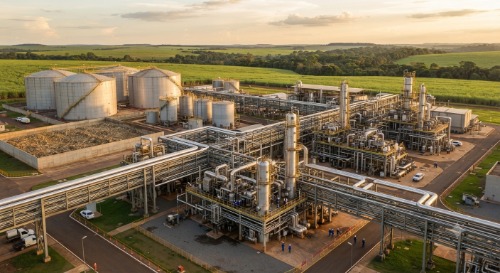
JetBio plans to develop a US$2 billion biofuels facility in Brazil that will convert ethanol into renewable diesel or sustainable aviation fuel (SAF), offering a potential new market for the country’s expanding ethanol industry.
The proposed plant, located in Paulínia in São Paulo state, will use technology licensed from Honeywell UOP to switch production between renewable diesel and SAF according to market demand and offtake agreements. Construction is expected to begin in 2027, with production targeted for 2030.
The facility was announced as a major SAF production project, but its planned dual-fuel output could provide greater commercial flexibility as demand for lower-carbon transport fuels develops. JetBio expects to make its final investment decision in March 2027.
Honeywell UOP Technology to Enable Flexible Fuel Production
The proposed facility will be designed to produce either 100% renewable diesel or 100% SAF, rather than maintaining a fixed production split between the two fuels.
This flexibility could allow JetBio to respond to differences in demand, pricing and buyer commitments across the aviation and diesel markets. Renewable diesel could also open additional outlets for ethanol if SAF demand or production economics prove less favourable than anticipated.
The project aims to use ethanol as the feedstock for renewable diesel production, a pathway that differs from conventional biodiesel production, which typically uses vegetable oils, animal fats and other lipid-based feedstocks.
Renewable diesel is a hydrocarbon fuel with properties similar to petroleum diesel and can be used in compatible existing diesel engines and equipment without the same blending requirements associated with conventional biodiesel. Its lifecycle emissions performance will depend on factors including feedstock production, processing energy and the carbon intensity of the manufacturing process.
Project Targets US$2 Billion Investment
JetBio is advancing financing arrangements for the proposed US$2 billion facility. The current plan is to fund approximately half of the investment through debt from Brazilian and international commercial banks and development lenders.
Brazil’s development bank, BNDES, has indicated potential financing of US$500 million, according to project details disclosed by the company. The remaining US$1 billion is expected to come from Summit Agricultural Group, JetBio’s controlling shareholder.
The project is also preparing for commercial negotiations with potential buyers of renewable diesel and SAF. JetBio plans to establish greater visibility on capital requirements, production costs and feedstock economics before finalising offtake agreements.
The company expects these agreements to form a key part of the project’s final investment decision process.
Ethanol Demand Could Reach 1.8 Billion Litres Annually
JetBio expects the facility to consume approximately 1.8 billion litres of ethanol annually, equivalent to around 476 million US gallons. This would make it a significant industrial buyer in Brazil’s ethanol market.
FS, a major Brazilian ethanol producer in which Summit Agricultural Group is the largest shareholder, is expected to source the required volume. Supplies will combine ethanol produced at FS’s own facilities with purchases from third-party producers.
Feedstock economics will be central to the project’s financial viability. Ethanol is expected to account for approximately 85% of JetBio’s total cost structure, making the price and carbon intensity of its supply particularly important.
The company has held preliminary discussions with Brazilian ethanol producers, with FS expected to take the lead in securing supplies.
The project could create an additional outlet for ethanol as production capacity expands, particularly if conventional fuel markets cannot absorb all the anticipated growth in supply.
Renewable Diesel Offers Access to Broader Markets
Renewable diesel could give JetBio access to a wider range of end users than SAF alone. Potential applications include heavy-duty road transport, shipping, mining, agriculture, power generation and heavy industry, where reducing emissions from existing equipment remains a challenge.
The company expects renewable diesel to cost more than conventional diesel in many market conditions, although production costs will depend on feedstock prices, process efficiency and the emissions profile of the finished fuel.
JetBio has indicated that lifecycle greenhouse-gas emissions reductions could reach at least 65%, with the potential to approach 95% depending on the ethanol feedstock and heat source used during production. These figures are company-stated expectations rather than independently verified performance results from an operating plant.
The ability to use a broader range of ethanol feedstocks may also improve production economics. SAF pathways often face more restrictive feedstock eligibility and sustainability requirements, while renewable diesel may offer greater sourcing flexibility under applicable certification systems and regulations.
Export Strategy Forms Part of Project Plans
JetBio expects to export approximately 80% of the facility’s output and is seeking approval under Brazil’s Export Processing Zone regime, which offers tax benefits to qualifying projects.
The export strategy would expose the plant to international demand for lower-carbon transport fuels, while the ability to switch between renewable diesel and SAF could help it respond to changing market conditions.
The project must still complete financing arrangements, secure feedstock supplies, establish commercially viable offtake terms and reach its final investment decision before construction proceeds.
If delivered as planned, the facility could establish a new industrial route for converting Brazilian ethanol into advanced transport fuels while connecting the country’s agricultural feedstock base with international diesel and aviation fuel markets.
Bioenergy Business Analysis
JetBio’s proposed facility represents a potential expansion of ethanol’s role beyond conventional blending into petrol and towards the production of hydrocarbon fuels for aviation and diesel applications. Its planned ability to switch between renewable diesel and SAF could reduce reliance on a single end market and provide a way to respond to differences in demand, fuel prices and offtake conditions.
The project’s economics will depend heavily on competitively priced ethanol, the carbon intensity of feedstock and processing energy, access to financing and long-term buyer commitments. The expected emissions reductions and production costs will need to be assessed against the eventual process design and verified lifecycle data. With a final investment decision targeted for March 2027 and production planned for 2030, the project remains in development rather than commercial operation. Its progress will be an important indicator of whether ethanol-to-hydrocarbon fuel technology can be deployed at scale in Brazil.