


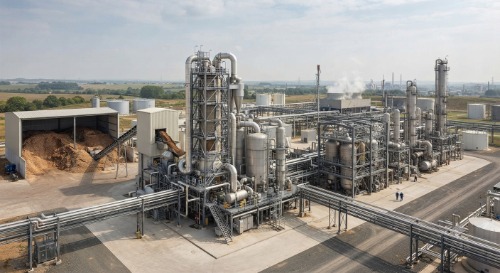
Chinese researchers have developed a cobalt-manganese catalyst for converting biomass-derived synthesis gas into sustainable aviation fuel (SAF), reporting promising results from a 1,000-tonne-per-year pilot plant and projecting a gross profit margin of nearly 55% for a proposed commercial-scale facility.
The research, led by scientists from the Chinese Academy of Sciences (CAS) Shanghai Advanced Research Institute, combines woody biomass-derived syngas with a catalyst designed to improve the production of jet-fuel-range hydrocarbons through Fischer–Tropsch synthesis. The findings were published in Nature Communications in September 2026, according to the supplied report.
A techno-economic assessment of a proposed 100,000-tonne-per-year plant estimated annual sales revenue of US$302 million, operating costs of approximately US$114 million and gross profit of US$165 million. These figures are projections rather than demonstrated commercial results, and the researchers identified biomass feedstock costs as a major factor affecting the project’s economic viability.
The team plans to build a facility using syngas derived from biomass gasification in Luzhou, Sichuan province, before 2028. If developed as planned, the project could provide a route to expanding biomass-based SAF production in China, although commercial performance will depend on feedstock availability, plant-scale operation and the ability to reproduce pilot results economically.
New catalyst targets a key limitation in biomass-based SAF production
The research addresses a technical challenge in converting synthesis gas into liquid hydrocarbons suitable for aviation fuel: improving conversion efficiency while maintaining selectivity towards the desired products.
Syngas, a mixture primarily of carbon monoxide and hydrogen, can be produced by gasifying biomass. It can then be converted into hydrocarbons through Fischer–Tropsch synthesis, a process used to produce liquid fuels from synthesis gas.
The researchers developed a cobalt-manganese catalyst intended to improve the performance of this conversion process. According to the reported findings, the catalyst achieved a carbon monoxide conversion rate of nearly 83% and selectivity towards jet-fuel-range hydrocarbons of more than 67%.
The team reported that the selectivity result exceeded the below-50% levels associated with many previously reported catalysts, suggesting progress in addressing the trade-off between reactant conversion and the formation of desired hydrocarbon products.
The research also outlines design principles intended to overcome selectivity limitations during syngas conversion. The team said the catalyst could potentially accommodate different real-world syngas feedstocks, extending its possible application beyond woody biomass.
However, performance across different feedstocks and operating conditions would need to be established for individual commercial applications.
Pilot testing supports plans for a larger SAF facility
The researchers progressed from kilogram-scale catalyst testing to a pilot trial with a reported capacity of 1,000 tonnes per year, completed in 2025, according to the supplied report.
The pilot results underpin the team’s proposal to construct a substantially larger facility in Luzhou, using syngas produced through biomass gasification. The planned plant would have an annual capacity of 100,000 tonnes, with construction targeted before 2028.
Moving from pilot testing to a facility of this scale would require validation of the integrated process, including reliable biomass supply, gasification performance, catalyst durability, fuel recovery and continuous plant operation.
The reported pilot capacity demonstrates progress beyond laboratory testing, but it does not establish that the proposed commercial plant has reached a final investment decision or secured all necessary financing, permits and feedstock agreements.
The figures are based on the researchers’ model and should not be interpreted as independently verified commercial returns.
There is also a discrepancy in the reported financial figures: sales revenue of US$302 million minus operating costs of US$114 million would leave US$188 million, rather than the stated gross profit of US$165 million. The reported profit of US$165 million is broadly consistent with a margin of nearly 55% of revenue, suggesting that additional cost items or different accounting assumptions may be involved. The supplied report does not explain the difference.
The researchers identified biomass as accounting for more than half of operating costs. This makes feedstock procurement a central consideration for the proposed plant, alongside gasification efficiency, catalyst performance, fuel yields and capital expenditure.
The projected margin therefore depends on the assumptions used in the techno-economic model. Actual profitability would need to be established through detailed project costs, financing arrangements, feedstock contracts and realised fuel prices.
Biomass-to-jet technology could diversify SAF production routes
The Fischer–Tropsch pathway converts syngas into hydrocarbons that can be refined into liquid fuels, including aviation fuel. Its ability to process syngas from different feedstocks offers potential flexibility for developers seeking alternatives to conventional petroleum-derived jet fuel.
For biomass-based production, the process begins with gasification, which converts organic material into a gas containing carbon monoxide and hydrogen. The gas is then processed through catalytic synthesis to produce hydrocarbons, followed by the necessary separation and upgrading steps.
The Chinese team’s work focuses on improving the catalytic stage, where product selectivity and conversion efficiency influence overall process performance. Its reported results could help inform the design of future biomass-to-liquid fuel facilities, although commercial-scale validation remains essential.
The researchers’ planned Luzhou project would be an important next step if it progresses from the proposed development stage to construction and sustained operation. Its performance would help establish whether the pilot results and projected economics can be maintained at a plant producing 100,000 tonnes of fuel annually.
Separate Chinese SAF project advances direct CO₂ hydrogenation
The biomass-to-jet research is part of a broader effort in China to develop alternative production routes for sustainable aviation fuel.
In a separate development reported in the supplied article, a 1,000-tonne SAF pilot facility developed by Sichuan Jinxiang Sairui Chemical and a research team from Tsinghua University passed a continuous-operation test in August 2026.
That project uses direct carbon dioxide hydrogenation rather than biomass-derived syngas as its principal carbon-conversion route. According to Tsinghua University, recycling tail gas and recovering hydrocarbons helped raise the reported overall carbon dioxide utilisation rate to 98%. The successful trial was presented as a step towards a proposed 10,000-tonne industrial demonstration unit.
The team also estimated that a 100,000-tonne-per-year facility could recover its initial investment in approximately 2.5 years under its assumed fuel-price conditions. This remains a separate project’s estimate and should not be treated as a validated payback period for the biomass-to-jet facility.
The two developments illustrate different approaches to expanding synthetic aviation fuel production: using biomass gasification to supply syngas, and converting carbon dioxide with hydrogen. Their commercial prospects will depend on different feedstock, energy, process and capital-cost requirements.
SAF production remains small relative to aviation fuel demand
Scaling up production remains a central challenge for aviation decarbonisation. The supplied report cites International Air Transport Association (IATA) estimates that SAF production could reach 2.4 million tonnes in 2026, equivalent to approximately 0.8% of global jet fuel consumption.
Although production technologies are advancing, the industry continues to face constraints associated with high production costs, feedstock availability and the capital required to build commercial facilities. These barriers make improvements in catalyst performance and conversion efficiency potentially important, but they do not remove the need for reliable supply chains and competitive project economics.
Biomass-based SAF also requires a lifecycle assessment that accounts for feedstock sourcing, processing energy, transport and conversion emissions. The environmental benefit cannot be determined from catalyst performance alone.
For the Chinese researchers’ proposed facility, the next key milestones will be commercial project development, validation of the financial assumptions and demonstration of sustained operation at the planned scale.
Bioenergy Business Analysis
The cobalt-manganese catalyst study is significant because it targets a technical bottleneck in the conversion of biomass-derived syngas into aviation-range hydrocarbons. The reported carbon monoxide conversion rate of 82.8% and jet-fuel-range selectivity of 67.5% indicate promising catalyst performance in the research team’s tests.
The projected gross profit margin is potentially notable, but it requires careful interpretation. The financial model is based on a planned plant rather than a commercial facility with a demonstrated operating history, and the reported revenue, operating costs and gross profit do not fully reconcile. The discrepancy should be clarified with the researchers or the underlying supplementary analysis before the financial claim is repeated as a verified result.
The key test is whether the catalyst’s pilot-scale performance and the proposed plant’s economic assumptions can be reproduced in sustained commercial operation. Until that evidence is available, the study should be treated as a promising technical development with an encouraging but unproven commercial case.