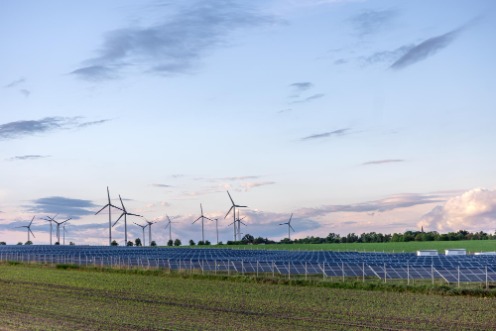
Juniper Green Energy Limited has reached approximately 2,745 MWp of operational renewable energy capacity, alongside 603 MWh of battery energy storage systems (BESS), following the full commissioning of a 150 MW wind-solar hybrid project in Gujarat.
The company completed the project under a power purchase agreement (PPA) with Gujarat Urja Vikas Nigam Limited (GUVNL) on 12 October 2026, after commissioning the final 5 MW wind turbine. Officials from the Gujarat Energy Development Agency and Paschim Gujarat Vij Company Limited witnessed the commissioning, while the formal certificate was expected to follow, according to the company’s regulatory disclosure.
The milestone expands Juniper Green Energy’s operational portfolio across solar, wind, hybrid renewable energy and battery storage assets.
Juniper Green Energy Completes 150 MW Wind-Solar Hybrid Project
The completed project adds 150 MW of wind-solar hybrid capacity under the GUVNL agreement. The final turbine commissioning marked the completion of the project, which had been progressing in stages.
The company’s reported aggregate operational capacity subsequently stood at approximately 2,745 MWp, supported by 603 MWh of operational battery storage. The capacity figures were stated in its exchange disclosure dated 12 October 2026.
The project reflects the continued conversion of renewable energy developments into operational assets under long-term power purchase agreements.
Subsidiary Adds Wind Capacity Under FDRE Project
Juniper Green Energy’s subsidiary, Juniper Green Stellar Private Limited, also commissioned 15.5 MW of wind capacity under its 200 MW firm and dispatchable renewable energy (FDRE) project, according to the source report.
FDRE projects combine renewable generation and, where required, storage or other balancing arrangements to deliver electricity against defined supply schedules. Such projects can help address the variability of solar and wind generation, although actual delivery performance depends on project configuration, resource availability and contractual requirements.
The commissioning adds to the company’s wind portfolio and supports its broader focus on hybrid and dispatchable renewable power.
Q1 FY27 Income Rises 79% to ₹324 Crore
Juniper Green Energy reported total income of ₹324 crore for the first quarter of FY27, an increase of 79% year-on-year. EBITDA rose 86% to ₹294 crore, while the EBITDA margin reached 91%.
The company also reported a 54% year-on-year increase in profit after tax to ₹33 crore. Its quarterly results, released in August 2026, highlighted the contribution of newly commissioned renewable capacity to its financial performance.
The figures provide a financial backdrop to the company’s ongoing expansion, although quarterly earnings and margins alone do not establish the profitability of individual projects or guarantee future performance.
Battery Storage Gains Importance in Renewable Power Deployment
The expansion of operational BESS capacity to 603 MWh highlights the growing role of storage in renewable power development.
Battery storage can shift electricity delivery across time periods, help manage short-term fluctuations and support grid balancing. When combined with wind and solar generation, storage can contribute to more flexible supply arrangements and help renewable developers meet the requirements of firm and dispatchable power contracts.
However, storage performance depends on factors including battery duration, charging availability, round-trip efficiency, degradation, operating strategy and project economics. The reported 603 MWh figure represents energy-storage capacity; it should not be interpreted as a 603 MW power output rating.
Bioenergy Business Analysis
Juniper Green Energy’s latest commissioning milestone illustrates a wider shift in India’s renewable energy market: developers are increasingly combining wind and solar generation with battery storage and dispatchable power contracts to address the limitations of variable renewable generation.
For the power sector, the key question is no longer only how much renewable capacity is installed, but also when electricity can be delivered and how reliably projects can meet contracted supply requirements. Battery storage and hybrid configurations can improve operational flexibility, but their commercial value depends on system design, utilisation, grid access and the cost of storage.
For Bioenergy Business readers, the project is relevant to the wider energy-transition landscape in which renewable electricity, storage, bioenergy and other low-carbon technologies may complement one another. It does not, however, represent a direct bioenergy development.
The next indicators to watch include formal commissioning documentation, further FDRE project additions, battery storage deployment and the company’s ability to convert its development pipeline into operational assets.