


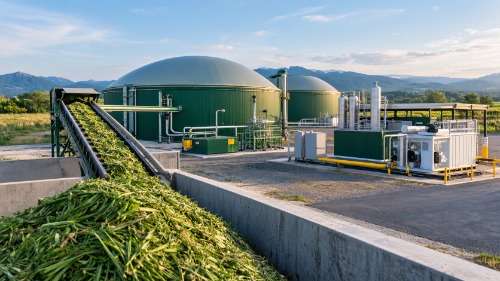
NetXeroC is advancing its first solid-waste-to-energy project based on Napier grass, with the proposed facility designed to produce approximately 6 tonnes per day (TPD) of compressed biogas (CBG) using biogas upgrading technology from Ivys Adsorption.
The project is intended to convert renewable biomass into upgraded biomethane for CBG applications. NetXeroC said the system is being designed to deliver more than 98% gas purity and high methane recovery, although the company announcement does not provide a specific methane-recovery percentage.
NetXeroC’s own website identifies Napier grass among the agricultural feedstocks it targets for conversion into biogas, upgraded biomethane and CBG.
Napier grass selected as CBG feedstock
Napier grass is a fast-growing perennial biomass feedstock that has attracted interest for biogas production because of its high biomass productivity. Research has also identified agricultural feedstock availability and characteristics as important factors determining the operational performance of CBG plants.
The NetXeroC project will use Napier grass as the primary feedstock, with the proposed output set at around 6 TPD of CBG.
The company’s announcement describes the facility as its first solid-waste-to-energy project, although Napier grass is more accurately characterised as an agricultural biomass feedstock rather than municipal solid waste. NetXeroC separately describes its CBG solid-waste-digestion offering as capable of processing agricultural and municipal organic waste. netxeroc.com
Ivys Adsorption technology to upgrade biogas
The project will incorporate biogas upgrading technology supplied by Ivys Adsorption.
The companies have previously announced a broader partnership covering biogas upgrading applications in India. Ivys Adsorption says its technology uses pressure swing adsorption (PSA) systems for separating and purifying biogas into renewable natural gas, while NetXeroC provides complementary treatment and project-engineering capabilities.
The companies have already identified applications across industrial wastewater, including a project at a recycled-paper facility in Uttar Pradesh designed to upgrade biogas into renewable natural gas. Ivys Adsorption said that system combines its rotary-valve PSA technology with NetXeroC’s Thiopaq biochemical hydrogen-sulphide removal system.
For the Napier grass project, NetXeroC’s announcement positions the technology as the upgrading stage between raw biogas production and CBG output.
Project targets 6 TPD CBG output
The proposed production capacity of approximately 6 TPD is equivalent to about 6,000 kg of CBG per day.
The project capacity is consistent with the scale of Napier-grass-based CBG configurations documented in the Indian market. A separate 2025 project report for a 6 TPD Napier grass CBG facility, for example, used a design basis involving 132 tonnes per day of Napier grass and estimated 6,000 kg/day of CBG. That report is not identified as being associated with NetXeroC and should therefore not be treated as the feedstock requirement for the NetXeroC project.
The actual feedstock requirement, biogas yield and CBG production of the NetXeroC facility will depend on its final process design and the characteristics of the supplied biomass.
Feedstock processing remains a key consideration
Napier grass is a lignocellulosic biomass, making feedstock preparation an important consideration in anaerobic digestion.
Industry discussions on CBG production from Napier grass have highlighted the need for appropriate pretreatment because lignocellulosic materials can be more difficult for anaerobic microorganisms to degrade than readily biodegradable substrates.
This makes the project’s engineering configuration, feedstock quality, digestion performance and gas-upgrading efficiency important factors in determining whether the proposed output can be achieved consistently.
NetXeroC says its agricultural-waste approach uses anaerobic digestion followed by gas purification for CBG production and is designed to accommodate feedstocks with varying characteristics.
NetXeroC expands focus on resource recovery
The Napier grass project fits within NetXeroC’s broader focus on resource recovery and renewable-energy engineering.
The company says it provides solutions spanning biogas, solar, hydrogen and wastewater recycling, with particular attention to sectors including pulp and paper, sugar and ethanol, food processing, pharmaceuticals and waste-to-energy.
Its partnership with Ivys Adsorption gives the company access to an international biogas-upgrading technology platform while allowing the equipment to be deployed within projects engineered for Indian operating conditions.