


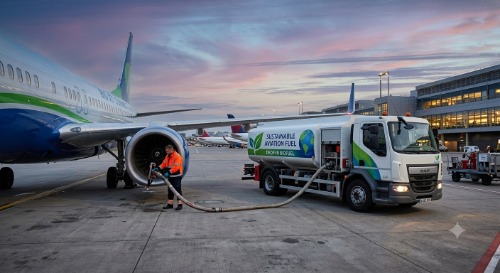
The Philippines is considering a 1% sustainable aviation fuel (SAF) blending mandate by 2030, with the Department of Energy (DOE) seeking to establish an initial domestic market that could encourage investment in local production capacity and improve long-term fuel supply resilience.
Energy Undersecretary Sandy Sales outlined the proposal on the sidelines of the ASEAN Energy Business Forum, saying the recommendation was being discussed through the National Biofuels Board. The proposed timeline would give prospective producers approximately three to four years to develop local supply before the blending requirement takes effect.
The initiative is intended to address a central challenge facing the emerging SAF industry: investors are reluctant to commit capital to production facilities without reliable demand, while airlines and fuel suppliers face high costs and limited availability of lower-carbon aviation fuel.
Philippines explores an initial SAF blending requirement
Sales said the recommendation under consideration was to introduce a 1% SAF sub-blend by 2030. The proposed target would establish an initial market for the fuel while giving domestic producers time to develop the infrastructure and supply chains required to meet demand.
The proposal remains under discussion, and the source material does not establish that the mandate has been formally approved or enacted.
According to Sales, a phased approach could help the Philippines avoid imposing a blending requirement before sufficient local supply becomes available. The three-to-four-year lead time is intended to give prospective investors greater clarity when assessing production projects, feedstock procurement and other infrastructure requirements.
Minimum blending requirements in the range of 1% to 2% have been used in other jurisdictions to stimulate early demand, Sales said. Such requirements can provide producers with a clearer market signal, potentially supporting investment as the industry develops.
However, the effectiveness of a mandate would depend on how the requirement is implemented, the availability of qualifying fuel and the costs passed through the aviation fuel supply chain.
High production costs remain a barrier to SAF investment
The cost of sustainable aviation fuel is a significant obstacle to establishing a domestic industry in the Philippines.
Sales estimated that SAF currently costs approximately three to four times as much as conventional fossil-based aviation fuel. He indicated that the government was initially considering a relatively small 1% blend rather than a more substantial substitution of conventional jet fuel.
Expanding production could help reduce costs over time, although the extent of any reduction remains uncertain. The economics will depend on production technology, feedstock prices, plant utilisation, logistics and the ability of producers to secure reliable offtake agreements.
The DOE has not yet established a firm estimate for the investment needed to develop domestic SAF production capacity.
Sales said the capital requirement would depend on several factors beyond the cost of constructing a processing facility, including the availability of suitable feedstocks, the location of production plants and the logistics required to transport raw materials.
These variables will be important in determining whether projects can produce SAF at commercially viable costs and supply aviation fuel buyers consistently.
Southeast Asia could play a larger role in SAF production
The Philippines’ proposal also reflects a wider opportunity for Southeast Asia to develop as both a consumer and producer of sustainable aviation fuel.
Sales said the region has potential demand for SAF alongside resources that could support production. However, advancing the market will require cooperation among Association of Southeast Asian Nations (ASEAN) members, including efforts to align policy approaches while recognising differences in national priorities.
Regional coordination could help strengthen supply chains, improve access to feedstocks and support the development of production capacity. The extent of these benefits would depend on how individual countries design their policies and whether producers can deliver fuel at competitive prices.
Sales also highlighted energy security as a consideration alongside the environmental and economic objectives associated with biofuels. He pointed to Indonesia and Malaysia, which already have established biofuel production, as neighbouring countries whose experience and supply capabilities could be relevant to regional cooperation.
For the Philippines, cooperation with regional producers could complement efforts to develop domestic SAF capacity. However, the proposal does not yet specify whether future demand would be met primarily through locally produced fuel, imports or a combination of both.
Policy design and feedstock supply will shape implementation
A blending mandate would establish a policy signal for the market, but it would not by itself resolve the practical challenges of producing and supplying SAF.
The availability and cost of suitable feedstocks will be central to project development. Plant location, transport infrastructure and the distance between raw-material sources and processing facilities could also influence project economics.
The government has yet to provide a domestic investment estimate, leaving prospective developers without a clear indication of the capital required to establish the industry at the scale needed to meet a future mandate.
Further details will also be important, including the proposed mandate’s regulatory framework, the fuels eligible for compliance, the mechanism for monitoring blending and the responsibilities of fuel suppliers. These elements have not been specified in the source material.
The proposed 2030 target therefore represents an early policy direction rather than a confirmed implementation framework. The next stage will be to translate the recommendation into clear rules and assess whether domestic and regional supply can meet the requirement at an acceptable cost.