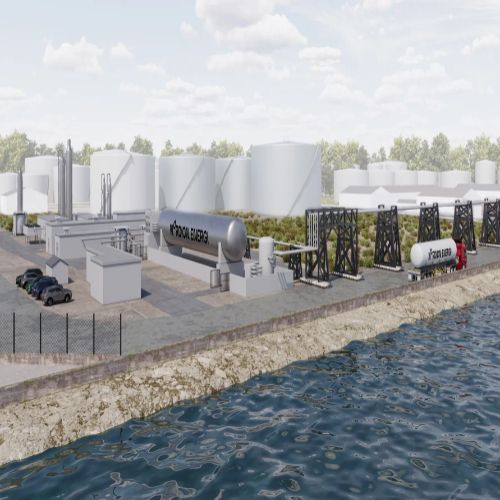
The Port of Gothenburg in Sweden has reached a new construction milestone in the development of a liquefied biogas (LBG) facility, following the installation of a 500-cubic-metre storage tank. The facility, being developed and owned by energy infrastructure company Nordion Energi, is scheduled for completion in the second quarter of 2027 and is expected to supply 250 gigawatt-hours (GWh) of LBG annually.
The project aims to expand access to Swedish-produced biogas for maritime transport, heavy-duty vehicles and industrial users. Once operational, the facility will enable biogas supplied through the western Swedish gas grid to be liquefied and distributed to customers, including shipping companies requiring renewable bunker fuels.
The storage tank weighs nearly 140 tonnes and can hold up to 200 tonnes of LBG. Its installation follows the completion of groundwork, including foundations and base slabs, marking the placement of the first major component of the liquefaction facility.
Nordion Energi advances LBG infrastructure at Port of Gothenburg
The 500-cubic-metre tank arrived at the Port of Gothenburg by ship and is the first of the facility’s major components to be installed.
Carolina Wistén, Head of Customers and Markets, Gas Grid, at Nordion Energi, said:
“This is an important milestone. The facility is now beginning to take shape, and we are moving closer to our goal of being able to deliver LBG from the gas grid to maritime transport, heavy-duty transport and industry.”
The facility will be Sweden’s first biogas liquefaction plant directly connected to the western Swedish gas grid. This connection is expected to provide an additional route to market for domestic biogas producers that are already connected to the network or are considering joining it.
By converting grid-supplied biogas into its liquefied form, the facility will enable the fuel to be stored and transported to customers beyond the immediate reach of the gas network.
LBG facility targets 250 GWh annual supply capacity
Upon completion, the liquefaction plant is expected to deliver 250 GWh of LBG annually. According to the Port of Gothenburg, this volume is equivalent to the annual fuel consumption of approximately 500 trucks or the bunkering requirements of 50 vessels.
The development is intended to strengthen the availability of renewable marine fuels as shipping companies explore alternatives to conventional fossil-based marine fuels.
Therese Jällbrink, Head of Renewable Energy at the Port of Gothenburg, said:
“The maritime sector’s transition requires a coordinated value chain. This facility strengthens the port’s position in renewable bunker fuels and makes it possible to offer LBG to the maritime sector on a larger scale. Now that we are seeing an increasing number of vessels being ordered for LBG-powered operations, we also see good opportunities for increased bunkering at the Port of Gothenburg.”
The project is designed to serve multiple markets, including maritime transport, heavy-duty road transport and industry. Its annual supply capacity could help improve access to liquefied biogas for users seeking alternatives to fossil fuels.
ST1 Biokraft secures part of future facility capacity
The project already has participation from companies operating within the Swedish biogas value chain.
ST1 Biokraft has previously signed an agreement to secure part of the future liquefaction facility’s capacity. Several shipping companies that regularly operate at the Port of Gothenburg are also already using LBG to power their vessels.
The involvement of existing biogas producers and fuel users provides a foundation for the facility’s planned supply chain. It is also expected to create additional market opportunities for Swedish biogas producers connected to the western Swedish gas grid.
Bioenergy Business Analysis
The Port of Gothenburg project highlights the importance of liquefaction and distribution infrastructure in expanding the market for biomethane-based marine fuels.
While biogas can be distributed through existing gas networks, converting it into liquefied biogas enables storage and transportation in a more energy-dense form. This is particularly relevant for shipping and heavy-duty transport, where fuel requirements and operational conditions can make direct electrification challenging.
The proposed 250 GWh annual supply capacity could strengthen the commercial connection between Swedish biogas producers and maritime fuel consumers. The agreement with ST1 Biokraft also indicates that prospective users are securing access to capacity ahead of the facility’s completion.
However, the project’s actual contribution to fossil fuel displacement will depend on commissioning, feedstock availability, renewable gas supply through the network and the extent to which shipping companies adopt LBG.
With completion targeted for the second quarter of 2027, the next important milestones will include the installation of remaining processing equipment, commissioning and the start of commercial LBG deliveries.