


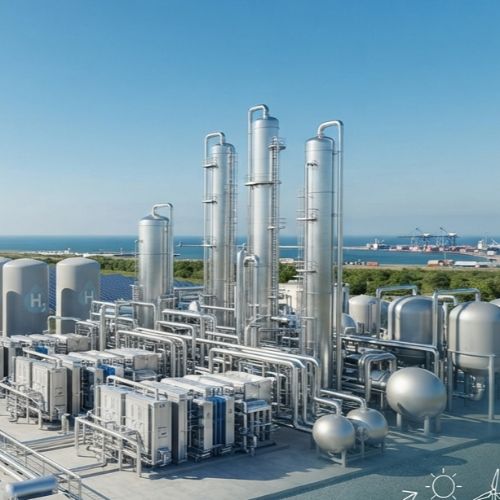
Sasol has commissioned Envision Energy to conduct a design study for a green hydrogen system at its Sasolburg operations in South Africa, assessing how renewable energy, battery storage and electrolyser technologies could support the production of lower-carbon fuels and chemicals.
The study will evaluate the technical and commercial feasibility of integrating these technologies to produce green hydrogen. Subject to the findings and future investment decisions, the hydrogen could be used to produce e-methanol and potentially sustainable aviation fuel (eSAF) at Sasolburg.
The design phase is expected to conclude later in 2026, providing information to help Sasol assess potential next steps. No final investment decision or production capacity was specified in the announcement.
Study to assess renewables, storage and electrolysers
The proposed system will combine renewable energy generation, battery energy storage systems and electrolysers. Envision Energy’s approach is designed to optimise hydrogen production according to forecast renewable energy availability and electricity pricing.
This integration is intended to help assess the conditions under which green hydrogen could be produced cost-effectively. The study will examine how the technologies could work together within Sasolburg’s existing industrial setting.
Green hydrogen is produced by using electricity to split water through electrolysis. When the electricity comes from renewable sources, the process can reduce emissions associated with hydrogen production compared with conventional fossil-based production, depending on the electricity supply and the wider lifecycle.
Potential applications include e-methanol and sustainable aviation fuel
Sasol is assessing whether green hydrogen could support the production of e-methanol and potentially eSAF at Sasolburg.
E-methanol can be produced by combining hydrogen with a source of carbon dioxide. Its overall emissions profile depends on the origin of the hydrogen and carbon, the energy used in production and the wider supply chain.
Sustainable aviation fuel can be produced through several pathways. The source announcement identifies eSAF as a potential application for the proposed hydrogen system but does not specify a production route, capacity or commissioning timeline.
Both options remain subject to the study’s findings and Sasol’s future investment decisions.
Sasol looks to build on existing industrial capabilities
Sasol Senior Vice President: Business Building Danie Cronje said the study would help assess how integrated renewable energy, storage and electrolyser technologies could support cost-competitive green hydrogen production.
He said the work would also examine how these technologies could contribute to lower-carbon fuel and chemical value chains while building on Sasol’s existing industrial capabilities.
For Sasol, the study represents an evaluation of how its industrial infrastructure could potentially support new energy and fuel pathways. The announcement does not confirm that the company has committed to constructing a green hydrogen production facility.
Envision Energy to apply integrated energy technologies
Envision Energy will bring together renewable energy, storage and hydrogen technologies as part of the design work.
Kane Xu, Senior Vice President and President of International Product Line at Envision Energy, said green hydrogen could help reshape hard-to-abate industries and create new opportunities for industrial development. He highlighted the company’s use of AI-powered energy infrastructure and integrated technologies across renewables, storage and green hydrogen.
The study also reflects ongoing engagement between South Africa and China on energy innovation, according to the announcement.
Bioenergy Business Analysis
The Sasol–Envision collaboration highlights how established industrial companies are evaluating green hydrogen as a potential input for lower-carbon fuels and chemicals. By examining renewable power, battery storage and electrolysers as an integrated system, the study will assess how energy availability and pricing could influence hydrogen production economics.
The potential link to e-methanol and eSAF is particularly relevant to the development of synthetic fuels. However, the project remains at the design-study stage. Its commercial significance will depend on the results expected later in 2026, the technical configuration selected, access to competitive renewable electricity and subsequent investment decisions. The announcement provides no confirmed production volumes, capital expenditure or construction schedule.