


South Korea has unveiled a 10-year Korea-Green Transformation (K-GX) strategy that will mobilise KRW 1,000 trillion (about US$747 billion) through 2035 to accelerate renewable-energy deployment, decarbonise heavy industry and develop new clean-energy industries.
The strategy, announced on October 7, combines government fiscal investment and climate finance with private-sector projects. The government plans to secure 100 GW of renewable-energy capacity by 2030, while targeting a more than 70% share for electric and hydrogen-powered vehicles in new vehicle sales by 2035.
The K-GX programme is positioned by the government as both a decarbonisation strategy and an industrial-growth programme, with investment directed towards clean-energy technologies, low-carbon manufacturing and domestic supply chains.
Government targets 100 GW of renewable capacity by 2030
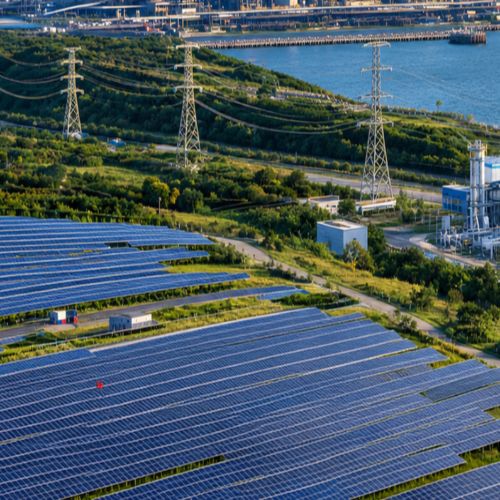
The K-GX strategy will support the expansion of solar and wind power alongside grid development to reach the 100 GW renewable-energy target by 2030. The government also intends to strengthen domestic supply chains for key clean-energy technologies.
The wider strategy includes support for green steel, batteries, solar power, wind energy, hydrogen and small modular reactors (SMRs). The government also plans to commercialise tandem solar-cell technology by 2028.
The renewable-energy expansion forms part of a broader effort to reduce reliance on carbon-intensive energy while creating industrial opportunities around clean technologies.
KRW 1,000 trillion government investment to support transition
Under K-GX, the government plans to deploy KRW 1,000 trillion over the 2026–2035 period through fiscal resources and climate finance. The strategy includes KRW 200 trillion in fiscal spending and more than KRW 790 trillion in climate finance, according to the Reuters report.
A further KRW 220 trillion in private-sector investment is planned through K-GX signature projects. South Korean government materials describe the initiative as a joint public-private strategy intended to mobilise investment while reducing uncertainty around the transition to lower-carbon production.
SK Group Chairman Chey Tae-won, who heads the private-sector consultative body supporting the initiative, said the strategy showed the government’s willingness to share investment risks with companies facing uncertainty around technology, markets and policy.
Five high-emitting industries targeted for decarbonisation
The strategy identifies five major emissions-intensive sectors for accelerated decarbonisation which includes steel, petrochemicals, refining, cement, and semiconductors and displays.
Sector-specific decarbonisation roadmaps are planned to guide the transition and support South Korea’s emissions targets through 2035.
For steel, the government aims to establish South Korea as a leading green-steel producer by supporting the development of hydrogen-reduced steelmaking and ultimately becoming the first country to mass-produce steel using hydrogen-reduction technology.
The strategy also links industrial decarbonisation with the development of new export-oriented technologies, including advanced batteries, carbon capture and SMRs.
Electric and hydrogen vehicles targeted at more than 70% of new sales
Transport electrification is another major component of K-GX.
The government is targeting electric and hydrogen-powered vehicles to account for more than 70% of new vehicle sales by 2035. The objective forms part of a wider push to electrify transport and reduce emissions from the country’s mobility sector.
The strategy also identifies electric vehicles and power semiconductors among the green industries that South Korea intends to develop as future growth sectors.
Clean-energy industries form part of wider industrial strategy
Beyond renewable power and transport, K-GX is designed to build domestic capabilities across a range of clean-energy and climate technologies.
The government has identified 10 green industries for focused development, including electric vehicles, batteries, solar, wind, hydrogen, SMRs and carbon-related technologies. The official strategy also includes measures for climate-tech companies and clean-energy supply chains.
The government said climate-finance-supported projects will be assessed according to their greenhouse-gas reduction impact. This links access to transition finance more closely with measurable emissions-reduction outcomes.
K-GX combines decarbonisation with industrial competitiveness
President Lee Jae Myung called for South Korea to move beyond following developments in other markets and establish a stronger role in shaping the global green economy.
The government has framed K-GX around three broad objectives: strengthening industrial competitiveness through technological innovation, ensuring that the transition benefits regions and workers, and creating a more predictable investment environment capable of mobilising private capital.
The strategy comes as South Korea faces pressure to address climate risks, energy-security concerns and increasingly stringent carbon-related requirements in international markets.
Bioenergy Business Analysis
The K-GX strategy gives South Korea’s energy transition a much broader industrial scope than renewable-power expansion alone. Its combination of renewable generation, hydrogen, green steel, electrified transport, carbon technologies and clean-energy manufacturing creates potential demand across several parts of the low-carbon value chain.
For the bioenergy sector, the most relevant opportunities are likely to emerge indirectly through the strategy’s emphasis on industrial decarbonisation, alternative fuels and hard-to-abate sectors. The government’s focus on hydrogen and low-carbon industrial processes could also influence competition and technology choices in sectors where bioenergy, hydrogen and electrification can serve overlapping decarbonisation roles.
The scale of the financing commitment is significant, but the headline KRW 1,000 trillion figure should not be interpreted as a single upfront government expenditure allocation. It represents the financing framework for the 2026–2035 strategy, incorporating fiscal resources and climate finance, alongside separate private-sector investment commitments.
The eventual impact will therefore depend on project execution, technology deployment, grid expansion, private capital mobilisation and the effectiveness of sector-specific decarbonisation roadmaps. For South Korea’s clean-energy industry, K-GX nevertheless establishes a long-term policy framework linking domestic industrial competitiveness with the expansion of low-carbon technologies.