


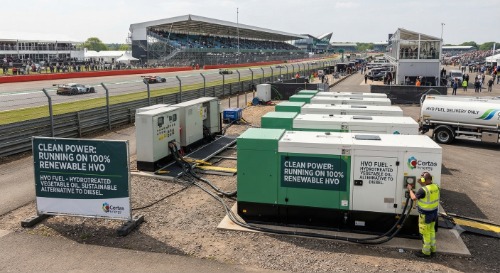
Silverstone is using at least 250,000 litres of hydrotreated vegetable oil (HVO) supplied by Certas Energy to power generators across the UK motorsport venue, with the switch from conventional diesel estimated to avoid around 645 tonnes of CO₂e.
The renewable fuel is being used for generators supporting mobile kitchens, lighting, live-music stages and other day-to-day operations at the circuit. The programme includes major events such as the Formula 1 Pirelli British Grand Prix.
HVO will also be used for generators during the Kwik Fit British Touring Car Championships on September 26–27 and the Motor Racing Legends event scheduled for October 17–18.
Third year of Silverstone’s HVO programme
The latest deployment marks the third consecutive year that Silverstone has used Certas Energy HVO as part of its renewable-fuel strategy.
Certas Energy supplied 350,000 litres of HVO in 2025 and 250,000 litres in 2024. Across the three years, Silverstone says the fuel switch has enabled estimated emissions savings of up to 1,549 tonnes of CO₂e.
The emissions reduction figures were calculated by Certas Energy using UK Government data to estimate the carbon savings associated with replacing standard diesel with HVO.
The source does not provide a breakdown of the emissions savings by individual event or by year beyond the latest estimate of approximately 645 tonnes of CO₂e.
HVO replaces diesel for temporary power
The fuel is being used in generators rather than directly as a vehicle fuel at the circuit. These generators provide power for a range of event-related activities, including temporary catering facilities, lighting and entertainment infrastructure.
HVO is a renewable diesel alternative that can be used in suitable diesel equipment, allowing organisations to replace conventional diesel without changing the underlying application where compatibility requirements are met.
At Silverstone, the fuel forms part of the venue’s broader ‘Shift to Zero’ initiative, which the circuit says contributes to Formula 1’s objective of reaching net zero by 2030.
Silverstone ESG Impact Manager Sophie Ellis said the venue was continuing its use of renewable fuels and described collaboration with suppliers as important to its emissions-reduction efforts.
Certas Energy continues renewable fuel supply
Certas Energy’s Energy Transition Manager Cathy Bailey said the company was supporting Silverstone’s transition for a third consecutive year, highlighting the use of HVO as an alternative to conventional diesel.
The latest supply extends a programme that has now covered three consecutive summers at the circuit.
The deployment demonstrates the use of renewable liquid fuels in applications where generators are required for temporary and operational power, including large sporting events.
UK HVO consumption reaches 408 million litres
The Silverstone programme comes as HVO consumption in the UK continues to grow.
According to the UK Department for Transport, HVO consumption reached 408 million litres during the first 10 months of 2025.
The figure provides broader context for the growing use of HVO in the UK, although the source does not specify how much of national consumption was associated with event power generation, construction, transport or other applications.
Bioenergy Business Analysis
Silverstone’s continued use of HVO shows how renewable liquid fuels can be deployed in existing diesel-generator applications without requiring the replacement of the temporary power infrastructure itself. For large venues, this can provide a practical pathway for reducing reliance on conventional diesel across events and routine operations.
The reported 645 tonnes of CO₂e savings for the latest programme should, however, be viewed as an estimate based on Certas Energy’s methodology and Government data rather than as an independently verified emissions measurement. The distinction is important when comparing emissions performance across renewable fuels.
The three-year programme also illustrates the role of recurring fuel supply arrangements in expanding HVO use beyond individual events. The wider UK consumption figure cited by the Department for Transport indicates that HVO is already being used at significant scale, although the supplied information does not establish how much of that demand comes from generators or event-related applications.