


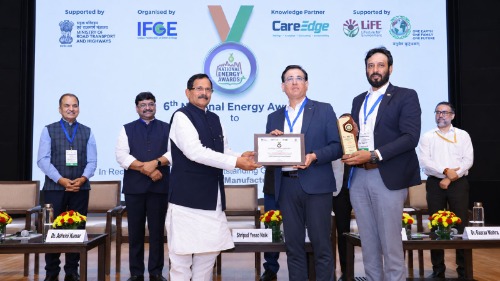
STEER World has received the India Green Energy Award 2026 in the Compressed Biogas (CBG) Equipment Manufacturer category, as the engineering company reports more than 130 processing lines under execution for its netiBIO biomass-processing technology, with over half already operational.
The award was presented to Nitin Gupta, Global CEO and Executive Director of STEER World, by Shripad Yesso Naik, Union Minister of State for Power and New & Renewable Energy, at a ceremony held at Atal Akshaya Urja Bhawan in New Delhi. The recognition was announced by the company on October 28.
Commenting on the award, Gupta said the recognition reflected the company’s efforts to address a fundamental operational challenge in India’s CBG sector.
“This recognition is particularly meaningful because it reflects the progress we have made in addressing a fundamental challenge in India’s CBG ecosystem. When we entered this sector, we recognised that processing agricultural residues efficiently required much more than conventional equipment. It demanded a deep understanding of the materials, their behaviour and the operating realities of CBG plants in India,” Gupta said.
STEER’s netiBIO technology focuses on processing fibrous agricultural residues before they enter anaerobic digesters at CBG plants. The company says its equipment is designed to address feedstock-handling challenges associated with materials such as paddy straw and Napier grass, which can affect plant operations when not adequately prepared.
The development highlights the role of biomass pretreatment in India’s expanding compressed biogas sector, where reliable feedstock handling is an important part of plant performance and operational continuity.
netiBIO Technology Targets Agricultural Residue Processing Challenges
Agricultural residues offer potential feedstock for compressed biogas production, but their physical and chemical properties can create challenges for equipment and digestion systems.
Materials such as paddy straw and Napier grass vary in fibre structure, moisture content, silica levels and abrasive characteristics. These differences can complicate size reduction and material handling, increasing equipment wear and affecting the consistency of feedstock supplied to digesters.
According to STEER World, inadequate pretreatment can contribute to blockages, lower conversion efficiency and reduced gas output. Processing equipment must therefore be designed around the characteristics of the feedstock as well as the operating requirements of individual plants.
The company’s proprietary netiBIO platform has been developed with a focus on biomass characteristics, equipment engineering and metallurgy. STEER says its approach draws on engineering development, field experience and collaboration with CBG project developers.
More Than 130 Processing Lines Under Execution
STEER World reports that more than 130 netiBIO processing lines are under execution, with over half already operational.
The company has not provided a detailed breakdown of the installations by location, customer, feedstock type or individual processing capacity. The reported figures therefore indicate the scale of its deployment programme but do not establish the aggregate throughput or production contribution of the installed equipment.
One example cited by STEER is a Napier grass processing line with a capacity exceeding 12 tonnes per hour. The company presents the installation as evidence of its ability to handle fibrous biomass at industrial scale.
Actual plant-level performance can vary according to feedstock quality, moisture content, equipment configuration, operating hours and maintenance requirements. Further data on availability, energy consumption, throughput consistency and downstream biogas production would help assess the technology’s operational performance.
Rural Installation and Commissioning Remain Operational Considerations
The deployment of biomass-processing equipment at CBG projects also involves practical challenges beyond equipment design.
STEER says its engineering and service teams have worked with project developers to address commissioning and operating requirements at rural sites, some of which are located far from established industrial infrastructure.
Site-specific factors can influence installation schedules, equipment servicing, spare-parts access and operating continuity. These considerations are relevant to CBG projects that depend on consistent feedstock processing to maintain digester operations.
The company’s experience in commissioning and supporting equipment across multiple sites may inform future deployment, although the announcement does not provide commissioning timelines, maintenance data or service-response figures for the processing lines.
India Green Energy Award Recognises CBG Equipment Development
The India Green Energy Award 2026 recognition places STEER World among the companies receiving industry recognition for work in compressed biogas equipment manufacturing.
Gupta said the recognition reflected the company’s efforts to address challenges in agricultural-residue processing. He also highlighted the engineering team’s work, field learning and collaboration with customers during the development and deployment of netiBIO.
STEER World operates across advanced materials technologies, precision engineering and manufacturing solutions. Its work in biomass processing represents an application of its engineering capabilities to the renewable gas sector.
Related: Vardhan Group signs EPC agreement for 10 TPD CBG plant in Gorakhpur


