


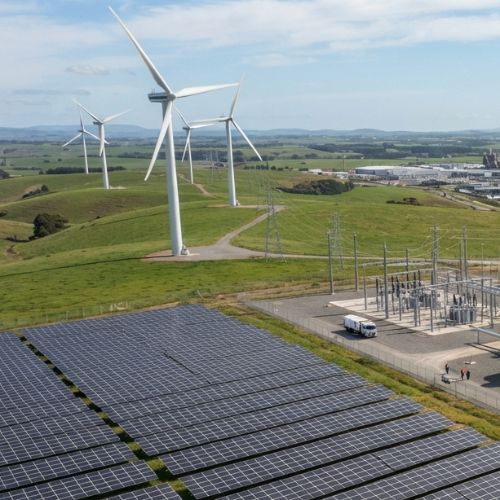
UltraTech Cement has commissioned new wind and waste heat recovery capacity, taking its installed green energy capacity for captive use to 2,024 MW and making it the first cement company in India to cross the 2 GW mark, according to the company.
The Aditya Birla Group company has commissioned 116.55 MW of wind capacity at its inter-state transmission system (ISTS)-connected wind-solar hybrid project in Barmer, Rajasthan.
It has also commissioned 10 MW of Waste Heat Recovery System (WHRS) capacity at Sarlanagar Cement Works, its integrated manufacturing unit in Karnataka.
With these additions, UltraTech’s cumulative installed green energy capacity has reached 2,024 MW. The portfolio comprises 1,580 MW of renewable energy capacity and 444 MW of WHRS capacity.
Green Energy Meets 48% of Power Requirements
UltraTech said its combined green energy capacity currently meets approximately 48% of its power requirements.
The company commissioned 430 MW of green energy capacity during FY26, continuing the expansion of renewable generation and waste heat recovery across its manufacturing operations.
The company said that, in FY27 so far, nearly one-third of its 76 manufacturing units in India have maintained green energy utilisation above 50% of their electricity requirements. Five units have recorded green energy utilisation of more than 95%.
The figures reflect the company’s strategy of increasing the contribution of renewable energy and recovered industrial heat to its electricity mix while reducing reliance on conventional power sources.
Wind, Solar, WHRS and Battery Storage Form Energy Strategy
UltraTech is combining several technologies as it expands its captive green energy portfolio.
Its renewable energy capacity includes projects based on wind and solar generation, while WHRS allows the company to recover energy from waste heat generated during industrial processes.
The company is also progressively integrating Battery Energy Storage Systems (BESS) across its operations. UltraTech said the storage systems are intended to increase renewable energy utilisation and improve supply reliability.
In 2025, the company operationalised what it described as India’s first on-site hybrid round-the-clock renewable energy project at its Sewagram Cement Works in Gujarat. The project combines solar, wind and battery storage.
UltraTech said it has also not invested in new captive thermal power capacity for more than a decade, either for greenfield projects or brownfield expansions at its integrated manufacturing units.
Cement Sector’s Energy Transition
Cement manufacturing is an energy-intensive industrial activity, making electricity sourcing an important component of the sector’s decarbonisation efforts.
UltraTech said its expansion of captive renewable generation and WHRS is helping reduce its dependence on conventional grid electricity and fossil fuel-based power, while limiting exposure to coal and electricity price volatility.
K C Jhanwar, Managing Director of UltraTech Cement, said crossing the 2 GW milestone was the result of a strategy pursued by the company over the past decade.
He said the company’s approach is intended to demonstrate that operational reliability and business growth can be maintained alongside a shift towards green energy.
“With nearly half of our power needs now met through green energy, we are significantly less exposed to fossil fuel supply constraints and power price volatility,” Jhanwar said.
He added that UltraTech is scaling up renewable energy, waste heat recovery and battery storage across its operations.
UltraTech Targets 85% Green Energy by 2030
The company aims to increase the share of green energy in its total power mix to 85% by 2030.
Separately, UltraTech, as a member of RE100, has committed to meeting 100% of its electricity requirement through renewable sources by 2050.
The company’s current portfolio therefore represents an intermediate milestone towards its longer-term renewable electricity targets.
Bioenergy Business Analysis
UltraTech’s 2,024 MW milestone illustrates how energy-intensive manufacturing companies are increasingly using a combination of renewable generation and waste heat recovery to reduce their dependence on conventional electricity. While the majority of the company’s green energy portfolio is renewable generation, the 444 MW of WHRS capacity is significant because it represents energy recovered from the company’s existing industrial processes rather than electricity generated from a separate fuel source.
The company’s continued deployment of BESS also points to a shift beyond simply adding renewable generation capacity. Storage can become particularly relevant when industrial facilities seek to increase renewable utilisation while maintaining reliable electricity supply. UltraTech’s stated 85% green energy target for 2030 and its 100% renewable electricity commitment by 2050 provide longer-term targets against which its current 48% contribution can be measured.
The company says it has avoided new captive thermal power investments for more than ten years and is instead expanding renewable energy, WHRS and storage. For the cement industry, where reliable energy supply remains essential to continuous manufacturing operations, this combination represents a pathway for increasing renewable electricity use without relying solely on intermittent generation.