


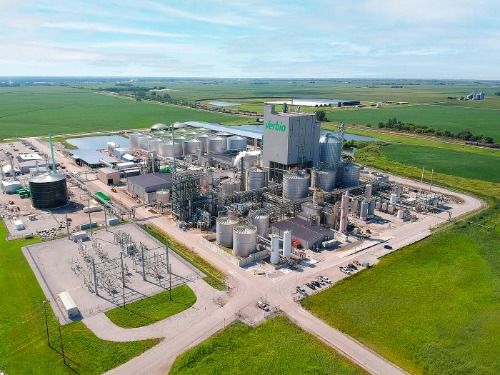
Verbio has commissioned a nearly €100 million industrial-scale plant in Bitterfeld, Germany, designed to produce up to 60,000 tonnes of bio-based chemicals annually from rapeseed methyl ester. The facility expands the company’s business beyond biofuels and targets fossil-derived raw materials used in lubricants, detergents, cleaning products and plastics.
Verbio has brought a new renewable chemicals production facility into operation at its Bitterfeld site in Saxony-Anhalt, marking its entry into large-scale manufacturing of bio-based speciality chemicals.
Commissioned on 6 October, the plant uses ethenolysis technology to convert rapeseed methyl ester (RME), a feedstock associated with biodiesel production, into chemical building blocks for industrial applications. Verbio says the facility is the world’s first large-scale ethenolysis plant based on rapeseed methyl ester and has the capacity to produce up to 60,000 tonnes of bio-based chemicals a year.
The investment is intended to add a higher-value use for a raw material that Verbio already produces, allowing it to serve chemical markets alongside its established biofuels business.
Verbio targets chemical markets with renewable carbon
The new facility will initially produce two chemical building blocks: 1-decene and methyl 9-decenoate, known as 9-DAME. Sold under the Verbio life chemicals brand, the products are intended to provide renewable alternatives to fossil-based inputs in existing chemical value chains.
1-decene is used in the manufacture of high-performance synthetic lubricants, while 9-DAME can be used in the production of detergents, cleaning products and other chemical intermediates. Both molecules can also serve as feedstocks for further chemical processing, including applications involving polymers and speciality materials.
The approach broadens the potential uses of rapeseed-derived material beyond fuel production. Rather than converting all of the site’s rapeseed methyl ester into biodiesel for energy use, Verbio can direct some of the material towards chemicals that retain the carbon in products.
Verbio chief executive Claus Sauter said the investment adds another stage to the company’s biorefinery value chain. He also pointed to the use of European rapeseed as a way to support regional agriculture and reduce exposure to disruption in global supply chains.
Ethenolysis brings olefin metathesis into industrial production
The process used at Bitterfeld is ethenolysis, a form of olefin metathesis. Specialised catalysts developed by Verbio subsidiary XiMo enable the conversion of carbon compounds in rapeseed methyl ester into molecules suited to chemical applications.
Olefin metathesis is associated with research recognised by the 2005 Nobel Prize in Chemistry, awarded to Yves Chauvin, Robert H. Grubbs and Richard R. Schrock. Schrock attended the commissioning and said it was significant to see the research put into industrial practice.
The Bitterfeld facility represents a move from technology development towards commercial-scale manufacturing. The investment also includes a catalyst-production component in Hungary, where XiMo is based.
Production to ramp up as customers qualify products
Although the plant has an annual capacity of up to 60,000 tonnes, Verbio expects production to increase in stages rather than immediately reaching that level.
Customers must qualify the chemical building blocks for their individual applications before they can be incorporated into specific formulations and products. The pace of the ramp-up will therefore depend partly on customer testing and the development of market demand.
Verbio says it has already received enquiries from prospective customers in Europe, North America, South America and Asia. These enquiries indicate international interest, but they do not by themselves establish the volume of confirmed orders or the speed at which the plant will reach full utilisation.
The company has said that the technology, feedstock base and production capacity could offer opportunities for further expansion if demand develops.
Investment adds jobs at Bitterfeld-Wolfen
The plant is located in the Bitterfeld-Wolfen Chemical Park, where Verbio has operated for 25 years. The company expects the project to create approximately 50 jobs, bringing its workforce at the site to around 130.
The investment received support through Germany’s Improvement of the Regional Economic Structure programme, a federal and state initiative that supports regional economic development, including environmentally friendly and innovative technologies.
The project also comes as Germany and other European countries seek to reduce the chemical industry’s dependence on fossil-based feedstocks while maintaining industrial production and employment. The sector faces pressure from high production costs and international competition, alongside the need to develop alternative sources of carbon for chemical manufacturing.
German Federal Minister for Research, Technology and Space Dorothee Bär described the facility as a signal of the potential for innovation in the German and European chemical industries. Michael Carus, senior adviser and shareholder of the nova-Institute, argued that scaling renewable-carbon technologies beyond pilot plants will be important to Europe’s industrial competitiveness.
Bioenergy Business Analysis
Verbio’s Bitterfeld investment illustrates how established biofuel infrastructure and feedstocks can be extended into the production of renewable chemicals. Using rapeseed methyl ester as a chemical input creates another potential outlet for the company’s existing raw-material base and positions it to participate in markets beyond transport fuels.
The commercial test will be whether customers qualify and adopt the new molecules at sufficient scale to support sustained plant utilisation. The announced capacity of up to 60,000 tonnes a year is a design figure, not evidence of current output or contracted sales. Gradual commissioning and customer qualification mean that actual production and demand will be important indicators to track.
The project also highlights a broader distinction in the bioeconomy of replacing fossil-derived carbon in chemical products is different from replacing fossil fuels in energy use. Its climate and resource benefits will depend on factors including the feedstock’s sustainability, processing inputs, product performance and the fossil-based materials displaced. The commissioning marks an important industrial milestone, but long-term market uptake and verified environmental performance will determine its wider significance.


