

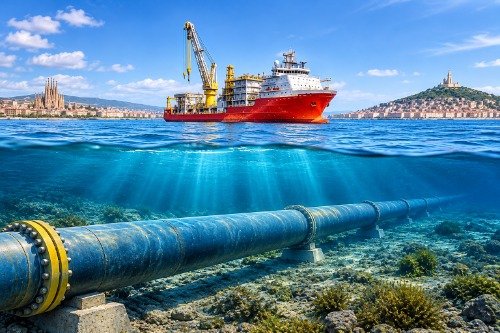
Engineering company Wood has been awarded a front-end engineering design (FEED) contract by the BarMar consortium for a planned subsea hydrogen pipeline connecting Spain and France. The approximately 380-kilometre offshore pipeline is designed to transport up to two million tonnes of green hydrogen annually and will form part of the wider H2med corridor.
The BarMar consortium comprises Spanish and French transmission system operators Enagás, NaTran and Teréga. The project is intended to connect hydrogen production hubs in the Iberian Peninsula with demand centres across Central Europe, supporting the development of a cross-border hydrogen transport network.
Wood’s FEED scope covers the offshore pipeline and associated compression facilities, both designed for 100% hydrogen service. The engineering work is expected to continue until April 2028, with around 50 Wood employees supporting the project through teams in Spain and the UK, alongside specialists from the company’s wider engineering network.
Wood to Deliver Engineering Design for Offshore Pipeline
The planned BarMar pipeline will run beneath the Mediterranean Sea between Barcelona in Spain and the Marseille area in France. It is expected to become a major subsea link dedicated to hydrogen transportation.
Wood will undertake engineering work covering subsea pipeline design, route engineering, microtunnelling and hydrogen infrastructure. Its scope also includes the associated compression facilities required for the planned pipeline system.
The infrastructure is being developed specifically for 100% hydrogen service rather than the transportation of natural gas. Its planned annual capacity of up to two million tonnes is intended to support the movement of hydrogen from production areas in the Iberian Peninsula to industrial and other demand centres elsewhere in Europe.
BarMar Forms Offshore Section of H2med
BarMar is the offshore component of H2med, a proposed hydrogen corridor connecting Portugal, Spain, France and wider European markets. The wider initiative is intended to facilitate cross-border hydrogen transport and support the development of an integrated European hydrogen market.
The corridor is expected to help connect renewable hydrogen production in the Iberian Peninsula with industrial demand in Central Europe, including sectors where emissions reductions can be difficult to achieve through direct electrification.
The project has been designated an EU Project of Common Interest, reflecting its role in the development of cross-border energy infrastructure.
Wood Builds on Previous BarMar Engineering Work
Wood has been involved in BarMar since its earlier development stages. Its previous work included pre-FEED engineering for the offshore pipeline and compression facilities, as well as technical support for offshore corridor reconnaissance activities.
Ellis Renforth, Regional President for UK & Europe at Wood, said: “BarMar is a pioneering project that requires specialist engineering to safely transport green hydrogen at scale beneath the Mediterranean.
“Our involvement since the early conceptual stages in 2022 gives us a detailed understanding of the project’s technical challenges as we prepare to successfully deliver the FEED phase. We bring that knowledge alongside decades of subsea pipeline experience and established relationships with the consortium partners.”
The FEED contract represents a further step in the engineering development of the proposed subsea connection. The work will establish the technical design needed to progress the project through subsequent development stages.
Bioenergy Business Analysis
The BarMar project is part of Europe’s broader effort to establish hydrogen transport infrastructure linking renewable hydrogen production regions with industrial demand centres. A dedicated subsea pipeline between Spain and France could provide an additional route for moving hydrogen across national borders and supporting the development of a European hydrogen market.
The planned capacity of up to two million tonnes annually makes BarMar a significant proposed component of the H2med network. However, this figure represents the pipeline’s intended transport capacity, not confirmed hydrogen production or contracted deliveries.
Wood’s appointment advances the project’s engineering work, but the FEED phase should not be confused with the start of construction or commercial operations. The pipeline’s eventual delivery will depend on the completion of engineering, investment and subsequent project-development decisions.