


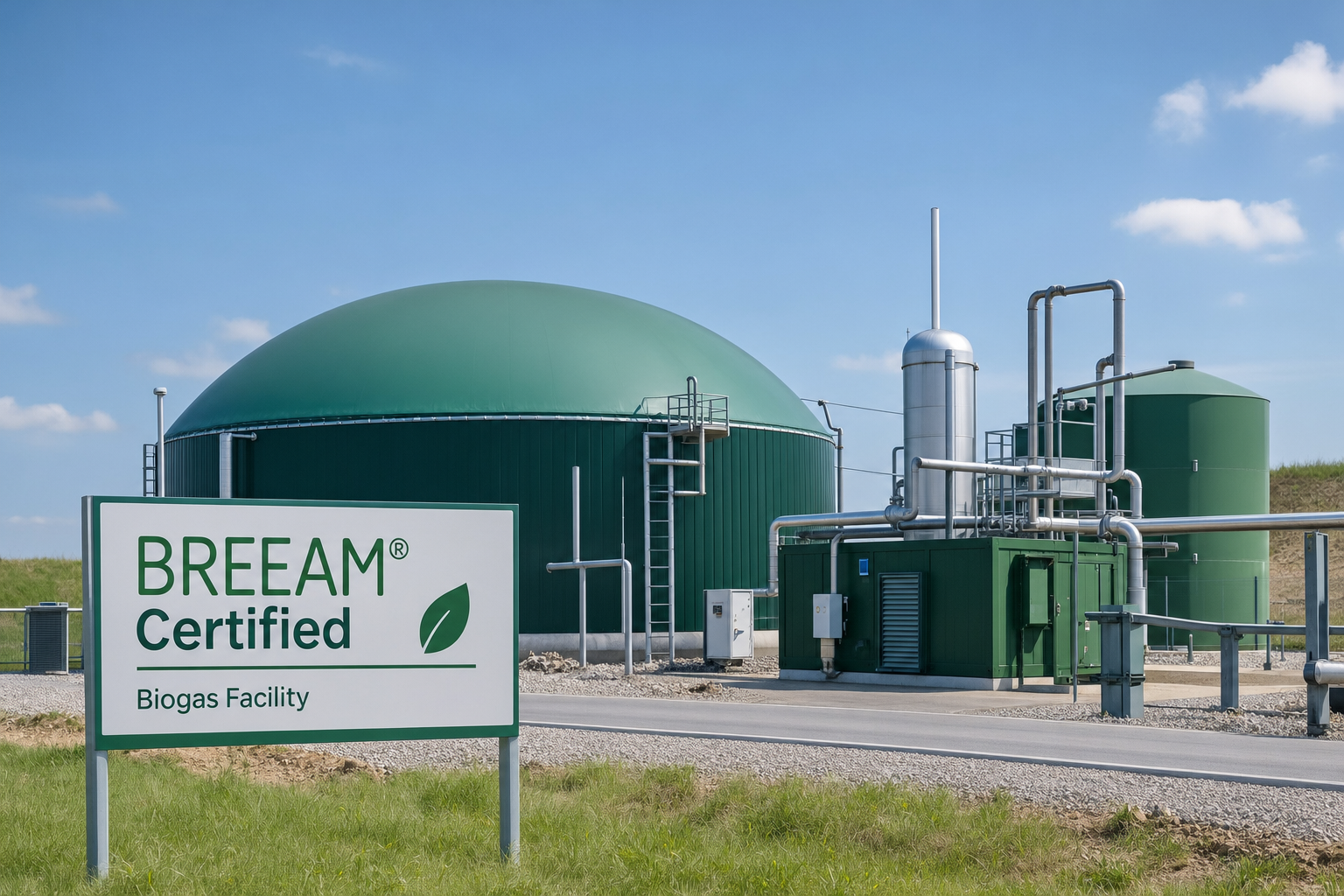
Norway’s waste-to-value leader BIR AS is successfully scaling operations at its new BREEAM-certified biogas plant in Voss, utilizing advanced Valmet DNAe automation to process 45,000 tonnes of regional waste into renewable biomethane.
Key Takeaways
High-Volume Processing: The facility treats 15,000 tonnes of municipal biowaste and 30,000 tonnes of cattle slurry annually.
Streamlined Operations: The complex is managed by just four control room operators using the industry’s first fully web-based, natively cyber-secure distributed control system (DCS).
Rapid Scale-Up: Following its official operational start in December 2025, the plant is now approaching planned production levels, targeting full capacity in 2027.
Closed-Loop Output: The site generates biomethane for regional transport alongside organic fertilizer to support local agriculture.
The Context
Located in the Bergen region, the facility demonstrates how technical engineering can align with strict BREEAM environmental standards for material reuse, sorting efficiency, and lifecycle impact. Suomen Biovoima served as the engineering, procurement, and construction (EPC) contractor, integrating multiple subsystems under a unified automation framework provided by Valmet.
To support local utilization, the city is establishing a dedicated fueling station for the biomethane. This infrastructure ensures that regional commercial vehicles will operate directly on fuel derived from local food waste and agricultural byproducts, creating a tangible circular economy model.
The Quotes
Speaking on the facility’s structural design and certification, Øyvind Birkeland, Plant Manager at BIR, stated, “BIR has now set a new standard for how biogas plants can be built.” Regarding system integration, Birkeland confirmed the platform’s value, “One clear advantage is the reliability of the data flow we are managing. It allows us to confidently use both the data provided by Valmet’s system and the inputs coming from the various subsystems.”
Discussing the site’s ramp-up to full capacity, Birkeland concluded that, “We are now approaching our planned production level, with full capacity expected in 2027. Valmet’s automation system plays an important role in supporting this progress. While some subsystems are operated through separate systems, further automation through the Valmet system would provide an even clearer overall picture of the process. This would support more efficient process management.”
Emphasizing the role of digital infrastructure, Tiina Stenvik, Director of Process Automation at Valmet, noted, “With our future-proven automation system, we provide reliable automation that drives digitalization, enables a data-driven user experience, and creates long-term value for both BIR and our EPC partner Suomen Biovoima.”
Commenting on the international collaboration, Eero Tilsala, CEO of Suomen Biovoima, remarked, “The trust we have received from the BIR shows that Finnish environmental technology expertise is of high quality.”
Reflecting on the deployment phase, Tero Kemppi, Project Manager at Suomen Biovoima, added “Valmet’s technological expertise has impressed us. Its modern automation system with web-based engineering tools and user interface allows for a great result from the start.”
Bioenergy Business Analysis
This project highlights a critical shift in bioenergy asset development, the reliance on unified, cyber-secure automation to manage complex, mixed-feedstock streams. By deploying a modern, web-based DCS, operators gain the real-time data transparency required not only to maintain continuous BREEAM certification, but to optimize process yields with minimal staffing. For industry investors and plant managers, the Voss facility serves as a blueprint for maximizing long-term profitability and operational reliability in Europe’s rapidly expanding biomethane sector.
Read also: Suzuki Motor Corporation expands cow dung-based biogas operations in India