


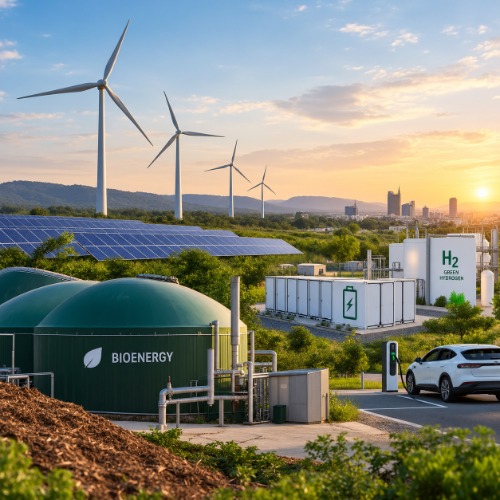
Karnataka is broadening its clean-energy investment strategy beyond large-scale solar and wind, with energy storage, green hydrogen, electric mobility, bioenergy and renewable-energy manufacturing identified as priority areas for the state’s next phase of development.
According to the reports from ETV Bharat, Energy Minister KJ George outlined the strategy at a Bengaluru roadshow for the Bharat Renewable Energy Summit and Expo 2026, where he also called on global investors and technology companies to establish partnerships in Karnataka.
“Our message to the industry is clear: come to Karnataka, invest in Karnataka, innovate in Karnataka and partner with Karnataka,” George said.
The minister said India had crossed 300 GW of installed electricity-generation capacity from non-fossil-fuel sources and was targeting 500 GW by 2030. Karnataka currently has nearly 27.3 GW of renewable-energy capacity, including more than 11.5 GW of solar and 8.5 GW of wind, according to figures presented by George.
Karnataka renewable energy strategy expands towards bioenergy
While solar and wind remain central to Karnataka’s renewable-energy base, the state is now looking to build a broader clean-energy ecosystem.
George identified battery energy storage, pumped-storage projects, solar-wind hybrid systems, green hydrogen, rooftop renewable energy, electric mobility, bioenergy, smart grids and renewable-energy manufacturing among the areas where Karnataka wants to attract investment and technology partnerships.
The shift reflects the operational challenges associated with increasing variable renewable generation. Solar and wind output changes with weather and time of day, increasing the importance of storage, grid management and forecasting as their contribution to electricity supply grows.
“We must move from simply adding renewable capacity to building a flexible, reliable and resilient clean-energy system,” George said.
The state also plans to expand green-energy corridors to support the integration of renewable electricity into the wider power grid. George said Karnataka was seeking commercially viable solutions in areas including storage, hydrogen, energy forecasting and grid management.
For the bioenergy sector, the inclusion of bioenergy within the state’s broader investment priorities is significant because it places biomass and other bioenergy technologies alongside emerging clean-energy infrastructure rather than treating renewable development as primarily a solar and wind expansion exercise.
Pavagada offers a model for community participation
George pointed to the Pavagada Solar Park as an example of large-scale renewable development involving local landowners.
According to the minister, nearly 10,000 acres were provided by local landowners for the project. A further 10,000 acres for renewable-energy development are reportedly nearing the final stage.
George said local residents had voluntarily offered additional land because communities could benefit economically from renewable-energy projects.
“The renewable-energy transition is no longer only an environmental necessity. It is also driving economic growth, industrial development, technological innovation, employment and energy security,” he said.
The comments underline the state government’s emphasis on linking renewable-energy deployment with local economic participation, particularly as Karnataka seeks to develop additional clean-energy infrastructure.
Storage and grid infrastructure become bigger priorities
Karnataka’s planned expansion comes as the power system accommodates growing volumes of variable renewable electricity.
Battery storage and pumped storage can help shift electricity availability across different periods, while hybrid renewable projects can combine generation sources with different operating profiles. Smart-grid technologies and forecasting systems can further support grid planning and balancing.
The state’s focus therefore extends beyond generating additional renewable electricity to infrastructure capable of integrating and managing that generation.
Green hydrogen is another part of the strategy, alongside electric mobility and clean-energy manufacturing. These areas could create additional demand for renewable electricity while expanding the industrial applications of Karnataka’s clean-energy resources.
Bharat Renewable Energy Summit set for november
The Bharat Renewable Energy Summit and Expo 2026 is scheduled to take place at Bharat Mandapam in New Delhi from November 2–5.
The event will include the ninth session of the International Solar Alliance Assembly and the fourth International Conference on Green Hydrogen. Governments, investors, financial institutions, technology providers, researchers, start-ups and industry representatives are expected to participate.
The Bengaluru roadshow was organised by the Union Ministry of New and Renewable Energy (MNRE) in collaboration with the International Solar Alliance as part of consultations ahead of the summit.
MNRE Secretary Santosh Kumar Sarangi attended the event alongside George, senior ministry officials, representatives of the Karnataka Renewable Energy Development Limited (KREDL), investors, industry representatives, technology providers and financial institutions.
Bioenergy Business Analysis
Karnataka’s approach signals a broader shift in renewable-energy planning: capacity additions are increasingly being considered alongside storage, grid infrastructure and technologies that can provide flexibility.
For bioenergy, the development is relevant because the state has explicitly included the sector within its next-stage clean-energy investment priorities. However, the announcement does not yet specify new bioenergy capacity, individual projects, investment commitments or financial incentives.
The immediate significance is therefore strategic rather than project-specific. Karnataka is positioning bioenergy as one component of a diversified clean-energy portfolio that also includes hydrogen, storage, electric mobility and renewable manufacturing.
For investors and technology suppliers, the next important indicators will be whether this strategy translates into defined projects, procurement programmes, investment commitments and policy measures. The upcoming Bharat Renewable Energy Summit could provide further detail on those opportunities.
Read also: Suzlon Secures 200 MW Wind Order from Ayana Renewable Power