


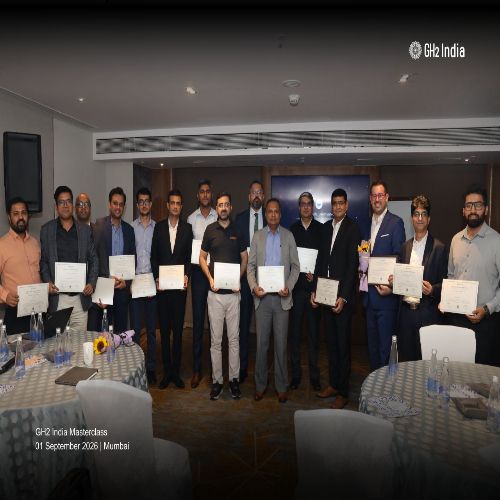
GH2 India hosted the Green Hydrogen Masterclass on September 2, 2026, featuring three analytical sessions focused on global hydrogen project development, Europe’s transition to industrial-scale deployment and the factors influencing projects to reach financial close.
During the first session, Mikaa Blugeon-Mered, Vice President, International Advisory Board, GH2 India, assessed the gap between global hydrogen ambition and delivery, comparing developments across China, Saudi Arabia, Europe and India.
Blugeon-Mered presented the NEOM Green Hydrogen Project as a significant first-of-a-kind project, supported by a 30-year offtake agreement with Air Products and financing from 23 institutions.
He also examined China’s progression from demonstration plants to replicable, integrated projects. According to him, pre-FEED and engineering readiness are important in enabling hydrogen projects to reach Final Investment Decision (FID).
Europe’s transition to industrial-scale hydrogen
Rajesh Mehta, Senior Consultant and India Representative, TNO, analysed Europe’s transition from research and pilot projects to industrial-scale deployment.
Mehta drew lessons from the Dutch innovation ecosystem and hydrogen valleys, while also highlighting opportunities for Indian manufacturers to participate in European technology and component supply chains.
The session also examined how Indian manufacturers could position themselves strategically alongside China’s manufacturing ecosystem.
Project bankability remains a key challenge
In the third session, Shrikant M Vaidyaa, former Chairman, Indian Oil Corporation Ltd, examined why many announced hydrogen projects do not progress to FID or financial close despite having the technical ability to produce hydrogen.
Using NEOM as a project-bankability case study, Vaidyaa analysed its integrated sponsors, non-recourse debt, long-term offtake structure and development timeline.
For India, he proposed a deliberate sequence for developing the hydrogen market. This would begin with refineries and fertilisers, where hydrogen demand already exists.
The next step would be to aggregate production and consumption through industrial hubs, followed subsequently by scaling into newer applications and selected export markets.
The three sessions at the Green Hydrogen Masterclass focused on the gap between hydrogen project announcements and actual project delivery, while examining technology readiness, manufacturing opportunities, project bankability and demand as key factors in scaling the sector.