


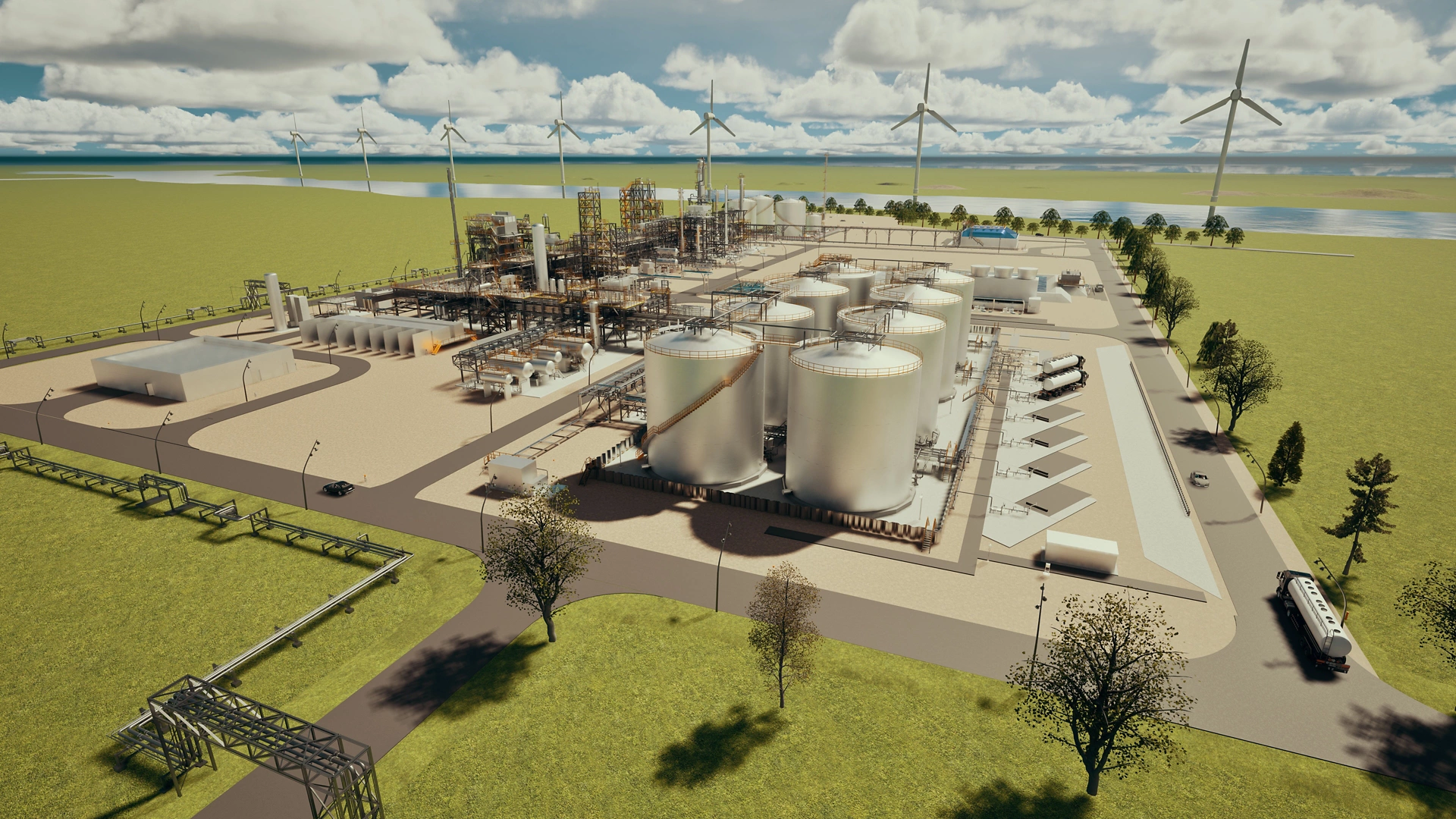
Emerson has secured a contract from Technip Energies to supply automation technologies for SkyNRG’s sustainable aviation fuel (SAF) facility under construction in Delfzijl, Netherlands, a project described as Europe’s first dedicated greenfield SAF production plant.
Emerson’s DeltaV integrated control and safety system (ICSS) will be deployed across the facility to support process control, safety functions and plant asset management. SkyNRG expects the plant to begin operations in 2028 with annual SAF production of approximately 100,000 tonnes.
The facility is being developed to produce SAF from residual fats and greases. The resulting fuel is designed as a drop-in aviation fuel that can be blended with conventional jet fuel without requiring changes to aircraft or existing fuelling infrastructure.
DeltaV system to integrate plant control and safety
Emerson will provide a combination of its DeltaV Distributed Control System and DeltaV Safety Instrumented System as part of the integrated automation architecture.
The system will cover process control, safety shutdown functions and fire and gas detection. Emerson will also deploy its AMS Device Manager plant asset management software to support commissioning and maintenance through device data, equipment health information and diagnostics.
The automation platform is intended to provide operators with real-time visibility across the facility and support stable plant operation.
As a greenfield development, the SAF plant is being designed with digital automation incorporated from the beginning rather than added to an existing facility. Emerson said this approach is intended to simplify project execution and reduce risks associated with the development of a first-of-a-kind plant.
SAF facility to use residual fats and greases
The Delfzijl project will use a hydroprocessed esters and fatty acids (HEFA) process to convert residual fats and greases into SAF.
The facility will also include an advanced feedstock pre-treatment unit and an on-site hydrogen plant. The hydrogen unit will use Technip Energies’ proprietary high-efficiency steam methane reforming technology.
These process units will be managed through the integrated control and safety system, with the automation architecture connecting the different modular components of the facility.
Emerson said the integrated approach is intended to support consistent operation while simplifying commissioning and providing flexibility during project execution.
Project linked to EU SAF requirements
The plant is expected to contribute to the Netherlands’ efforts to meet European Union requirements for SAF use in aviation.
The source states that the ReFuelEU Aviation Regulation requires jet fuel supplied at EU airports to contain at least 2% SAF from 2025, with the requirement increasing to 70% by 2050.
Against this regulatory backdrop, the planned Delfzijl facility is expected to add approximately 100,000 tonnes of annual SAF production capacity when fully operational in 2028.
The project is therefore being developed as part of a European market that is increasing the required share of sustainable aviation fuel in aviation fuel supplies.
Digital automation designed for long-term operations
Emerson will provide end-to-end project services alongside the automation systems. The company said modern project-management methods and digital technologies will be used to reduce engineering complexity and support plant operations.
The automation architecture will be integrated with a range of modular production units. Emerson’s DeltaV Electronic Marshalling with distributed CHARMs is also intended to reduce field wiring requirements and provide greater flexibility for late-stage design changes.
According to Emerson, the combination of process control, safety systems and asset-management software is designed to support the plant from commissioning through long-term operation.
Bart Rosendaal, site director of DSL-01 at SkyNRG, said the project represents a step in scaling SAF production and that collaboration with Technip Energies and Emerson would support the development of a safe and reliable facility.
Nathan Pettus, president of Emerson’s process systems and solutions business, said complex first-of-a-kind plants require early engineering coordination and an integrated automation architecture to support predictable project execution and long-term operational performance.
Bioenergy Business Analysis
The SkyNRG project combines SAF production, feedstock pre-treatment, hydrogen generation and digital automation within a new greenfield facility. Emerson’s role illustrates how automation is becoming an integral part of the design of new renewable-fuel plants, rather than simply an operational system added after construction.
For the Delfzijl facility, the ability to integrate multiple process units into a common control and safety architecture will be important as the project moves towards its planned 2028 operation. The disclosed automation scope also highlights the role of digital asset management and flexible field infrastructure in commissioning a complex SAF plant.
The project’s significance for the SAF sector will ultimately depend on successful construction, commissioning and sustained production at the stated scale. For now, the automation contract represents a further step in the development of a dedicated European SAF production facility designed around residual fats and greases.
The plant is expected to produce approximately 100,000 tonnes of SAF annually once fully operational in 2028.