


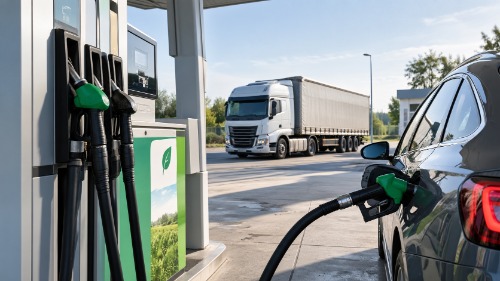
Germany’s waste-based fuel industry is calling for measures to accelerate the nationwide availability of B10 diesel, arguing that increasing the biodiesel content of conventional diesel could expand domestic renewable fuel use while reducing dependence on fossil diesel imports.
The Mittelstandsverband abfallbasierter Kraftstoffe (MVaK), the German Association of Waste-Based Fuel Manufacturers, has urged the federal government to make B10 more widely available at filling stations. The association says the higher blend could support greenhouse-gas reductions, energy security and domestic biodiesel production.
B10 can contain up to 10% biodiesel, compared with up to 7% in Germany’s established B7 diesel. Germany has permitted B10 for sale since the amended 10th Federal Immission Control Ordinance (10. BImSchV) entered into force in May 2024, but there is currently no general obligation for filling stations to offer it.
MVaK targets Germany’s B7-B10 transition
MVaK managing director Detlef Evers said wider B10 availability would provide an immediate way to increase the renewable component of diesel consumption.
“An increasing supply of B10 is a sensible climate, energy and economic policy measure,” Evers said. He argued that greater biodiesel use could reduce greenhouse-gas emissions from road transport while strengthening fuel supply security and domestic value creation.
The association’s position comes as Germany’s biodiesel industry seeks greater utilisation of domestic production capacity. MVaK has previously said Germany has around 4 million tonnes of annual biodiesel production capacity, including more than 1 million tonnes focused on waste and residue feedstocks.
MVaK also argues that higher biodiesel blending could reduce exposure to imported fossil diesel and provide an additional outlet for domestically produced renewable fuel.
B10 is permitted but remains limited at German filling stations
Germany’s regulatory framework allows filling stations to sell B10, but the fuel is not required to be offered nationwide.
Under Section 4 of the 10. BImSchV, a filling station that sells B10 containing more than 7% FAME must also offer B7 at the same location. The rule does not apply to stations with combined annual sales of B7, B10 and XTL below 500 cubic metres, or to non-public filling stations.
The association has proposed greater flexibility, arguing that B7 should remain available across the national filling-station network without necessarily requiring every station that sells B10 to stock both grades.
The German environment ministry’s current guidance confirms the purpose of the rule: B7 must remain available to ensure fuel supply for vehicles that are not approved for B10 or XTL.
Vehicle approvals remain another constraint
The expansion of B10 is also linked to vehicle compatibility. German authorities advise motorists to verify B10 compatibility with their vehicle manufacturer before using the fuel. Vehicles without demonstrated B10 compatibility should continue using B7.
MVaK has highlighted differences in manufacturer approvals as another factor limiting the potential customer base for B10.
Mercedes-Benz, for example, has approved B10 for relevant diesel vehicles, with current Mercedes-Benz documentation specifying B10 compatibility for vehicles equipped with certain common-rail diesel engines where the corresponding compatibility marking is present.
Volkswagen, by contrast, currently states that its vehicles are not approved for B10 diesel under DIN EN 16734, although many Volkswagen diesel models have approvals for XTL fuels such as HVO under specified conditions.
The result is a fragmented vehicle-compatibility landscape in which the potential market for B10 depends partly on the composition and age of the diesel fleet.
EU policy supports higher renewable content
The B10 debate is also linked to the implementation of the EU’s revised Renewable Energy Directive, known as RED III.
MVaK says the EU framework points towards increasing the maximum biobased component in conventional diesel from 7% to 10%. The association argues that harmonising higher biodiesel blends across European markets would improve the operating environment for renewable diesel and biodiesel producers.
Several European markets have already moved towards B10 or higher biodiesel blends, according to MVaK. France, Belgium and Portugal offer B10 or higher blends, while Italy, Sweden and Ireland have been preparing measures to increase biodiesel content.
Germany’s own amended 10. BImSchV was introduced partly to implement changes stemming from the revised EU fuel-quality framework. The federal government says the legislation enables B10, defined as conventional diesel containing up to 10% FAME, to be marketed in Germany.
Feedstock sustainability remains important
A higher B10 share would not automatically translate into the same level of climate benefit for every litre of fuel.
Germany’s Federal Ministry for the Environment, Climate Action, Nature Conservation and Nuclear Safety (BMUKN) specifically notes that the sustainability of B10 depends on the origin of its biodiesel component. FAME can be produced from feedstocks including rapeseed oil, soybean oil, corn oil and palm oil, while waste and residue feedstocks can also be used.
The ministry cautions that the B7 and B10 designations themselves say nothing about the sustainability of the underlying feedstock. It also notes that the share of FAME produced from wastes and residues remains relatively low.
This distinction is relevant to Germany’s policy debate because increasing the blend level without considering feedstock origin could produce different lifecycle emissions outcomes depending on the biodiesel used.
MVaK points to potential fuel-price benefits
MVaK has also presented B10 as a potential cost measure for motorists. The association said its calculations indicated that B10 could have been offered at up to €0.03 per litre below B7 during the first six months of 2026, based on the relative costs of the fuel components.
This is an industry association estimate rather than a government assessment or guaranteed retail price effect. MVaK has argued that greater biodiesel use could become increasingly relevant to fuel-price exposure if the cost of fossil-carbon emissions rises.
Germany has significant biodiesel capacity
The push for greater B10 availability comes against a backdrop of substantial domestic biodiesel manufacturing capacity.
MVaK says Germany has around 4 million tonnes of annual biodiesel production capacity and that more than 1 million tonnes of that capacity is focused on waste and residue feedstocks.
The association argues that increasing domestic consumption could help improve utilisation of this capacity rather than leaving producers dependent on exports or operating below potential.
The German Biodiesel Industry Association (VDB), MVaK and the European Waste-based & Advanced Biofuels Association (EWABA) jointly highlighted B10, B20, B30 and B100 at the September 2026 IAA Transportation event in Hannover, reflecting a broader industry push for higher biodiesel blends in road transport.
Policy decision now centres on fuel availability
The German government’s existing framework already permits B10, meaning the immediate policy question is less about technical authorisation and more about how the fuel is made available across the retail network.
Any change to the protected-grade requirement would need to balance wider B10 availability against the need to maintain access to compatible fuel for vehicles that cannot use the higher blend.
The BMUKN has confirmed that B7 must continue to be available for vehicles without B10 or XTL approval and that filling stations are not generally required to sell B10.
For the biodiesel industry, the outcome of that regulatory debate could determine how quickly B10 moves from being a permitted fuel to a more visible component of Germany’s mainstream diesel market.