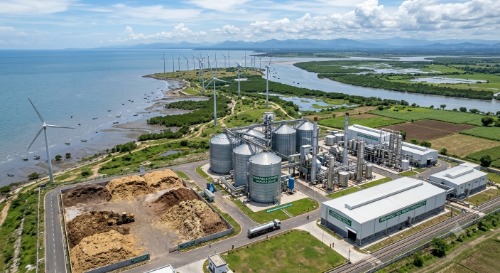
Nova Sustainable Fuels is planning a C$6 billion renewable energy project in Goldboro, Nova Scotia, designed to produce 165,000 tonnes of sustainable aviation fuel (SAF) annually using forestry residues and renewable electricity. The proposed Renewable Energy Park (REP) would combine biomass conversion, renewable hydrogen production and fuel synthesis to supply aviation markets, particularly in Europe, where regulations are increasing demand for lower-carbon fuels.
The project would be supported by a planned 1.1-gigawatt (GW) renewable electricity development in the District of Saint Mary’s, comprising approximately 800 megawatts (MW) of onshore wind and 300 MW of solar power. Nova Sustainable Fuels is backed by UK-based Octopus Energy Generation.
According to project director Andrew Parsons, Nova Scotia offers a combination of wind resources, solar potential, forestry biomass and coastal access that could support large-scale SAF production. The project remains in development, with a final investment decision targeted for late 2028 and commercial operations planned for late 2031.
Renewable Energy Park to Combine Forestry Biomass and Green Hydrogen
The proposed Goldboro facility would use woody biomass sourced from forestry operations in Nova Scotia as a feedstock for producing aviation fuel. Its process design combines biomass gasification with hydrogen production through electrolysis, using electricity generated by the associated wind and solar projects.
The project also envisages methanol production for potential use as a marine fuel, creating a possible market beyond aviation.
The proposed configuration combines biomass-derived carbon with renewable hydrogen. Its overall efficiency, fuel yields and carbon intensity will depend on the final technology design, feedstock composition, hydrogen requirements and process energy consumption.
European SAF Mandates Create a Potential Export Market
Nova is targeting European buyers, where the European Union’s ReFuelEU Aviation Regulation requires aviation fuel suppliers to increase the share of sustainable aviation fuels supplied at covered EU airports.
The regulation sets a minimum SAF share of 2% from 2025, rising to 6% in 2030 and 70% in 2050. It also introduces a dedicated requirement for synthetic aviation fuels, beginning in 2030.
These requirements provide a regulatory driver for SAF demand, although they do not guarantee that a particular producer will secure buyers or achieve its targeted selling price. Nova has not disclosed its expected SAF price or signed customer offtake agreements in the SustainableBiz Canada report.
The company expects its fuel to achieve a carbon intensity at least 85% below that of conventional fossil-derived jet fuel, according to project director Andrew Parsons. That figure remains a company projection; independent lifecycle assessment and confirmation that the fuel meets relevant EU sustainability criteria will be important for market access.
The commercial opportunity comes as SAF remains a small share of global aviation fuel use. The International Air Transport Association estimated that SAF production would reach 1.9 million tonnes in 2025, equivalent to approximately 0.6% of total jet fuel consumption. It also highlighted the substantial price premium over conventional jet fuel as a barrier to wider adoption.
Project Timeline and Environmental Approvals
Nova is targeting a final investment decision in late 2028, followed by an estimated three-year construction period and commercial operations in late 2031. These dates remain project targets rather than confirmed delivery milestones.
The provincial government approved the Renewable Energy Park’s first-phase environmental assessment with conditions on 18 December 2025. The separate wind, solar and transmission infrastructure will require its own environmental assessment and additional approvals.
The proposed renewable generation system would include approximately 130 wind turbines and a solar installation occupying around 1,500 acres, connected to the Goldboro fuel facility through a transmission line.
The company has also identified potential concerns relating to biomass transportation and water use. Parsons said the project design could be adjusted to mitigate these impacts. The scale of forestry residue deliveries, water requirements and associated infrastructure will be important considerations as the project progresses through permitting and engineering.
Nova’s project has also featured in materials associated with Canada’s investment promotion efforts. However, inclusion in an investment prospectus does not establish that financing has been secured or that a final investment decision has been taken.
Bioenergy Business Analysis
Nova Sustainable Fuels’ proposed Renewable Energy Park brings together three elements of the energy transition: forestry-residue utilisation, renewable hydrogen production and synthetic fuel manufacturing. Its potential significance lies in integrating these processes at a single site and linking them to renewable electricity generation designed specifically to support fuel production.
The project depends on securing sufficient forestry residues at a commercially viable delivered cost. Although Nova Scotia has an established forestry sector, the availability of suitable biomass cannot be assessed from the project’s headline capacity alone. Competing uses, collection logistics, moisture content, transport distances and sustainability requirements will all influence the amount of feedstock available.
Overall, Nova’s proposed C$6 billion investment represents an ambitious attempt to connect regional forestry resources and renewable electricity with Europe’s emerging SAF market. Its significance will ultimately depend on whether the company can secure financing, demonstrate the technical and environmental performance of its production pathway, obtain the required approvals and establish credible long-term fuel offtake arrangements.
Related coverage: Aeon Blue and Eskasoni First Nation’s seawater-to-SAF pilot in Nova Scotia concerns a separate proposed project and a different fuel-production route.