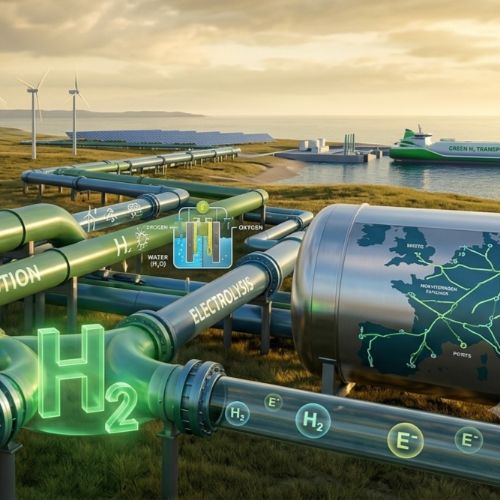
German energy supplier EWE AG and Austrian utility Verbund AG are planning a joint green hydrogen project in northern Germany, with an electrolyser capacity of up to 500 MW and expected annual production of around 50,000 tonnes from renewable electricity.
The CHC Elektrolyse JadeWeser project is planned for Nordenham, in the Wesermarsch region of Lower Saxony. The partners expect the facility to begin supplying hydrogen to industrial, mobility and energy-sector customers from 2032.
The companies have secured sites for the development and previously received European Commission approval to establish their green hydrogen joint venture. The project is intended to support the development of Germany’s hydrogen infrastructure and contribute to the wider European hydrogen market.
Nordenham site offers access to hydrogen infrastructure
The partners selected Nordenham because of its proximity to a high-capacity electricity grid connection, Germany’s planned hydrogen core network and underground cavern storage infrastructure.
These connections are expected to support the development and operation of a large-scale electrolyser, which uses electricity to split water into hydrogen and oxygen. When powered by qualifying renewable electricity, the process can produce renewable hydrogen with lower lifecycle greenhouse gas emissions than conventional hydrogen production routes.
The location also offers potential for future expansion into the gigawatt range, according to the companies. However, the partners have not announced a specific timeline or final capacity for any expansion beyond the planned 500 MW project.
Access to electricity infrastructure will be particularly important for a project of this scale, as electrolyser operations require substantial power supplies. Connections to hydrogen transport and storage infrastructure could also help the facility deliver hydrogen to customers as demand develops.
Project targets 50,000 tonnes of hydrogen annually
CHC Elektrolyse JadeWeser is designed to produce around 50,000 tonnes of green hydrogen per year at an electrolyser capacity of up to 500 MW.
The partners expect supplies to begin in 2032, with industrial users, mobility applications and the energy sector identified as target markets. The companies have not disclosed specific offtake agreements, customer commitments or a detailed construction schedule in the information available.
Green hydrogen is being developed as an alternative to fossil-derived hydrogen in applications where direct electrification may be difficult or where hydrogen can serve as an industrial feedstock. Potential uses include industrial processes, selected transport applications and energy-system balancing, depending on cost, infrastructure and the availability of suitable alternatives.
The project’s eventual contribution to decarbonisation will depend on the renewable electricity used, the emissions associated with construction and operation, and the extent to which hydrogen replaces higher-emission fuels or feedstocks.
European Commission approval clears joint venture step
EWE and Verbund have already secured European Commission approval for their proposed green hydrogen joint venture.
The partners said the project is intended to help establish a European hydrogen economy by combining domestic renewable energy resources with the infrastructure needed to produce, transport and store hydrogen.
Developing large-scale electrolyser capacity is one part of the broader challenge facing Europe’s hydrogen market. Production facilities also need reliable electricity supplies, transport infrastructure, storage capacity and customers willing to purchase hydrogen at commercially viable prices.
The Nordenham project’s proximity to Germany’s planned hydrogen core network and cavern storage infrastructure could help address some of these logistical requirements as the wider network develops.
Regulatory conditions remain important for market growth
EWE has highlighted the need for further regulatory adjustments to support the successful expansion of the hydrogen market. The company has pointed in particular to European Union requirements for renewable fuels of non-biological origin (RFNBOs) and the importance of strong industry partnerships.
RFNBO rules establish criteria for qualifying renewable fuels produced from non-biological sources, including renewable hydrogen. Requirements governing renewable electricity sourcing and emissions accounting can influence project design, operating arrangements and the costs of producing compliant hydrogen.
For large-scale projects, regulatory clarity can affect investment decisions and the ability to secure long-term supply agreements. Developers must also contend with the cost of renewable electricity, electrolyser equipment, infrastructure and competition from established fossil-based hydrogen production.
The partners have not provided a detailed assessment of how regulatory changes would affect the CHC Elektrolyse JadeWeser project or its final production costs.
EWE and Verbund develop broader hydrogen portfolios
The proposed 500 MW facility adds to the partners’ wider hydrogen activities. Together, EWE and Verbund have around 400 MW of hydrogen projects in development or operation, according to the source report.
The planned JadeWeser project would therefore represent a substantial addition to their combined hydrogen development pipeline if it reaches the announced capacity.
Its expected 2032 start-up also places the project within a longer-term market development period, during which Germany’s hydrogen transport network, storage infrastructure, renewable electricity supply and industrial demand are expected to play important roles in determining the pace of deployment.
Bioenergy Business Analysis
The CHC Elektrolyse JadeWeser project highlights the scale of investment and infrastructure coordination required to develop a European renewable hydrogen market. A planned 500 MW electrolyser, with annual output of around 50,000 tonnes, could supply multiple sectors, but the project’s commercial significance will depend on whether production can be matched with competitively priced renewable electricity, compliant hydrogen certification and dependable offtake demand.
Nordenham’s access to a high-capacity grid connection, planned hydrogen network and cavern storage infrastructure could provide advantages as Germany develops its hydrogen system. However, the expected 2032 supply date leaves several years for project development, construction and market conditions to evolve. Regulatory requirements for RFNBOs will also influence how the project sources electricity and demonstrates compliance.