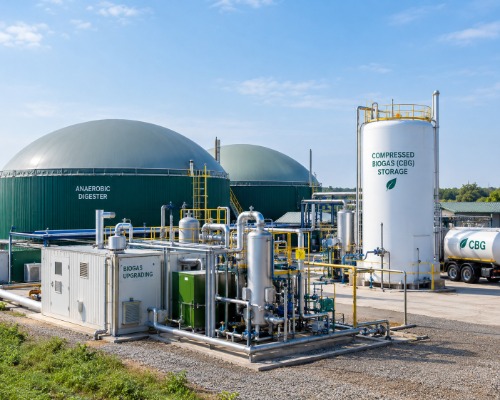
Petronet LNG Limited and Gruner Renewable Energy Private Limited have formed a 50:50 joint venture (JV) to develop compressed biogas (CBG) plants across India. Joint venture aims to develop 10 compressed biogas (CBG) plants in India at an estimated total capital cost of ₹1,200 crore, marking a major step in its diversification into domestically produced renewable gas.
Under the proposed arrangement, each plant is expected to have a production capacity of 18 tonnes per day, giving the portfolio a combined capacity of 180 tonnes per day once all facilities are operational. The companies signed a binding term sheet on 22 October 2026, but plant locations and commissioning schedules have not yet been announced.
The investment would give Petronet a foothold in the CBG market alongside its established liquefied natural gas (LNG) import and regasification business. It also comes as disruptions to international gas supply routes and volatility in LNG prices highlight the risks faced by import-dependent energy markets.
The proposed capacity represents an expansion opportunity rather than current production. Actual output will depend on project execution, feedstock availability, plant commissioning and operating performance.
LNG supply disruptions strengthen focus on domestic gas alternatives
Petronet’s proposed CBG investment comes amid challenges in its core LNG business. According to BioEnergy Times, throughput at its Dahej LNG terminal fell to 192 trillion British thermal units (TBtu) in the April–June 2026 quarter, compared with 207 TBtu in the corresponding period a year earlier.
The report attributes the decline partly to disruptions affecting Qatari gas supplies amid restrictions around the Strait of Hormuz. Rising spot LNG prices during the period also underscored the exposure of imported gas to geopolitical developments and international market fluctuations.
CBG offers a different supply model. Produced by processing organic materials such as agricultural residues, animal manure and biodegradable waste, biogas can be upgraded to remove impurities and increase its methane concentration. The resulting gas can be compressed for use as a transport fuel or, where specifications and infrastructure permit, supplied to gas networks.
Unlike imported LNG, domestic CBG production relies on locally available feedstocks and processing infrastructure. However, its contribution to energy security will depend on how consistently projects can source suitable waste, maintain production and deliver gas to customers.
Ten plants planned with 180 tonnes per day of CBG capacity
The proposed joint venture would establish 10 plants, each designed to produce 18 tonnes of CBG daily.
Based on 350 operating days annually, the combined portfolio could produce approximately 63,000 tonnes of CBG per year at full capacity.
The proposed annual output is modest relative to India’s LNG import requirements, but it could provide Petronet with an additional domestic gas business and exposure to the expanding renewable gas market.
The companies have not disclosed the individual project locations, construction schedules or expected commissioning dates in the term sheet. These details will be important for assessing the pace at which the proposed capacity could become operational.
CBG adds to Petronet’s broader expansion plans
The proposed biogas venture forms part of a wider investment landscape for Petronet, whose existing business centres on LNG imports, regasification and associated gas infrastructure.
The BioEnergy Times report also cites a ₹20,685 crore integrated petrochemical complex at Dahej and a ₹6,355 crore LNG terminal project at Gopalpur. The Gopalpur development is expected to increase Petronet’s regasification capacity to 32.5 million tonnes per year, according to the report.
These investments serve different purposes. LNG infrastructure expands the ability to receive and process imported gas, while CBG facilities would develop a domestic renewable gas supply chain. The proposed joint venture would therefore diversify Petronet’s activities without replacing the scale or role of its established LNG business.
Government blending obligations could support CBG demand
India’s compressed biogas market also has a policy-driven demand opportunity. The government’s CBG obligation trajectory specifies that blending obligations for city gas distribution companies are set to rise from 3% in financial year 2026–27 to 5% from FY2028–29, covering compressed natural gas used in transport and piped natural gas supplied to households.
Such requirements could create additional demand for CBG and support the development of domestic production capacity. However, the commercial impact on the proposed Petronet–Gruner venture will depend on applicable compliance rules, procurement arrangements, pricing and the availability of suitable buyers.
On the supply side, securing consistent quantities of agricultural residues, manure and other organic waste will be essential. Feedstock collection, seasonal availability, transport costs and competing uses of agricultural materials can all affect plant economics.
The project’s success will depend not only on building 10 facilities but also on maintaining reliable operations and establishing efficient feedstock and gas offtake arrangements.
Bioenergy Business Analysis
Petronet LNG’s proposed ₹1,200 crore CBG joint venture signals an effort to broaden its gas portfolio beyond imported LNG and into domestic renewable gas production. The partnership combines Petronet’s position in the gas market with Gruner Renewable Energy’s role in the planned CBG platform, although the project’s execution details remain to be established.
The 180-tonne-per-day target could provide a foundation for future expansion if the initial plants demonstrate reliable output and commercially viable operations. Yet the proposed capacity should not be confused with immediately available gas supply: the plants still need to be developed, commissioned and supplied with consistent feedstock.
India’s CBG blending obligations may strengthen the demand outlook, while geopolitical volatility reinforces the strategic value of diversifying gas sources. Even so, domestic CBG cannot be viewed as a direct substitute for LNG at the scale of national gas demand. Its more immediate contribution is likely to be incremental supply, waste utilisation and diversification of energy-sector revenues.
The next developments to watch are the announcement of plant locations, project-level investment and commissioning schedules, feedstock procurement arrangements and confirmed gas offtake agreements. These will determine whether the proposed venture can translate its planned capacity into a dependable domestic renewable gas business.