


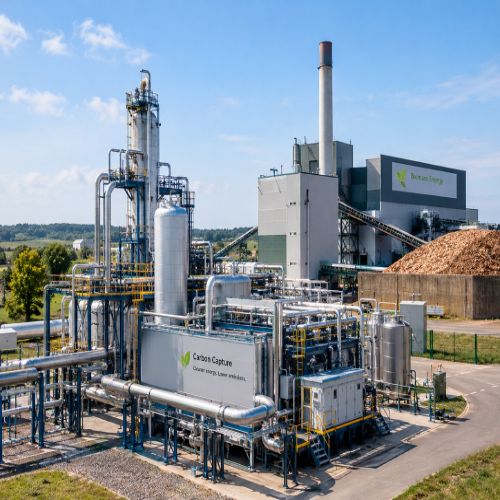
Belfast-based carbon-capture technology developer Nuada has been selected for €14.6 million in support from the European Union’s Innovation Fund to deploy its carbon-capture technology at a biomass cogeneration plant operated by Idex in France.
The project, named SCALA, is planned for the Hauts-de-France region and aims to capture 10,000 tonnes of biogenic carbon dioxide (CO₂) annually, producing liquid CO₂ for potential use in industrial applications. The funding selection places the project among 77 initiatives chosen in the latest Innovation Fund round, according to the supplied announcement.
SCALA will use Nuada’s AdSpire capture process, which combines advanced materials and vacuum technology in an electric, solvent-free system. The company says the approach is designed to reduce energy demand and simplify integration with existing industrial facilities.
The project has also received the European Commission’s Strategic Technologies for Europe Platform (STEP) Seal. The total project investment and expected commissioning date have not been disclosed in the supplied information.
SCALA to Capture Biogenic CO₂ at Biomass Cogeneration Facility
The planned installation will be integrated with Idex’s biomass cogeneration plant in Hauts-de-France, linking carbon capture to a facility that generates energy from biomass.
The project targets annual production of 10,000 tonnes of liquid biogenic CO₂. Unlike carbon dioxide captured from fossil-fuel combustion, biogenic CO₂ originates from biomass-derived carbon released during processing or energy generation.
Capturing this stream could create opportunities to supply CO₂ for industrial applications, depending on its purity, the availability of suitable buyers and the economics of processing, transport and storage. The announcement does not specify the intended end use of the captured CO₂ or whether any offtake agreements have been secured.
Nuada’s AdSpire Technology Uses Electric, Solvent-Free Capture
Nuada’s AdSpire process combines advanced capture materials with vacuum technology and is designed to operate without conventional chemical solvents.
According to the company, the system can reduce energy requirements and make it easier to integrate carbon capture into existing industrial sites. These characteristics may be relevant to biomass facilities, where the additional energy demand and integration costs of capture equipment can affect project economics.
Project Builds on Earlier Industrial Demonstrations
SCALA follows industrial pilot campaigns, including a demonstration of Nuada’s technology at enfinium’s Ferrybridge-1 facility in West Yorkshire, England.
The French installation is intended to support the broader commercial deployment of the company’s carbon-capture system. Moving from pilot demonstrations to an operating industrial installation will provide an opportunity to assess performance under site-specific conditions and determine how the technology integrates with existing energy infrastructure.
EU Innovation Fund Supports Industrial Decarbonisation
The EU Innovation Fund finances projects aimed at deploying innovative low-carbon technologies, using revenues generated through the European Union Emissions Trading System (EU ETS).
Nuada’s selection provides support for a project that combines industrial carbon capture with biomass-based energy production. The additional STEP Seal recognises the project under the European Commission’s Strategic Technologies for Europe Platform framework.
The €14.6 million award is a funding allocation for the project, but the supplied announcement does not establish whether all funding has already been disbursed or what proportion of the project’s total cost it will cover.
Bioenergy Business Analysis
Nuada’s SCALA project highlights a potential role for carbon capture in reducing emissions from biomass-based energy facilities. Although biomass is often treated as a renewable energy source, combustion and processing still release CO₂. Capturing some of these emissions can create additional options for managing biogenic carbon, provided the full emissions balance supports the intended climate benefit.
Energy consumption will be a key performance measure. Carbon capture requires energy for separation, compression and other process operations. Nuada’s electric, solvent-free approach is intended to reduce this burden, but commercial assessment will require measured data on energy use per tonne of CO₂ captured, capture rates, operating reliability and maintenance requirements.
The next milestones to monitor are the project’s investment plan, construction and commissioning schedule, measured capture performance, energy requirements and arrangements for handling the captured CO₂. These details will help establish whether SCALA can provide a commercially viable model for biogenic carbon capture in the European bioenergy sector.


