


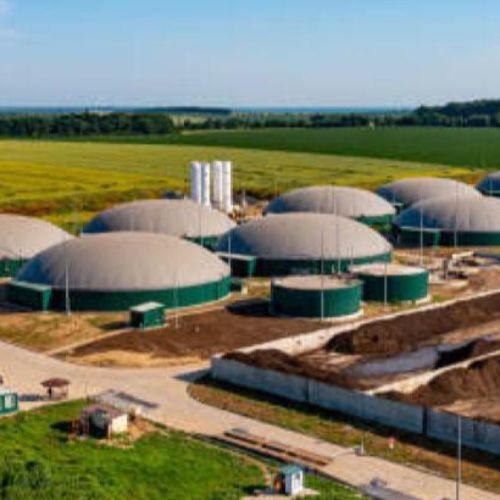
Hindustan Petroleum Corporation Limited (HPCL) has begun construction of three compressed biogas (CBG) plants in Andhra Pradesh, Uttar Pradesh and Punjab while advancing a 7,400-tonne-per-year sustainable aviation fuel (SAF) facility at its Visakh Refinery. The projects expand the state-owned oil company’s efforts to develop domestic biofuel production using agricultural residues, organic waste and waste-derived oils.
According to Energetica India, which reported the development on October 27, 2026, the projects are being implemented through HPCL Renewable and Green Energy Limited (HPRGE), HPCL’s wholly owned subsidiary. The company’s programme covers two distinct fuel markets: CBG for transport and other energy applications, and SAF for aviation.
HPCL advances CBG projects across three states
The three greenfield CBG plants are located in: Eluru, Andhra Pradesh, Bareilly, Uttar Pradesh and Ludhiana, Punjab.
The facilities are intended to process agricultural residues and organic waste into CBG and organic manure. Their development is part of HPCL’s broader effort to expand the domestic biofuel supply chain and create additional uses for biomass and other organic resources.
The projects are aligned with the Government of India’s GOBARdhan framework, which supports the development of compressed biogas infrastructure through measures covering offtake arrangements, pricing, capital assistance, pipeline connectivity, credit guarantees and ecosystem development, as described in the Energetica India report.
CBG is produced by purifying biogas to remove impurities, including carbon dioxide, hydrogen sulphide and water vapour, before compression. With methane content typically exceeding 95%, it can be used as a transport fuel and in suitable industrial and commercial applications. HPCL’s existing CBG operations also produce organic manure, providing a potential additional revenue stream from the treatment of organic feedstocks.
HPCL deploys proprietary technology for biomass conversion
HPRGE is using HP RAMP, a technology developed by HPCL Green R&D Centre (HPGRDC), for its CBG programme. The technology is designed to process lignocellulosic biomass, including rice straw, bagasse, Napier grass and garden waste.
HPGRDC has also operated a pilot CBG plant using rice straw and other lignocellulosic feedstocks continuously for more than two years, according to Energetica India. The pilot operation has provided experience intended to support commercial deployment of the technology.
Using agricultural residues as feedstock could help connect biomass availability in rural areas with demand for commercial fuels. However, the practical performance of individual projects will depend on factors such as feedstock availability, collection and transport costs, processing efficiency and reliable offtake arrangements.
HPCL’s existing CBG projects provide a foundation for this expansion. The company has commissioned CBG plants at Budaun in Uttar Pradesh and Pathmeda in Rajasthan, using rice straw and cattle dung, respectively. Its official CBG programme also identifies organic manure as a coproduct of these facilities.
7.4 KTPA SAF facility planned at Visakh Refinery
Alongside its CBG expansion, HPCL is developing a commercial sustainable aviation fuel unit with a planned capacity of 7.4 kilotonnes per annum (KTPA) at its Visakh Refinery.
The facility is intended to support domestic SAF production using HPCL’s proprietary HP-TriJet hydroprocessing technology. Developed by HPGRDC, the platform is designed to produce SAF and green diesel from waste-based lipid feedstocks, including used cooking oil and animal fats. The company says the technology incorporates in-house catalyst systems and process conditions and has undergone pilot-scale validation.
Waste-derived oils offer an alternative feedstock pathway to conventional petroleum-based aviation fuels. Their suitability for SAF production depends on feedstock quality, conversion efficiency, fuel specifications and applicable certification requirements.
HPCL has also demonstrated the technical feasibility of co-processing used cooking oil in the vacuum gas oil (VGO) hydrocracker at its Visakh Refinery.
According to Energetica India, pilot studies established the feasibility of blending up to 5% used cooking oil with conventional VGO feed without major modifications to the refinery configuration. HPCL is progressing towards continuous SAF production through the hydrocracker following demonstration and certification activities, with the objective of supporting proposed SAF blending requirements from 2027.
The co-processing route could provide an additional pathway for integrating waste-derived feedstocks into existing refinery infrastructure. However, the reported pilot results should not be interpreted as confirmation of continuous commercial production or achievement of future blending targets.
Government policy supports the domestic biofuel value chain
HPCL’s CBG and SAF projects are progressing amid India’s efforts to broaden the use of alternative fuels and improve domestic energy security.
For CBG, the GOBARdhan framework is intended to address several infrastructure and commercial requirements associated with converting organic waste into marketable fuel. These include offtake, financing support and connectivity to gas infrastructure. The effectiveness of such support will depend on implementation and on whether individual projects can secure sustainable feedstock supplies and commercially viable operations.
The SAF programme addresses a different challenge: reducing aviation’s dependence on conventional fossil-derived jet fuel. Waste oils and animal fats can serve as feedstocks for certain SAF production pathways, while refinery co-processing may offer another route to introducing renewable content into fuel production.
The two programmes therefore serve different markets but share a common objective: developing technologies that can convert domestic waste and biomass resources into transport fuels.
Bioenergy Business Analysis
HPCL’s latest projects illustrate how India’s established oil companies are extending their capabilities into waste-based fuels across road transport and aviation. The significance lies not simply in the number of facilities under development, but in the effort to connect feedstock processing, proprietary technology, refinery infrastructure and fuel distribution.
For CBG, execution and feedstock economics will be decisive. Agricultural residues such as rice straw and bagasse are widely recognised as potential bioenergy feedstocks, but their availability does not automatically translate into an economical supply chain. Collection, seasonal variation, storage, transport and competing uses can affect plant utilisation and costs. Organic manure can add value, although its commercial contribution will depend on product quality, local demand and distribution.
HPCL’s use of HP RAMP is also relevant because experience with lignocellulosic biomass could support the conversion of crop residues that are otherwise difficult to process. The extent to which pilot experience translates into reliable commercial performance will need to be assessed through operational data from the new facilities.
For SAF, the key test is the transition from technical validation to sustained production. The proposed 7.4 KTPA facility represents a defined step towards domestic production, while the reported 5% used-cooking-oil co-processing result indicates a potential route using existing refinery equipment. Neither development alone establishes the cost competitiveness, lifecycle emissions performance or commercial output of the resulting fuel.
Taken together, the CBG and SAF initiatives broaden HPCL’s potential role in India’s energy transition. Their long-term significance will depend on operational delivery and commercial viability, rather than project announcements alone.


