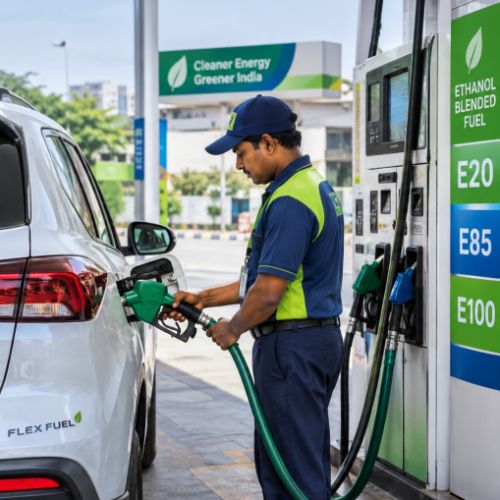
India has added E100 alongside E85 in several provisions of its motor vehicle rules for flex-fuel vehicles. The change gives manufacturers a clearer regulatory framework for vehicles designed to use high-ethanol fuel. It does not mean that every petrol vehicle can run on E100.
Key points at a glance
- The Ministry of Road Transport and Highways (MoRTH) issued notification G.S.R. 911(E), dated 23 October 2026, amending the Central Motor Vehicles Rules, 1989.
- Several references to E85 in vehicle emission and testing provisions now read E85 or E100.
- The notification says E85 or E100 is for flex-fuel vehicles designed by original equipment manufacturers for that purpose.
- An E20-compatible petrol vehicle is not automatically approved for E85 or E100. Check the vehicle manufacturer’s approved fuel range.
- The amendment provides a regulatory framework; it does not itself guarantee fuel availability, a particular price, mileage or emissions outcome.
What changed in India’s E85 and E100 flex-fuel rules?
The notification amends Rule 115 of the Central Motor Vehicles Rules, 1989, including references in sub-rules 18, 19, 20 and 22. In the relevant tables, E100 is added alongside the existing reference to E85. It also inserts an explanatory note under Rule 115(19)(i) stating that E85 or E100 shall be used in vehicles designed by original equipment manufacturers as flex-fuel vehicles.
The changes concern particular regulatory tables and associated testing provisions. They should not be read as blanket approval to put high-ethanol fuel in any vehicle. The notification also revises an E100 testing reference in Rule 115E(4), changing Annexure S to Annexure SA, and makes other technical corrections to the rules.
The notification is dated 23 October 2026; its commencement clause ties the rules to publication in the Official Gazette. The ministry’s Press Information Bureau release explains the policy background. The draft amendment was published in April 2026 for public comments before the final notification. Read our news report on the E100 amendment for the initial announcement.
Other changes in the same notification are narrower than a general fuel mandate. In the table under Rule 115(18)(i), the heading changes the stated gross-weight threshold from 3,000 kg to 3,500 kg, the gasoline reference is corrected to E10/E20, and a specific B10 entry becomes B100. The notification also makes other technical corrections. These changes apply to the cited table entries and should not be interpreted as blanket permissions for all vehicles.
E20, E85 and E100: what do the fuel labels mean?
| Fuel | What the label means | Vehicle compatibility |
|---|---|---|
| E20 | Petrol with 20% ethanol by volume | Use only where approved by the manufacturer. |
| E85 | Petrol-ethanol blend with up to 85% ethanol by volume | For vehicles designed and certified for the relevant blend. |
| E100 | Fuel consisting predominantly of ethanol, subject to the applicable specification | For vehicles designed and certified for E100; E20 or E85 compatibility alone is insufficient. |
E20 refers to petrol blended with 20% ethanol by volume. E85 is a high-ethanol petrol blend containing up to 85% ethanol. E100 refers to fuel consisting predominantly of ethanol; the applicable fuel specification matters, so the label should not be treated as proof that a pump dispenses chemically pure ethanol.
These labels describe fuel, not universal vehicle compatibility. A vehicle approved for E20 may not be designed for much higher ethanol concentrations. Likewise, a vehicle approved for E85 is not necessarily approved for E100. Always use the range specified for the exact vehicle and model.
What is a flex-fuel vehicle?
A flex-fuel vehicle is designed by its manufacturer to operate on an approved range of fuel blends. Its fuel system and engine controls must suit those fuels; depending on the design, the vehicle can adjust its operation as the blend changes. The approved range varies by model, so “flex fuel” alone does not establish that E100 is permitted.
Ethanol has different chemical and energy properties from petrol. Fuel-system materials, calibration, starting behaviour and emissions certification therefore matter. A vehicle’s approval and the manufacturer’s instructions are more useful than assuming that one blend is safe because another is permitted.
Can existing petrol or E20 vehicles use E100?
Do not use E85 or E100 in an ordinary petrol vehicle or an E20-compatible vehicle unless the manufacturer explicitly approves the fuel for that exact vehicle. The new notification does not turn existing petrol cars and two-wheelers into flex-fuel vehicles, and it does not require owners to retrofit or switch fuels.
Before filling up, check the owner’s manual, the fuel-filler label and any manufacturer guidance for the model. If the approved blend is unclear, ask an authorised dealer or the manufacturer. Do not rely solely on a pump label, a sales claim or the fact that a vehicle accepts E20.
What does the amendment mean for automakers and ethanol producers?
For manufacturers, the amendment places E100 alongside E85 in the specified rule provisions and provides a clearer basis for developing and certifying eligible flex-fuel vehicles. Individual vehicles still need to satisfy applicable approval, emissions and testing requirements. The notification does not announce automatic approval of every E100 model.
For ethanol producers and fuel suppliers, high-ethanol vehicles could create another potential route to market beyond petrol blending. Actual demand will depend on the number of compatible vehicles, fuel specifications, distribution infrastructure, pricing and customer acceptance. The relationship with the existing blending programme also depends on supply and procurement policy. Our explainer on India’s OMC ethanol tender describes how ethanol procurement for blending works.
Will E100 cost less or reduce emissions?
The regulation does not set a retail E100 price or promise a particular saving. Compare the cost per kilometre, not only the price per litre: fuel economy depends on the vehicle, fuel and driving conditions, and ethanol has a lower energy content per litre than petrol. Availability can vary by location.
Ethanol can displace some fossil petrol, but its overall climate impact depends on feedstock, land use, farming, production energy, transport and other lifecycle factors. Tailpipe emissions also depend on the vehicle and how it is calibrated. It would be misleading to assume that every E100 vehicle has zero emissions or that the same reduction applies in every case.
What drivers should check before buying or refuelling
- Confirm the exact minimum and maximum ethanol blends approved for the vehicle in the manufacturer’s documentation.
- Ask whether the vehicle is approved for E85, E100 or both; do not assume these approvals are interchangeable.
- Check fuel availability, pump specifications, service support and warranty conditions in your area.
- Compare expected running costs using real-world fuel economy and local prices.
- Use only the fuel and maintenance instructions provided by the vehicle manufacturer.
Frequently asked questions
Is E100 mandatory in India?
No. This notification adds E100 to specified provisions for eligible flex-fuel vehicles; it does not require all motorists to buy E100 or switch vehicles.
Can an E20 car run on E100?
E20 compatibility alone does not establish E100 compatibility. Use E100 only if the manufacturer explicitly approves it for that exact vehicle.
Can an E85 flex-fuel vehicle use E100?
Not automatically. Check the manufacturer’s approved fuel range. An E85-capable model may have a lower maximum ethanol content than E100.
Is E100 the same as 100% pure ethanol?
E100 denotes a fuel predominantly consisting of ethanol. Commercial fuel must meet its applicable specification; the name alone does not establish laboratory purity.
Does the notification allow a petrol vehicle to be converted?
The amendment does not itself authorise an arbitrary retrofit. Any proposed conversion would need to comply with applicable approval and safety rules and the vehicle manufacturer’s guidance.
When do the new rules take effect?
The notification says the rules take effect on publication in the Official Gazette. It is dated 23 October 2026; readers should consult the Gazette publication and any applicable commencement provisions for an authoritative determination.
Will E100 reduce fuel costs?
That depends on local pump prices and the vehicle’s actual fuel economy. Compare cost per kilometre and confirm local availability before making a decision.
Does E100 mean zero vehicle emissions?
No. Combustion and fuel production can both produce emissions. The overall impact varies with how the ethanol is produced and used.
Where can I read the official announcement?
MoRTH’s PIB announcement explains the change. This article is based on the ministry’s Gazette notification G.S.R. 911(E), dated 23 October 2026, and the announcement.
Source and update policy
This explainer is based on the Gazette notification G.S.R. 911(E), dated 23 October 2026, and the 26 October 2026 PIB announcement.