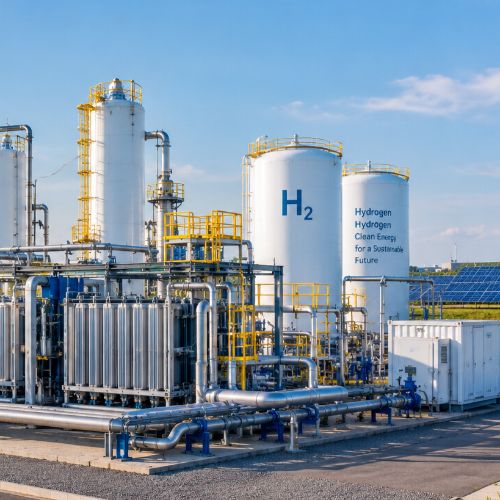
South Korea’s hydrogen industry is facing challenges in research and development, with 82.7% of the country’s 2,932 hydrogen-related companies reporting no dedicated R&D department in 2025, according to data from the Ministry of Climate, Energy and Environment.
The findings highlight concerns over the industry’s ability to develop technology and compete internationally as investment in hydrogen research declines. Only 11.2% of surveyed companies reported having their own corporate research institutes, while 7.6% said they had received central government funding.
South Korea’s hydrogen R&D spending drops 26.8%
Investment across South Korea’s hydrogen industry increased by just 4.6% between 2022 and 2024, rising from approximately 4.15 trillion won to 4.34 trillion won.
Research and development expenditure moved in the opposite direction. R&D spending fell 26.8% over the same period, declining from approximately 1.12 trillion won to 821.2 billion won.
The figures suggest that modest growth in overall industry investment has not translated into higher research expenditure. The limited presence of dedicated R&D departments and the low proportion of companies reporting central government funding also point to challenges in building research capacity across the sector.
South Korea entered the hydrogen technology race early, with private-sector companies including Hyundai Motor investing in hydrogen vehicles and related technologies. However, the latest findings have renewed concerns about the country’s ability to maintain its position as other major economies support hydrogen technology development.
Green hydrogen production costs remain a challenge
The cost of producing green hydrogen is another hurdle for South Korea’s industry. According to the reported government data, the average hydrogen production cost at domestic electrolysis facilities in South Korea stood at 18,163 won per kilogram.
By comparison, some demonstration projects in China’s Inner Mongolia and Xinjiang regions have reportedly achieved production costs of 14–18 yuan per kilogram, equivalent to approximately 2,800–3,600 won.
The comparison highlights the cost advantage that access to large renewable energy resources may offer. China has developed large-scale wind and solar installations in resource-rich areas and linked some of these projects to hydrogen production facilities.
However, the figures compare South Korea’s reported average with selected Chinese demonstration projects, rather than equivalent commercial facilities operating under identical conditions. They should therefore be treated as an indication of the reported cost gap, not a definitive comparison across the two countries’ entire hydrogen industries.
Experts call for a broader hydrogen supply strategy
The high cost of domestic electrolysis has prompted experts to question whether South Korea should rely so heavily on domestically produced green hydrogen.
Lee Sang-jun, a professor at Seoul National University of Science and Technology, said the country lacked the conditions needed to deploy renewable energy at the scale required for competitive hydrogen production.
He suggested easing domestic sourcing requirements to allow some imported hydrogen and considering blue hydrogen as part of a broader supply strategy. Blue hydrogen is produced from fossil fuels, with carbon capture and storage used to capture some of the associated carbon dioxide emissions. Its overall climate impact depends on capture rates, methane leakage and other lifecycle emissions.
Cho Hong-chong, an economics professor at Dankook University, argued that lower electricity prices are essential to making electrolysis-based hydrogen production more competitive. He called for a substantial expansion of nuclear power capacity as one way to secure lower-cost electricity.
These are expert policy recommendations, rather than announced government decisions. They reflect a debate over how South Korea can balance domestic technology development, production costs, energy security and emissions reduction.
Government continues to prioritise domestic clean hydrogen
Despite the cost concerns, South Korea has continued to support the development of a domestic clean hydrogen industry.
In June 2026, the Ministry of Climate, Energy and Environment announced changes to the hydrogen power bidding system intended to foster domestic clean hydrogen production based on electrolysis.
The policy direction places emphasis on developing local production capabilities. The latest industry figures, however, raise questions about whether companies have sufficient R&D capacity and financial support to develop technologies that could reduce production costs.
The policy challenge is to build domestic technological expertise while ensuring that hydrogen supplies can be produced or procured at commercially viable prices.
Bioenergy Business Analysis
South Korea’s hydrogen industry illustrates a challenge facing emerging clean-energy markets: ambitious domestic production targets do not automatically translate into competitive production costs or sustained technological innovation.
The decline in R&D expenditure between 2022 and 2024 is particularly relevant because improvements in electrolyser efficiency, manufacturing costs, system integration and operating performance are important to reducing the cost of green hydrogen. The fact that 82.7% of surveyed companies lacked dedicated R&D departments also highlights the importance of research partnerships, shared infrastructure and targeted support for smaller businesses.
South Korea’s options involve trade-offs. Expanding renewable-powered electrolysis could strengthen domestic green hydrogen production, but its competitiveness depends on access to affordable renewable electricity and suitable project locations. Imported hydrogen could diversify supply, while blue hydrogen could provide another production route, depending on its lifecycle emissions and carbon capture performance.