


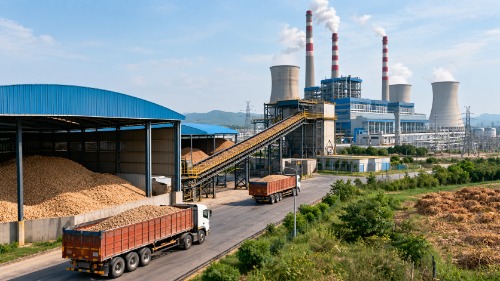
The Central Pollution Control Board (CPCB) has backed the Commission for Air Quality Management (CAQM)’s enforcement action against six coal-fired thermal power plants accused of failing to meet mandatory biomass co-firing requirements during 2024-25, as the dispute over environmental compensation continues before the National Green Tribunal (NGT).
According to a Times of India report published on October 6, 2026, CPCB has filed a written submission before the NGT defending the regulatory action. The submission relates to appeals filed by Deenbandhu Chhotu Ram Thermal Power Plant (DCRTPP) in Yamunanagar, Rajiv Gandhi Thermal Power Plant (RGTPP) in Hisar and Talwandi Sabo Power Ltd (TSPL) in Punjab against CAQM’s action.
CAQM imposed a combined environmental compensation of approximately ₹61.85 crore on six thermal power plants in April 2026 after reviewing their biomass co-firing performance for FY2024-25. The commission said the plants had failed to demonstrate sufficient efforts to comply with the applicable statutory requirements despite being given opportunities to respond.
The case places the enforcement of India’s biomass co-firing policy under scrutiny while also highlighting a continuing dispute over biomass availability, procurement constraints and the ability of existing coal-fired plants to integrate crop-residue pellets at the required scale.
Six thermal plants face ₹61.85-crore environmental compensation
CAQM’s April 2026 order covered six coal-based thermal power plants located within 300 km of Delhi. The largest compensation was imposed on Talwandi Sabo Power Limited in Mansa, Punjab, at approximately ₹33.02 crore.
The penalties followed a compliance review for FY2024-25. CAQM said a committee comprising representatives from CAQM, the Central Electricity Authority (CEA), the Sustainable Agrarian Mission on use of Agri-Residue in Thermal Power Plants (SAMARTH) and CPCB examined the plants’ performance, written submissions and grounds cited for seeking relaxation.
The committee also provided the concerned plants with opportunities for personal hearings before recommending the compensation.
Biomass co-firing rules underpin the dispute
The enforcement action is based on the Environment (Utilisation of Crop Residue by Thermal Power Plants) Rules, 2023, alongside CAQM’s regulatory directions for thermal plants in and around the National Capital Region.
The rules require coal-based thermal power plants to use a 5% blend of biomass pellets or briquettes made from crop residue with coal. For FY2024-25, a minimum co-firing threshold of more than 3% was prescribed to avoid environmental compensation.
The policy is intended to create an ex-situ use for agricultural residue, particularly paddy straw, thereby reducing the quantity of crop residue available for open-field burning.
The Ministry of Environment, Forest and Climate Change has described biomass co-firing as a measure to support crop-residue management and reduce air pollution in Delhi-NCR and adjoining areas.
The broader power-sector biomass policy has also envisaged increasing co-firing requirements. The Ministry of Power’s 2023 revised biomass policy provided for 5% co-firing from FY2024-25 and an increase to 7% from FY2025-26.
Thermal plants cite biomass supply and technical constraints
The affected power plants have challenged the environmental compensation, arguing that compliance has been complicated by difficulties in obtaining sufficient quantities of suitable biomass.
A particular concern raised by the plants has been the availability of torrefied biomass pellets, along with procurement and technical constraints associated with introducing biomass into existing coal-fired generation systems.
The issue of supply availability has been part of the wider industry debate around India’s biomass co-firing programme. However, CAQM has maintained that non-compliance cannot be attributed solely to biomass availability and that the plants were expected to make adequate efforts to procure and use the required fuel.
CAQM’s plant-specific findings indicate that it assessed both actual co-firing performance and the efforts made by individual plants to meet the regulatory requirements. For example, CAQM’s record for Rajiv Gandhi Thermal Power Plant states that the Hisar facility achieved approximately 2.07% biomass co-firing in FY2024-25, below the more-than-3% threshold required to avoid compensation.
The Talwandi Sabo record similarly shows a very low co-firing level of approximately 0.36% against the applicable requirement.
For Panipat Thermal Power Station, CAQM recorded approximately 1.86% biomass co-firing, again below the threshold applicable for FY2024-25.
These plant-level figures form part of the regulatory record now being contested before the NGT.
NGT has granted conditional relief in several appeals
The compensation remains subject to ongoing legal proceedings.
The NGT has granted conditional stays in several cases involving the CAQM penalties. In April 2026, the tribunal granted conditional relief to Talwandi Sabo Power Limited against its ₹33.02-crore compensation and subsequently granted similar relief to Panipat, Deenbandhu Chhotu Ram and Rajiv Gandhi thermal power plants.
The Times of India has reported that the NGT required the affected plants to comply with conditions attached to the interim relief, including payment of a portion of the compensation.
As of August 2026, CAQM had received ₹30.92 crore, equivalent to half of the ₹61.85-crore total compensation, following the NGT’s interim orders.
The NGT’s interim relief does not amount to a final determination that CAQM’s compensation orders are invalid. The underlying appeals and regulatory questions remain before the tribunal.
CPCB’s position strengthens the regulatory case
CPCB’s latest submission is significant because the agency was itself represented on the committee that reviewed the thermal plants’ compliance and requests for relaxation.
CAQM’s April order records that the committee included CPCB representatives and reviewed the performance data, compliance status and submissions from the six plants before recommending environmental compensation.
The Times of India report now indicates that CPCB has defended this regulatory approach before the NGT, supporting CAQM’s position in the appeals brought by the affected plants.
This gives the dispute a wider regulatory dimension: the tribunal is not only considering individual plants’ explanations for missed co-firing targets, but also the enforceability of a policy intended to create a large-scale market for agricultural-residue biomass.
Bioenergy Business Analysis
The CPCB-CAQM position before the NGT is an important development for India’s biomass energy market because the environmental compensation mechanism is intended to turn biomass co-firing from a policy objective into an enforceable demand signal. The ₹61.85-crore action against six plants shows that regulators are prepared to attach a financial consequence to shortfalls, while the plants’ appeals demonstrate the operational challenges of converting that policy into reliable fuel consumption at individual generating stations.
The larger issue is therefore not simply whether thermal plants should co-fire biomass, but whether the biomass supply chain can scale at the pace required by regulation. Pellet availability, feedstock aggregation, quality specifications, logistics and boiler-level handling all affect actual utilisation. The NGT proceedings could consequently have implications for how future compliance disputes are assessed and how responsibility is divided between power generators and the wider biomass-fuel supply chain.